ISRA FACTSHEETS
ISRA FACTSHEETS
EUROPEAN ATLANTIC
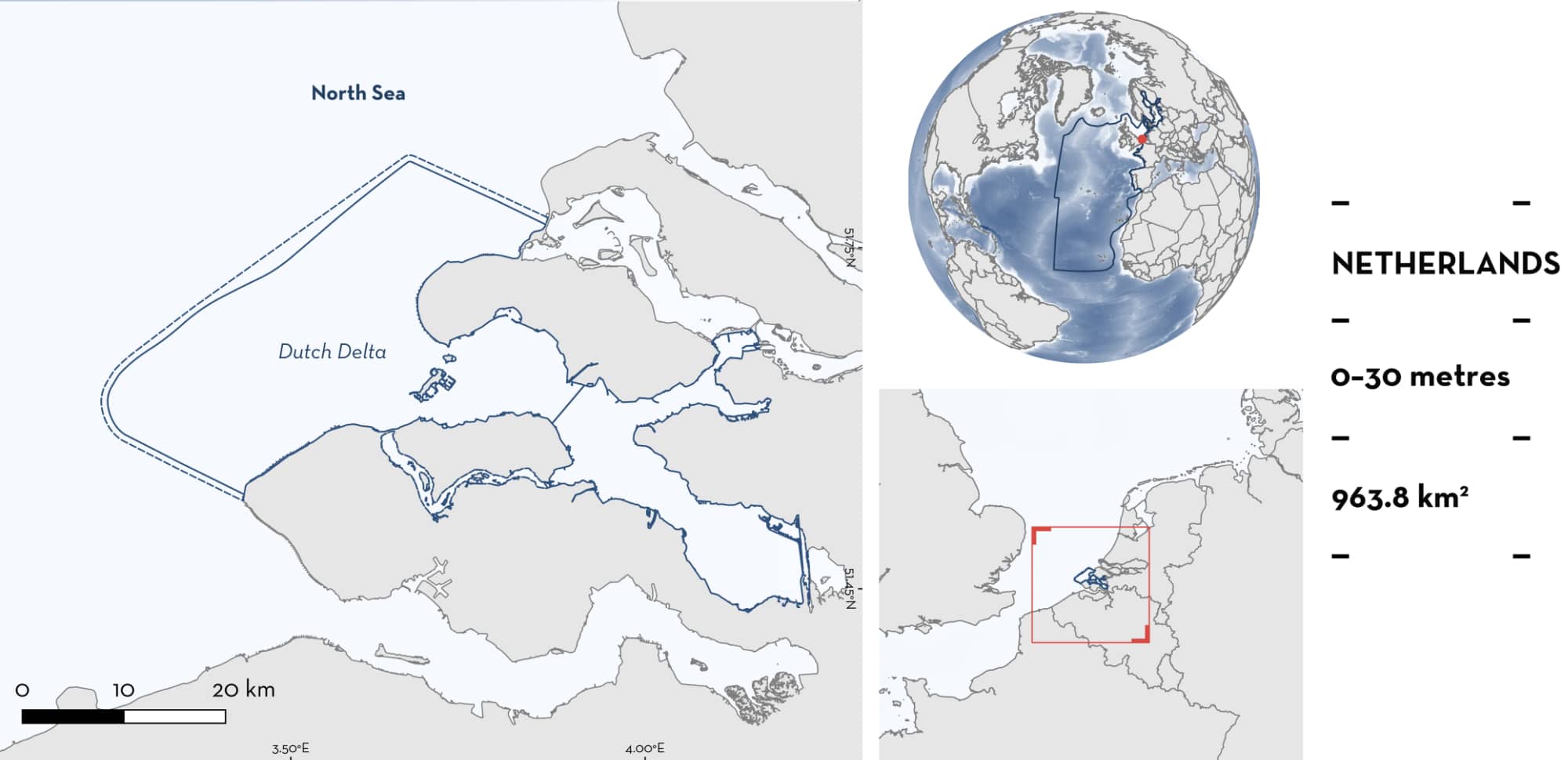
Dutch Delta
Summary
Dutch Delta is located in the southwest of the Netherlands. This coastal area is characterised by an estuary (Westerschelde) and a partially closed sea arm (Oosterschelde). The substrate is a mixture of sand and mud and is influenced by the Delta Works – a series of storm surge barriers, dikes, dams, and sluice gates – which has created a system of tidal and deep sandbanks connected by deep channels. Within this area there are: reproductive areas (Starry Smoothhound Mustelus asterias).
Download factsheet
Dutch Delta
DESCRIPTION OF HABITAT
Dutch Delta is located in the southwest of the Netherlands. This area comprises the shallow sea part of the Zeeland and South Holland Delta with an estuary (Westerschelde) and a partially closed sea arm (Oosterschelde). The area is characterised by a varied and dynamic environment of coastal waters (salt), intertidal zone, and beaches, which forms a relatively sheltered transition zone between the (former) estuaries, and the high seas (EEA 2025a, 2025b, 2025c). The area is influenced by the Delta Works – a series of storm surge barriers, dikes, dams, and sluice gates – which has extensively changed the region, creating a system of tidal and deep sandbanks connected by deep channels (EEA 2025a; Netherlands 2025). Erosion and sedimentation processes cause shifts in the size of the intertidal areas. The area has extensive reefs of Blue Mussel Mytilus edulis and Pacific Oyster Crassostrea gigas.
This Important Shark and Ray Area is benthic and pelagic and is delineated from inshore and surface waters (0 m) to 30 m based on the bathymetry of the area.
CRITERION C
SUB-CRITERION C1 – REPRODUCTIVE AREAS
Dutch Delta is an important reproductive area for one shark species.
A Starry Smoothhound mark-recapture programme was led by anglers between 2011–2019. Sharks were caught by a group of licensed taggers and fishing occurred in the river Scheldt outer estuary (Westerschelde) and the adjacent sea arm in the Netherlands (Oosterschelde) within this area. During this period, 4,495 individuals were captured, of which 3,699 were tagged using unique plastic rototags (Brevé et al. 2016, 2020). Fishing took place year-round, but 99.9% of all Starry Smoothhounds were caught between May and October, supporting a seasonal nature to their habitat use at this location. The size and numbers of recaptures included 76 neonates measuring <33 cm total length (TL); 179 males (46 young-of-the-year [YOY] measuring 33–65 cm TL; 21 juveniles, 65–70.4 cm TL; 112 adults, >70.4 cm TL); and 187 females (46 YOY measuring 33–69 cm TL; 63 juveniles, 69–81.9 cm TL; 78 adults, >81.9 cm TL). The size-at-birth for this species is ~28–38 cm TL and it reaches maturity at 72–85 cm TL for males and ~83–96 cm TL for females (Ebert et al. 2021). Whether females were pregnant or not was not recorded. It is unclear where mating takes place, but gravid females move into the English Channel and into sheltered waters for pupping, with parturition occurring June to July in the eastern English Channel and southern North Sea, including the Dutch Delta (Brevé et al. 2016). In addition, expert knowledge surveys in the region have informed consensus maps of important pupping and reproduction areas for Starry Smoothhound in this area (V van den Berg unpubl. data 2025). There is additional photographic evidence of neonates in the area, and the data indicate that the Dutch Delta is used on an annual and seasonal basis as a pupping area, the only one known along the Dutch coastline.
Download factsheet
SUBMIT A REQUEST
ISRA SPATIAL LAYER REQUEST
To make a request to download the ISRA Layer in either a GIS compatible Shapefile (.shp) or Google Earth compatible Keyhole Markup Language Zipped file (.kmz) please complete the following form. We will review your request and send the download details to you. We will endeavor to send you the requested files as soon as we can. However, please note that this is not an automated process, and before requests are responded to, they undergo internal review and authorization. As such, requests normally take 5–10 working days to process.
Should you have questions about the data or process, please do not hesitate to contact us.