ISRA FACTSHEETS
ISRA FACTSHEETS
AUSTRALIA AND SOUTHEAST INDIAN OCEAN
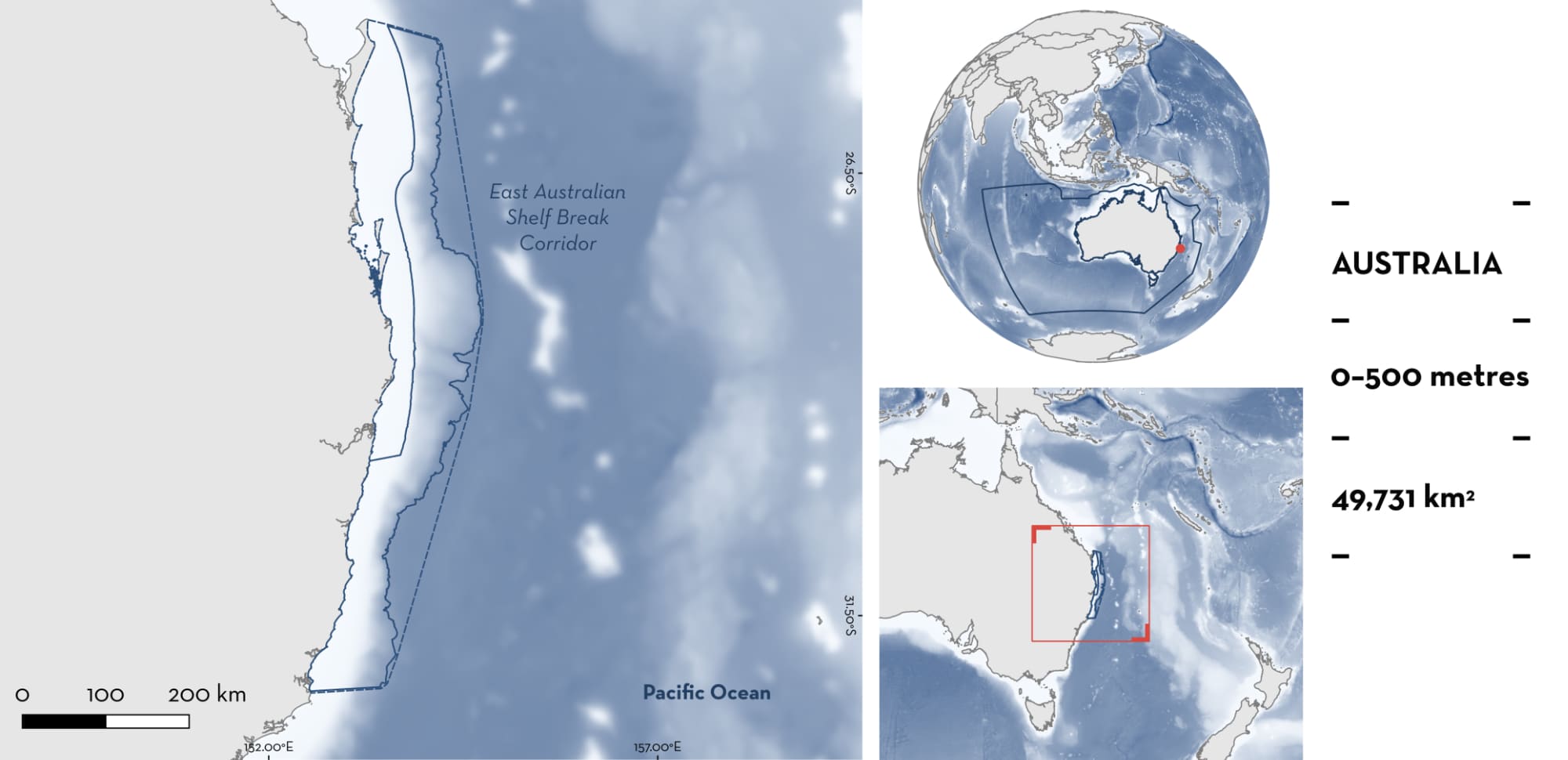
East Australian Shelf Break Corridor
Summary
East Australian Shelf Break Corridor is located off the east coast of Australia between K’gari, Queensland and Port Macquarie, New South Wales. It comprises mostly offshore waters over the continental shelf break and slope but also includes coastal and shelf waters in the southern part of the area. The habitat encompasses canyons and escarpments on the shelf slope, pelagic waters, soft and rocky substrates, sandy beaches, and rocky headlands along the southern coast. It is influenced by the East Australian Current that has its main flow along the shelf break. Within this area there are: threatened species and areas important for movement (Dusky Shark Carcharhinus obscurus).
Download factsheet
East Australian Shelf Break Corridor
DESCRIPTION OF HABITAT
East Australian Shelf Break Corridor is located off the east Australian coast between offshore of K’gari, Queensland and Port Macquarie, New South Wales. It comprises mostly offshore waters over the continental shelf break and slope and extends to the coast in the southern part of the area between Coffs Harbour and Port Macquarie. It includes many canyons and escarpments on the shelf slope. The habitat is characterised by pelagic waters and by soft and rocky substrates, sandy beaches, and rocky headlands in the southern coastal part.
This area is influenced by the East Australian Current that carries warm water southward along Australia’s east coast (Ridgway & Hill 2009). The East Australian Current is a dynamic western boundary current, with mesoscale eddies influencing current strength and direction. The flow is seasonally stronger in the austral summer. While the current frequently moves onto the shelf into coastal waters, this area along the shelf break overlaps with the location of the strongest flow of the current (Ridgway & Hill 2009).
This Important Shark and Ray Area is benthic and pelagic and is delineated from inshore and surface waters (0 m) to 500 m based on the global depth range of the Qualifying Species.
CRITERION A
VULNERABILITY
One Qualifying Species considered threatened with extinction according to the IUCN Red List of Threatened Species regularly occurs in the area. This is the Endangered Dusky Shark (Rigby et al. 2019).
CRITERION C
SUB-CRITERION C4 – MOVEMENT
East Australian Shelf Break Corridor is an important movement area for one shark species.
Dusky Sharks regularly move through this area, as indicated by satellite and acoustic telemetry (Barnes et al. 2016; Huveneers et al. 2021; IMOS unpubl. data 2025). Seven Dusky Sharks were tagged off Coffs Harbour in New South Wales in 2013 as part of a satellite tracking study and their movements were monitored for 2–30 days (Barnes et al. 2016). Five tracked individuals were mature and two were large juveniles, with a size range of 209–362 cm total length (TL). The size-at-maturity for males is 265–280 cm TL and 257–310 cm TL for females (Ebert et al. 2021). Despite the relatively short tracking duration, Dusky Sharks dispersed widely, with three individuals swimming to offshore areas of K’gari in Queensland and a further two swimming into southeast Queensland waters. All tracked sharks first moved offshore past the continental shelf and then swam north (n = 5) or south (n = 2 short tracks) along the shelf slope (Barnes et al. 2016). Three tags prematurely popped up at the northern extent of the area, which may have been caused by antagonistic behaviour between sharks during mating or feeding (Barnes et al. 2016). Combined with the faster dispersion rates observed here (22–89 km per day) compared to other tracking studies of the species elsewhere (8–41 km per day; Kohler et al. 1998; Hussey et al. 2009; Hoffmayer et al. 2014), this indicates that Dusky Sharks may use this movement corridor to swim to a feeding or mating area off K’gari (Barnes et al. 2016). Additionally, shelf slope waters can be good foraging grounds and Dusky Sharks tracked elsewhere also showed that slope waters are important for this species (Rogers et al. 2013; Hoffmayer et al. 2014). Compared to other species that also move along this region of the east coast of Australia, such as Indo-Pacific Leopard Sharks, Sand Tiger Sharks (Grey Nurse Shark), or Bull Sharks, Dusky Sharks showed a clear preference for the shelf slope.
Fourteen Dusky Sharks were tagged during an acoustic telemetry study between 2010–2016 in New South Wales and tracked until November 2020 (Huveneers et al. 2021). Most tagged individuals were immature. Five of these individuals moved interstate to Queensland, Victoria, and Tasmania (Huveneers et al. 2021). For an updated analysis, passive acoustic telemetry data were sourced from Australia’s Integrated Marine Observing System (IMOS): IMOS is enabled by the National Collaborative Research Infrastructure Strategy (NCRIS). These data include only one additional individual for a total of 15 Dusky Sharks tracked on Australia’s east coast between 2010–2025 (IMOS unpubl. data 2025). Few movement segments were apparent when using a speed filter of 1 km h-1 and only displaying movements between receiver stations that were >10 km apart. This approach means that movement segments are indicative of relatively direct and fast movements and can thus be used to infer a movement corridor. As receivers were in coastal waters, but satellite-tagged Dusky Sharks swam along the shelf slope, a slower speed filter of 0.1 km h-1 was then used. Broad regions were then assigned to examine where most movements occurred, including (north to south) Gladstone, Hervey Bay, southeast Queensland, northern New South Wales, Coffs Harbour, Port Macquarie, Newcastle, Sydney, Wollongong, and Bass Strait/Tasmania. Despite movement segments connecting New South Wales with Tasmania and southeast Queensland, the strongest connection was between Coffs Harbour and Port Macquarie with 25 movements of four sharks southward and 29 movements of seven sharks northward. Acoustic receivers were placed mostly along the coast, and the southern part of this area, supported by acoustic telemetry, therefore reaches the coast while the northern part of the area, supported by satellite telemetry, lies along the shelf slope.
While Dusky Sharks also move further afield, between Tasmania, Victoria, New South Wales, and Queensland (Huveneers et al. 2021), these movements detected by acoustic telemetry may not be regular or fast, and thus directional enough to help infer a movement corridor along the entire area. Evidence from satellite tagging, connecting northern New South Wales with southern Queensland, and from acoustic telemetry connecting Coffs Harbour to Port Macquarie indicates that the main movement corridor for the species on the east coast of Australia is within this area. Dusky Sharks tracked elsewhere showed seasonal migrations along continental coasts and shelf slope waters (Hussey et al. 2009; Rogers et al. 2013; Hoffmayer et al. 2014) and it is likely that East Australian Shelf Break Corridor is important for their movement to connect feeding, and potentially mating, areas along eastern Australia.
Download factsheet
SUBMIT A REQUEST
ISRA SPATIAL LAYER REQUEST
To make a request to download the ISRA Layer in either a GIS compatible Shapefile (.shp) or Google Earth compatible Keyhole Markup Language Zipped file (.kmz) please complete the following form. We will review your request and send the download details to you. We will endeavor to send you the requested files as soon as we can. However, please note that this is not an automated process, and before requests are responded to, they undergo internal review and authorization. As such, requests normally take 5–10 working days to process.
Should you have questions about the data or process, please do not hesitate to contact us.