ISRA FACTSHEETS
ISRA FACTSHEETS
AUSTRALIA AND SOUTHEAST INDIAN OCEAN
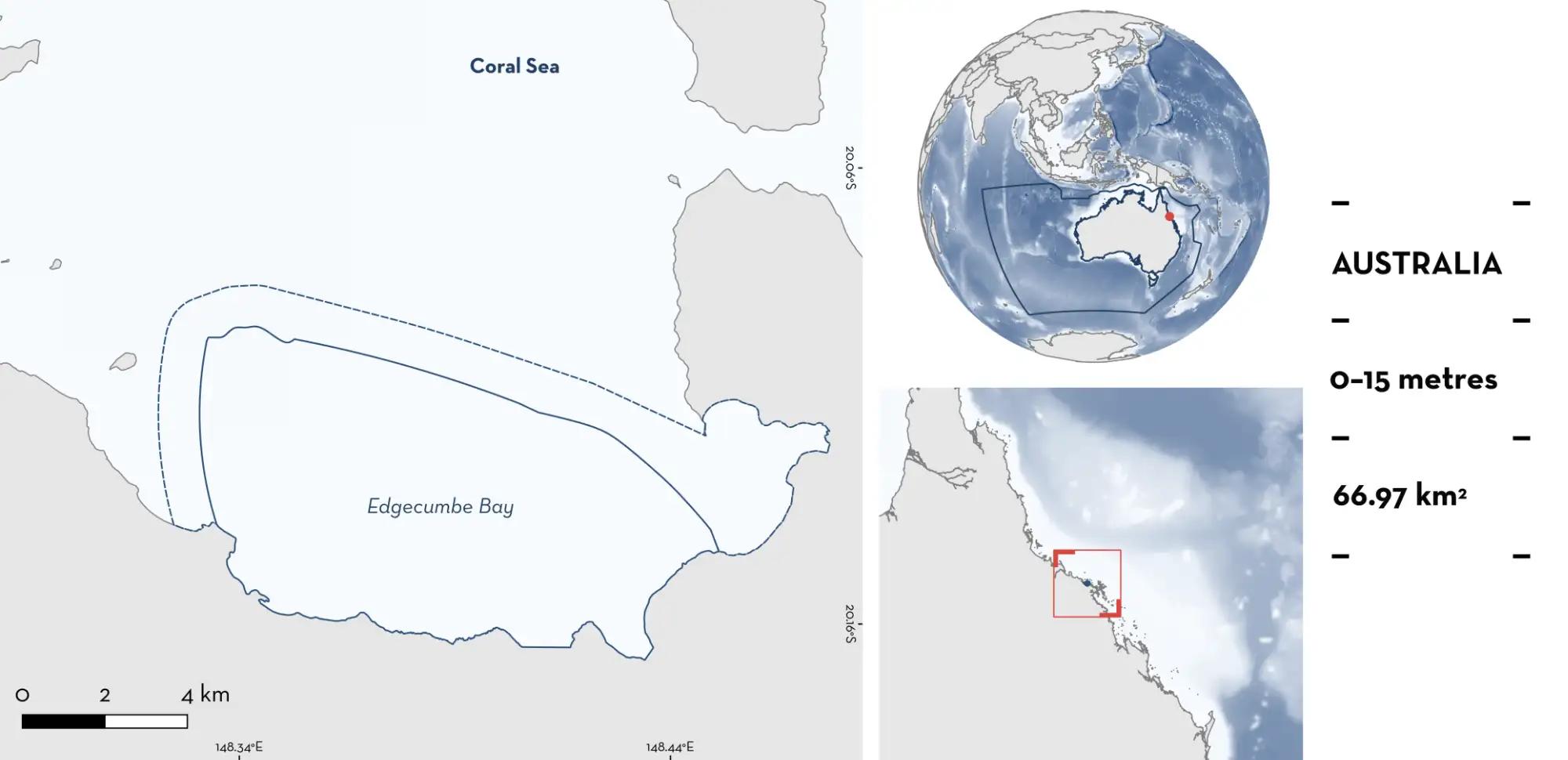
Edgecumbe Bay
Summary
Edgecumbe Bay is located along the Whitsunday Coast in Queensland, Australia. It encompasses the estuaries of Greta Creek and Greogory River. The area is characterised by mangroves and intertidal flats, with silty substrates and mudflats. The area is influenced by freshwater discharge from the rivers and by southeasterly winds and high water turbidity. Within this area there are: threatened species and reproductive areas (Blacktip Reef Shark Carcharhinus melanopterus).
Download factsheet
Edgecumbe Bay
DESCRIPTION OF HABITAT
Edgecumbe Bay is located along the Whitsunday Coast in Queensland, Australia. It encompasses the estuaries of Greta Creek and Greogory River. The area is characterised by mangroves and intertidal flats, with silty substrates and mudflats (Yates et al. 2015).
The area is influenced by freshwater discharge from the rivers and by southeasterly winds and high water turbidity. The area experiences a tropical climate with distinct wet (November–April) and dry (May–October) seasons, influenced by monsoonal patterns and occasional cyclonic activity (Bruinsma & Danaher 2001).
This Important Shark and Ray Area is benthic and pelagic and is delineated from inshore and surface waters (0 m) to 15 m based on the bathymetry of the area.
CRITERION A
VULNERABILITY
One Qualifying Species considered threatened with extinction according to the IUCN Red List of Threatened Species regularly occurs in the area. This is the Vulnerable Blacktip Reef Shark (Simpfendorfer et al. 2020).
CRITERION C
SUB-CRITERION C1 – REPRODUCTIVE AREAS
Edgecumbe Bay is an important reproductive area for one shark species.
Between 2009–2012, data were gathered from observers on vessels operating in the commercial gillnet sector of the Queensland East Coast Inshore Finfish Fishery from foreshore nets placed in the area (AV Harry unpubl. data 2025). All captured sharks were identified, measured, sexed, tagged, with life-stage assessed using length-at-age and anatomical indicators (Yates et al. 2015; AV Harry unpubl. data 2025).
Between 2008–2011, a total of 36 Blacktip Reef Sharks ranging in size between 55.8–160.0 cm total length (TL) were recorded within the area by fishery observers (AV Harry unpubl. data 2025). Neonates (n = 6, 17%) ranging in size between 55.8–73.0 cm TL were identified based on size (n = 2) or a partially open umbilical scar (n = 4). Young-of-the-year (n = 21, 58.3%), ranged in size between 60–70 cm TL. Size-at-birth for the species is estimated at 58.7 cm TL and YOY are up to 70 cm TL based on growth curves (Chin 2013; Chin et al. 2013). Neonates and YOY were captured across years in 2008 (n = 5), 2009 (n = 10), and 2011 (n = 12; AV Harry unpubl. data 2025). The remaining individuals captured in Edgecumbe Bay (n = 9) ranged from 71–160 cm TL (mean = 107 cm TL) and included both sexes (five females, three males, one unsexed), indicating use of the area by small juveniles (n = 5), measuring between 71.0–76.5 cm TL. Captures of these life-stages occurred only in March and August (Yates et al. 2015). Mating and parturition in the region occur during the austral summer (December–February; Chin 2013; Chin et al. 2013), coinciding with the presence of neonates in the area.
Although Edgecumbe Bay is located ~200 km south of Magnetic Island, which also hosts important habitat for young Blacktip Reef Sharks, these areas are individually important. Blacktip Reef Sharks in the Western Pacific display natal philopatry, with females returning to particular areas to pup (Mourier & Planes 2013). Additionally, neonatal Blacktip Reef Sharks in Australia exhibit small home ranges (Chin et al. 2016). Edgecumbe Bay has the highest proportion of neonates and YOY for this species along the mainland coast between Cape York and Mackay in Queensland. Although total abundance is lower than at island-associated sites in the Great Barrier Reef lagoon, the high proportion of early life-stages indicates that Edgecumbe Bay is an important reproductive area, with limited data reflecting its remoteness.
Download factsheet
SUBMIT A REQUEST
ISRA SPATIAL LAYER REQUEST
To make a request to download the ISRA Layer in either a GIS compatible Shapefile (.shp) or Google Earth compatible Keyhole Markup Language Zipped file (.kmz) please complete the following form. We will review your request and send the download details to you. We will endeavor to send you the requested files as soon as we can. However, please note that this is not an automated process, and before requests are responded to, they undergo internal review and authorization. As such, requests normally take 5–10 working days to process.
Should you have questions about the data or process, please do not hesitate to contact us.