ISRA FACTSHEETS
ISRA FACTSHEETS
EUROPEAN ATLANTIC
El Cabrón
Summary
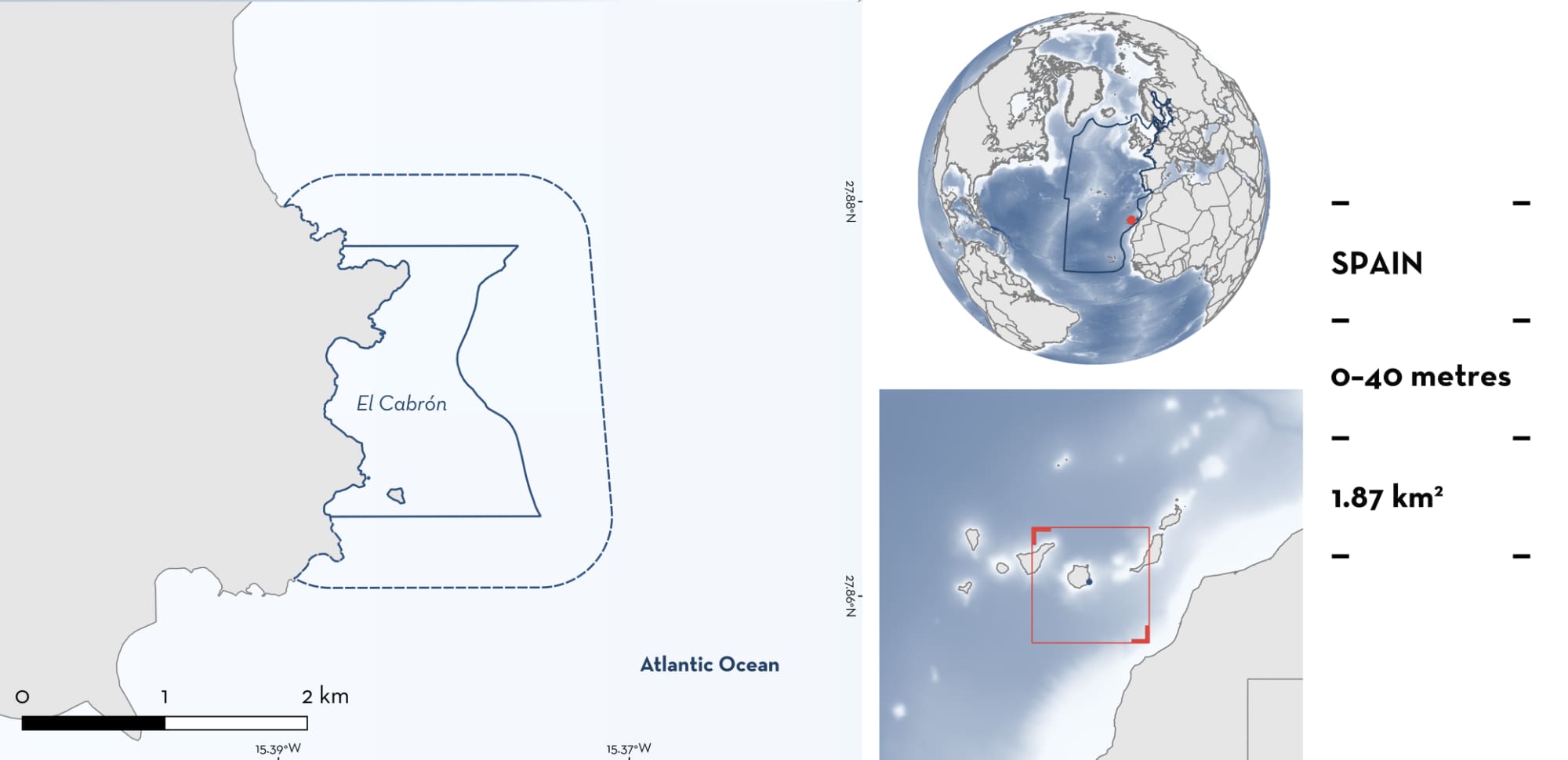
El Cabrón is located on the eastern coast of Gran Canaria Island, Canary Islands, Spain. The area encompasses a coastal terrace and is characterised by rocky reefs, basaltic platforms, sandy plains, and small patches of rhodolite beds and seagrass. It is influenced by the Canary Current and the seasonal coastal upwelling system off northwest Africa, internal waves, and localised coastal currents. The area overlaps with the Oceanic Islands and Seamounts of the Canary Region Ecologically or Biologically Significant Marine Area. Within this area there are: threatened species (e.g., Spiny Butterfly Ray Gymnura altavela); and undefined aggregations (e.g., Angelshark Squatina squatina).
Download factsheet
El Cabrón
DESCRIPTION OF HABITAT
El Cabrón is located on the eastern coast of Gran Canaria Island, Canary Islands, Spain. It encompasses a coastal terrace that extends from the shoreline to a depth of 40 m. The area is characterised by rocky reefs, basaltic platforms, sandy plains, and small patches of rhodolith beds and seagrass (mainly Cymodocea nodosa) (Pérez-Fernández et al. 2001). The area also features volcanic formations such as overhangs, ledges, and cavities distributed along a shallow slope that progressively deepens toward the edge of the platform (Pérez-Fernández et al. 2001; Angel Shark Project & Rays of Paradise pers. obs. 2025).
The area is influenced by the Canary Current and the seasonal coastal upwelling system off northwest Africa, which brings cold, nutrient-rich waters that enhance primary productivity, especially from the boreal spring to autumn (Gómez-Letona et al. 2017; Espino-Ruano et al. 2023). The area is also subject to the periodic influence of internal waves and localised coastal currents, which contribute to sediment redistribution and prey availability (Gómez-Letona et al. 2017).
This area overlaps with the Oceanic Islands and Seamounts of the Canary Region Ecologically or Biologically Significant Marine Area (EBSA; CBD 2025).
This Important Shark and Ray Area is benthic and pelagic and is delineated from inshore and surface waters (0 m) to 40 m based on the bathymetry of the area.
CRITERION A
VULNERABILITY
Two Qualifying species considered threatened with extinction according to the IUCN Red List of Threatened Species regularly occur in the area. These are the Critically Endangered Angelshark (Morey et al. 2019) and the Endangered Spiny Butterfly Ray (Dulvy et al. 2021).
CRITERION C
SUB-CRITERION C5 – UNDEFINED AGGREGATIONS
El Cabrón is important for undefined aggregations of one shark and one ray species.
Between 2017–2024, the Angel Shark Project conducted a combination of underwater visual census (UVC) surveys with snorkel and SCUBA, tagging, and citizen science data collection in the area. Tagged animals were measured, while the size of animals resting was visually estimated. Between 2017–2022, a total of 14 campaigns were conducted in the area, each lasting one day with 1–2 dives per campaign (Angel Shark Project unpubl. data 2025). Visual transects and tagging surveys were conducted across the Canary Islands in high suitability areas (Meyers et al. 2017), potential nursery areas (Jiménez-Alvarado et al. 2020), and locations where Angelsharks are commonly observed.
Aggregations of 4–6 adult Angelshark (individuals >100 cm total length; TL), were recorded during a single dive in the area across multiple years (2019, 2020, 2021, and 2023), based on both UVC and citizen science reports from local dive centres (Angel Shark Project unpubl. data 2025). Specifically, between 2020–2021, during a single dive, three aggregations of 4–5 mature individuals were documented through UVC that are conducted in one single dive spot within a ~400 m radius (Angel Shark Project unpubl. data 2025). Angelshark were on the substrate a few metres from each other (Angel Shark Project unpubl. data 2025). Additionally, three aggregations of 4–6 individuals were reported by dive centres between 2019–2023 (Angel Shark Project unpubl. data 2025). Angelsharks are regularly seen individually and scattered year-round, but aggregations have been recorded within the reported mating season in winter (November–March) and occasionally during other periods of the year (Meyers et al. 2017; Mead et al. 2023). During UVCs and tagging efforts, 30 Angelsharks were recorded, comprising 21 adults, 6 juveniles (40–59 cm TL), and 3 neonates/young-of-the-year (YOY) (<39 cm TL) (Angel Shark Project unpubl. data 2025). Individuals were classified as neonate/YOY as their size (<39 cm TL) was close to the reported size-at-birth for the species (26–30 cm TL; Ebert et al. 2021). Additionally, of the 53 sightings of Angelsharks via the Angel Shark Sightings Map, 46 individuals were classified as adults (>60 cm TL) (Angel Shark Project unpubl. data 2025). Overall, sightings peaked during winter and spring, and Angelsharks were mainly distributed between 11–20 m depth (Angel Shark Project unpubl. data 2025). Mating events (n = 4) were also observed and reported by local dive centres in November and December in 2020, 2021, and 2023, with one individual showing fresh mating scars in March 2020, and at least two pregnant females, inferred from distended abdomens (Angel Shark Project unpubl. data 2025). El Cabrón was highlighted as one of four sites across the Canary Islands with a high frequency of Angelshark sightings per grid cell, and as the area with the second highest number of adult Angelshark sightings of Gran Canaria Island (Meyers et al. 2017). It has also been described as a moderate to highly suitable area during the winter and spring particularly for adult females (Noviello et al. 2021). These aggregations could therefore be linked to reproductive purposes; however, further information is required to understand the nature and function of these aggregations.
Spiny Butterfly Ray aggregations are regularly observed in this area between June–November (Espino-Ruano et al. 2023; Rays of Paradise unpubl. data 2025). Between 2018–2019, monthly scientific surveys (n = 24) were conducted using random 50 m transects, with two SCUBA divers surveying each transect at depths of 15–25 m for three minutes (Rays of Paradise unpubl. data 2025). Spiny Butterfly Rays observed in the area were recorded, sexed, and measured for TL (i.e., from the tip of the snout to the end of the tail) and disc width (DW) (Espino-Ruano et al. 2023). Measurements were estimated by approaching the resting rays with a tape measure while they were on the seafloor (Espino-Ruano et al. 2023). Aggregations of up to six individuals (mean = 4) were observed on eight occasions (18% of the total sightings; n = 44), four aggregations in each year (Espino-Ruano et al. 2023; Rays of Paradise unpubl. data 2025). Due to the larger surveyed area at El Cabrón, each random transect covered a smaller proportion of the total area compared to other surveyed sites across the Canary Islands (D Jiménez-Alvarado pers. obs. 2025). As a result, fewer individuals were recorded. However, it is likely that the area supports a significant concentration of individuals that went undetected due to the limited transect coverage. Further information is required to understand the nature and function of these aggregations.
Download factsheet
SUBMIT A REQUEST
ISRA SPATIAL LAYER REQUEST
To make a request to download the ISRA Layer in either a GIS compatible Shapefile (.shp) or Google Earth compatible Keyhole Markup Language Zipped file (.kmz) please complete the following form. We will review your request and send the download details to you. We will endeavor to send you the requested files as soon as we can. However, please note that this is not an automated process, and before requests are responded to, they undergo internal review and authorization. As such, requests normally take 5–10 working days to process.
Should you have questions about the data or process, please do not hesitate to contact us.