ISRA FACTSHEETS
ISRA FACTSHEETS
EUROPEAN ATLANTIC
El Hierro
Summary
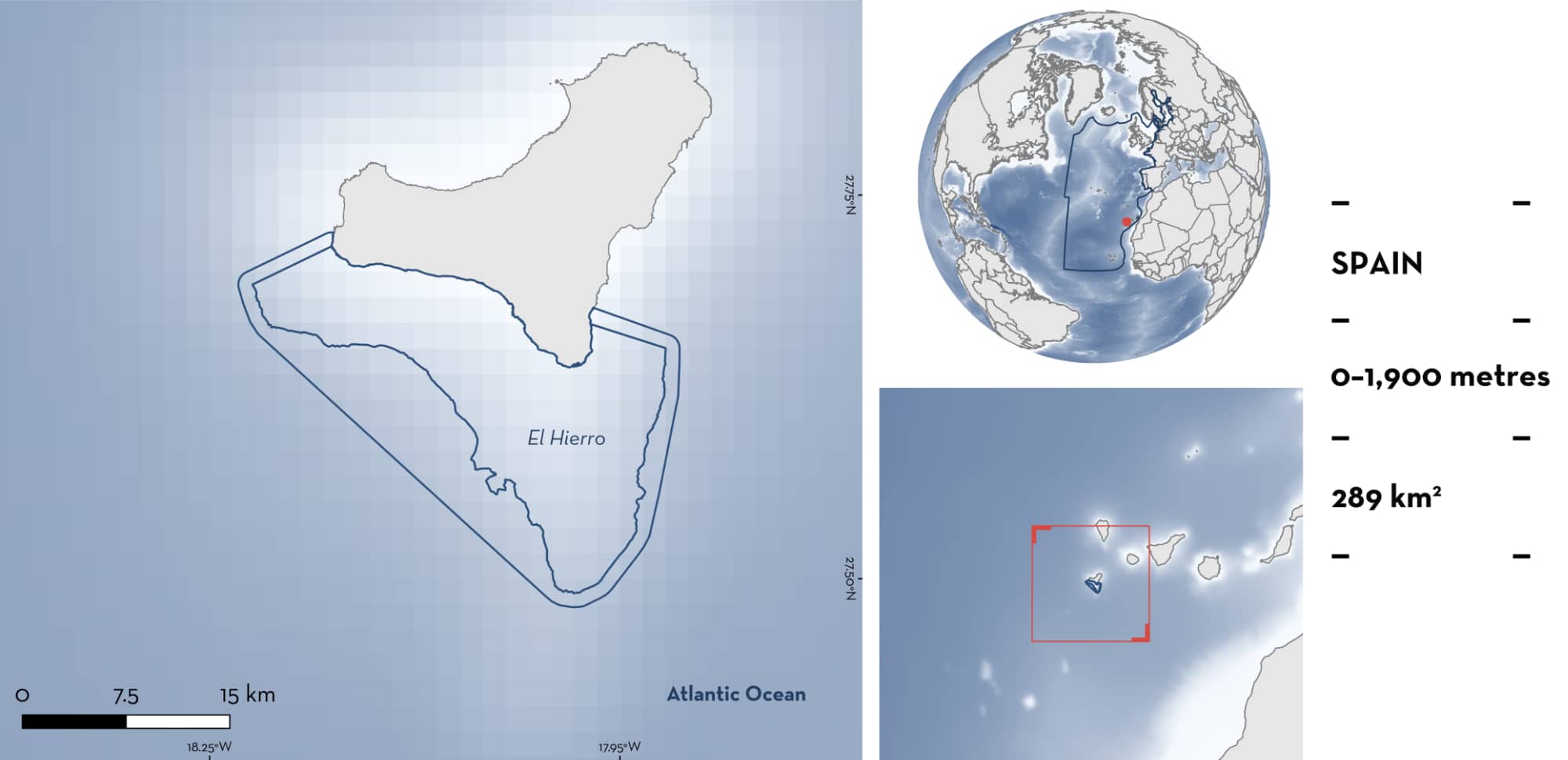
El Hierro is located off the southern coast of El Hierro Island, Canary Islands, Spain. It encompasses the Mar de las Calmas, El Bajón Seamount, and the southern coastline of El Hierro Island. The area is characterised by a narrow coastal platform followed by a steep slope with lava-formed reefs, basaltic terraces, rocky pinnacles, sandy patches, and vertical walls. It is influenced by the Canary Current and the coastal upwelling system off northwest Africa. The area overlaps with the Oceanic Islands and Seamounts of the Canary Region Ecologically or Biologically Significant Marine Area, and the Western coast of El Hierro Key Biodiversity Area. Within this area there are: threatened species (e.g., Duckbill Eagle Ray Aetomylaeus bovinus); reproductive areas (e.g., Smalltooth Sand Tiger Odontaspis ferox); undefined aggregations (Sicklefin Devil Ray Mobula tarapacana); and the area sustains a high diversity of sharks (13 species).
Download factsheet
El Hierro
DESCRIPTION OF HABITAT
El Hierro is located off the southern coast of El Hierro Island, Canary Islands, Spain. It encompasses the Mar de las Calmas, El Bajón seamount, and the southern coastline of El Hierro Island. The area is characterised by a narrow coastal platform followed by a steep slope, with lava-formed reefs, basaltic terraces, rocky pinnacles, sandy patches, and vertical walls (A Rodríguez-Juncá pers. obs. 2025).
This area is influenced by the Canary Current and the coastal upwelling system off northwest Africa, which inject cold, nutrient-rich waters seasonally, promoting elevated primary productivity, especially from boreal spring to autumn (Gómez-Letona et al. 2017). Additionally, dynamic oceanographic processes such as internal waves, thermocline shifts, and local turbulence influence prey availability and productivity, particularly along the slope (Fraile-Nuez et al. 2023).
This area overlaps with the Oceanic Islands and Seamounts of the Canary Region Ecologically or Biologically Significant Marine Area (EBSA; CBD 2025) and the Western coast of El Hierro Key Biodiversity Area (KBA; KBA 2025). It also overlaps with the Mar de Las Calmas Special Conservation Zone (ZEC) through the Natura 2000 network.
This Important Shark and Ray Area is benthic and pelagic and is delineated from inshore and surface waters (0 m) to 1,900 m based on the bathymetry and the depth range of Qualifying Species in the area.
CRITERION A
VULNERABILITY
Thirteen Qualifying Species considered threatened with extinction according to the IUCN Red List of Threatened Species regularly occur in the area. Threatened sharks comprise two Critically Endangered species and two Endangered species; threatened rays comprise two Critically Endangered species, four Endangered species, and three Vulnerable species (IUCN 2025).
CRITERION C
SUB-CRITERION C1 – REPRODUCTIVE AREAS
El Hierro is an important reproductive area for one shark and one ray species.
Between 2005–2019, at least 18 sightings of adult female Smalltooth Sand Tiger (based on visually estimated total length [TL]) were documented by citizen scientists and videographers while scuba or freediving in the area between May–November (Barría et al. 2018; RedPROMAR Gobierno de Canarias 2025; A Furundarena & F Ravina pers. obs. 2025). Among these, four individuals observed between 2005–2016 were estimated to measure between 300–400 cm TL and all displayed distended abdomens (likely indicating pregnancy) (Barría et al. 2018). Female size-at-maturity for the species is 300–350 cm TL (Ebert et al. 2021). Additionally, at least three adult females bearing fresh mating scars were observed in 2018 and 2019 (RedPROMAR Gobierno de Canarias 2025; F Ravina pers. obs. 2025). In 2019, two adult females were observed swimming together, one with a distended abdomen and the other with fresh mating scars (F Ravina pers. obs. 2025). A resighting with photo-identification (based on distinctive features on the pectoral and dorsal fins) of one adult female in 2005, 2010, and 2016 indicate site fidelity to the area (Barría et al. 2018). This shark species is rarely encountered as it is normally found in deeper waters (>300 m) with few mature females recorded worldwide (Pollard et al. 2015). However, El Hierro is one of the few locations globally where mature females have been regularly observed at shallow depths, ranging from the surface to ~20 m.
Between 2010–2024, citizen science and social media observations while scuba or free diving were collected across the Canary Islands (n = 403 Mobula spp. sightings with audiovisual material), with a total of 181 sightings of Sicklefin Devil Ray in the area (45% of the total sightings) (A Rodríguez-Juncá unpubl. data 2025). When possible, individuals were photo-identified and sexed, although sex was not recorded for all sightings. Between 2012–2022, a total of 29 individuals were photo-identified, with 13 sightings of 16 different pregnant individuals (64% of the females identified in the area), inferred by distended abdomens (A Rodríguez-Juncá unpubl. data 2025). Pregnant females were recorded in 2012–2022, between the months of May–November (A Rodríguez-Juncá unpubl. data 2025). Additionally, 11 females with healed mating scars were recorded in the area between 2017–2024, during May–September (A Rodríguez-Juncá unpubl. data 2025).
CRITERION C
SUB-CRITERION C5 – UNDEFINED AGGREGATIONS
El Hierro is an important area for undefined aggregations of one ray species.
Between 2010–2024, citizen science and social media observations while scuba or freediving were collected across the Canary Islands (n = 403 Mobula spp. sightings with audiovisual material), with a total of 181 sightings of Sicklefin Devil Ray in the area (45% of the total sightings) (A Rodríguez-Juncá unpubl. data 2025). Between 2016–2024, a total of 33 aggregations with 3–53 individuals (mean = 14) were recorded in the area (A Rodríguez-Juncá unpubl. data 2025). Aggregations were seasonal, with observations between May–October (A Rodríguez-Juncá unpubl. data 2025). Globally, large aggregations for this species are rare and have only been observed at a few other locations in the world such as the Azores Archipelago off the coast of Portugal (Sobral & Afonso 2014) and the São Pedro and São Paulo Archipelago off Brazil (Mendonça et al. 2018). Photo-identification data also confirmed six of the 29 Sicklefin Devil Ray photo-identified resighted over periods ranging from one month to three years, indicating potential site fidelity and consistent use of the area (A Rodríguez-Juncá unpubl. data 2025). Further information is required to confirm the nature and function of these aggregations.
CRITERION D
SUB-CRITERION D2 – DIVERSITY
El Hierro sustains a high diversity of Qualifying Species (13 species). This meets the regional diversity threshold (13 species) for the European Atlantic region. The regular presence of Qualifying Species has been documented between 2011–2024 by frequent observations in diving operations, visual census by scientists (A Rodríguez-Juncá unpubl. data 2025), citizen science while scuba or freediving (Espino et al. 2022; RedPROMAR Gobierno de Canarias 2025), and interviews with fishers (Rodríguez-Juncá et al. 2023). All Qualifying Species were recorded by citizen scientists and supported with photographic evidence (RedPROMAR Gobierno de Canarias, 2025) over a period of at least two years between 2011–2024, except for the Common Smoothhound, which was confirmed in the area by recreational fishers, diving guides, and marine scientists (Espino et al. 2022). Additionally, interviews with fishers (n = 12) were conducted at La Restinga (local village within the area) based on their observations and fishing experience in the area, reporting the regular and predictable presence of Smalltooth Sand Tiger, Angelshark, Duckbill Eagle Ray, Spiny Butterfly Ray, Common Eagle Ray, Oceanic Manta Ray, Sicklefin Devil Ray, and Marbled Torpedo Ray (Rodríguez-Juncá et al. 2023).
Download factsheet
SUBMIT A REQUEST
ISRA SPATIAL LAYER REQUEST
To make a request to download the ISRA Layer in either a GIS compatible Shapefile (.shp) or Google Earth compatible Keyhole Markup Language Zipped file (.kmz) please complete the following form. We will review your request and send the download details to you. We will endeavor to send you the requested files as soon as we can. However, please note that this is not an automated process, and before requests are responded to, they undergo internal review and authorization. As such, requests normally take 5–10 working days to process.
Should you have questions about the data or process, please do not hesitate to contact us.