ISRA FACTSHEETS
true
ISRA FACTSHEETS
WESTERN INDIAN OCEAN REGION
Emboodhoo Kandu
Summary
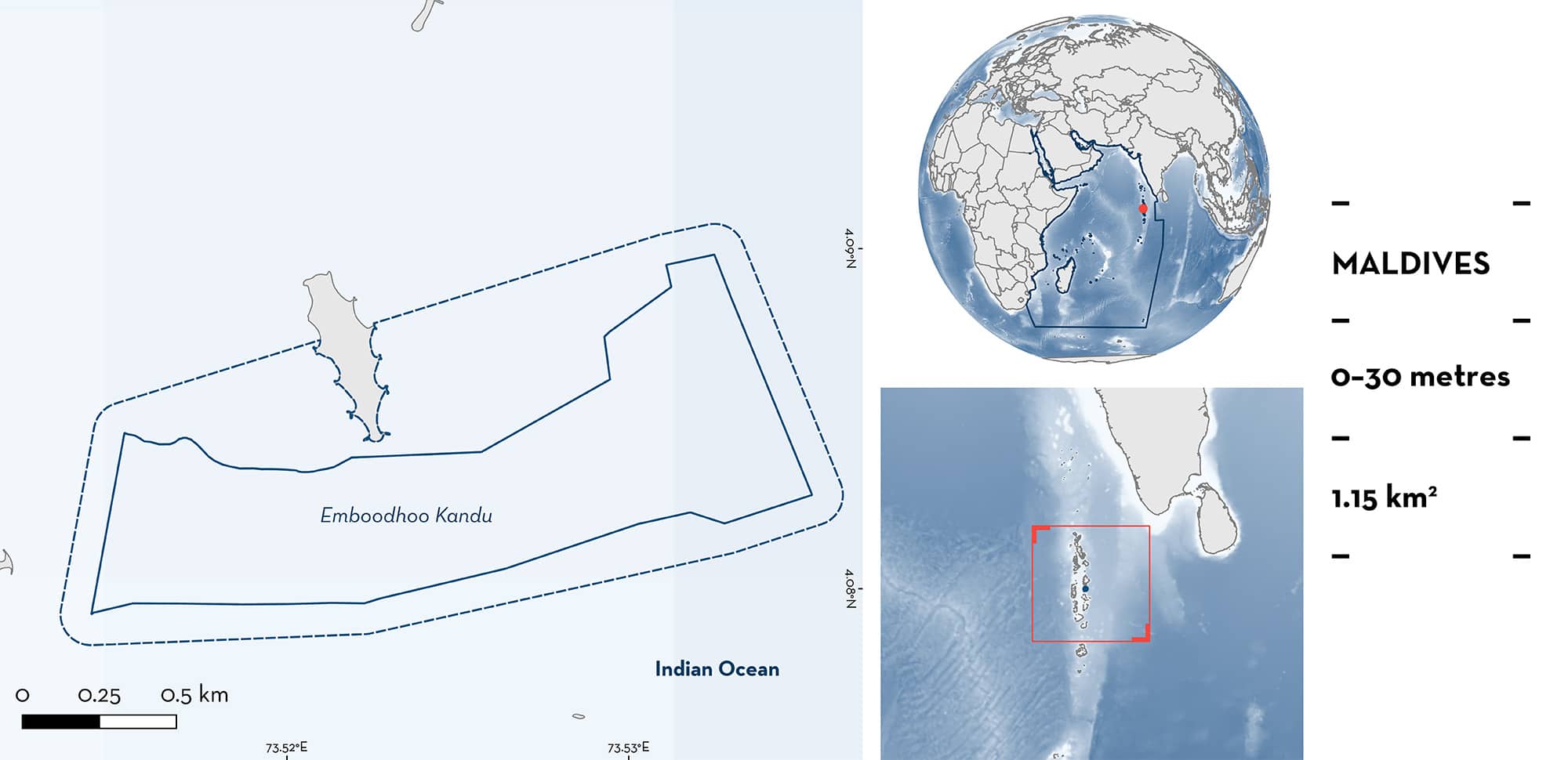
Emboodhoo Kandu is a channel located on the northeastern side of South Malé Atoll in the central Maldives. The north entrance of the area is bordered by a pinnacle reef, Emboodhoo Thila, while the south has several caves and overhangs. The channel entrance is narrow creating strong currents. This area sits within Embudhoo Kanduolhi, a marine protected area. Within this area there are: threatened species (e.g., Grey Reef Shark Carcharhinus amblyrhynchos) and undefined aggregations (e.g., Whitetip Reef Shark Triaenodon obesus).
Download factsheet
Emboodhoo Kandu
DESCRIPTION OF HABITAT
Emboodhoo Kandu is located in the Maldives archipelago which sits centrally upon the Chagos-Laccadive Ridge (Stevens & Froman 2019). This area (also known as Emboodhoo Channel) is a channel on the northeastern side of South Malé Atoll. Channels, locally known as kandu, are recognised by a high current flow (Stevens & Froman 2019).
The area is ~2 km long, ~0.45 km wide, and 5–30 m deep. The northern entrance of the channel is bordered by a pinnacle reef, Emboodhoo Thila, where the reef top is at 12 m depth and down to 40 m at the outward entrance of the atoll (Godfrey 2018). The channel entrance is narrow creating strong currents (Godfrey 2018). On the south of the channel, several caves and few overhangs are found (Godfrey 2018). Overhangs are shallow and are found at 14–30 m depth. The south corner of the area is known as Shark Point and has a depth range of 10–30 m. Inside the channel, the wall on the south side is steep, where the top is 1–3 m deep and drops down to 30 m (Godfrey 2018).
The weather in the Maldives is strongly influenced by the South Asian monsoon, especially the northern and central atolls as these are closer to the Indian subcontinent (Anderson et al. 2011). Therefore, two monsoons occur annually in Maldives. The southwest monsoon (locally known as Hulhan’gu), from May to November, and the northeast monsoon (locally known as Iruvai), from January to March, with transitional periods in December and April (Shankar et al. 2002; Anderson et al. 2011). The southwest monsoon increases average rainfall, and wind speeds, causing rougher seas and reduced visibility; in contrast, the northeast monsoon usually brings clear waters (Stevens & Froman 2019).
The Maldives archipelago disrupts the flow of the monsoon-driven North Equatorial Current as it crosses the Indian Ocean (Schott & McCreary 2001) which creates a current flow through the Maldives’ channels (Sasamal 2006). The strongest lunar currents can overcome the prevailing monsoonal currents through the tidal suction mechanism along the channel’s outer edges (Stevens 2016).
This Important Shark and Ray Area is benthopelagic and is delineated from surface waters (0 m) to 30 m based on the bathymetry of the area.
CRITERION A
VULNERABILITY
Two Qualifying Species considered threatened with extinction according to the IUCN Red List of Threatened SpeciesTM regularly occur in the area. These are the Endangered Grey Reef Shark (Simpfendorfer et al. 2020a) and the Vulnerable Whitetip Reef Shark (Simpfendorfer et al. 2020b).
CRITERION C
SUB-CRITERION C5 – UNDEFINED AGGREGATIONS
Emboodhoo Kandu is an important area for undefined aggregations of two shark species.
Data were collected from a citizen-science program known as the Sharkwatch project which was a government-led initiative between 2009–2019 (Maldives Marine Research Institute [MMRI] unpubl. data 2023). Data were collected by experienced dive guides using the roving diver technique where surveyors can swim in any direction and count the number of individuals encountered by species during one-hour dive survey. From the ~1,110 sites surveyed in the Maldives, this area has been identified as one of the most important aggregations for Whitetip Reef Shark and Grey Reef Shark (MMRI unpubl. data 2023).
Sharkwatch surveys conducted over 11 years (2009–2019; n = 57) estimated a mean encounter rate of 19 Whitetip Reef Sharks/hour with a maximum number of sharks per hour of >35 in 2009, 2010, and 2013, and 50 in 2016. (MMRI unpubl. data 2023). Sightings of Whitetip Reef Shark were observed in both northeast and southwest monsoon seasons. For example, in 2010 encounter rates of 40 sharks/hour were recorded in both seasons (MMRI unpubl. data 2023).
The same surveys estimated a mean encounter rate of five Grey Reef Sharks/hour. In 2011, 2014, and 2016, three surveys reported each >30 sharks/hour in this area (MMRI unpubl. data 2023). This area might be used as a resting ground for this species. In channels with strong currents in French Polynesia, Grey Reef Sharks use current-induced updraft zones to reduce energy expenditure, since these are negatively buoyant fishes and obligate swimmers (Papastamatiou et al. 2021). Further information is needed to understand the nature and function of these aggregations.
Download factsheet
SUBMIT A REQUEST
ISRA SPATIAL LAYER REQUEST
To make a request to download the ISRA Layer in either a GIS compatible Shapefile (.shp) or Google Earth compatible Keyhole Markup Language Zipped file (.kmz) please complete the following form. We will review your request and send the download details to you. We will endeavor to send you the requested files as soon as we can. However, please note that this is not an automated process, and before requests are responded to, they undergo internal review and authorization. As such, requests normally take 5–10 working days to process.
Should you have questions about the data or process, please do not hesitate to contact us.