ISRA FACTSHEETS
ISRA FACTSHEETS
EUROPEAN ATLANTIC
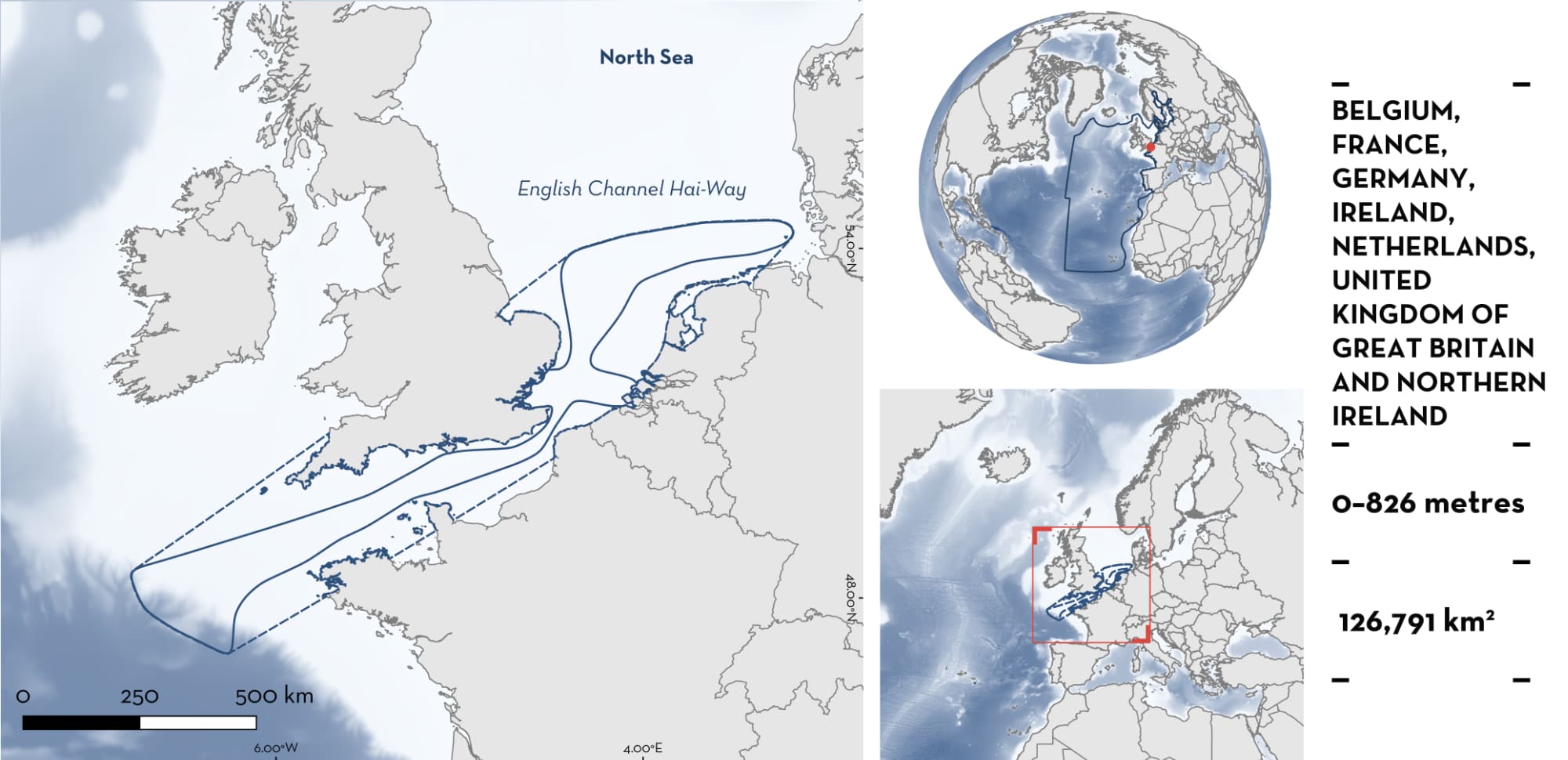
English Channel Hai-Way
Summary
English Channel Hai-Way is a transboundary area connecting the southern North Sea, English Channel, and Celtic Sea through the waters of Germany, the Netherlands, Belgium, France, the United Kingdom of Great Britain and Northern Ireland, and Ireland. The habitat is characterised by shallow shelf waters, pelagic waters, sandy and rocky substrates, sandbanks, and tidal flats. Within this area there are: threatened species (Tope Galeorhinus galeus); and areas important for movement (e.g., Starry Smoothhound Mustelus asterias).
Download factsheet
English Channel Hai-Way
DESCRIPTION OF HABITAT
English Channel Hai-Way is a transboundary area connecting the southern North Sea to the English Channel and the Celtic Sea. It spans from the German Bight in Germany and the Netherlands in the east via the English Channel across Belgium, France, and the United Kingdom of Great Britain and Northern Ireland, to the Celtic Sea around France, the United Kingdom of Great Britain and Northern Ireland, and Ireland. The southern North Sea is shallow, lying on the shelf, and is influenced by tides and terrestrial freshwater input. The benthic habitat of the English Channel is mostly comprised of coarse and sandy sediments (James et al. 2007). While the depth and seabed topography of the English Channel is comparatively uniform, the southern North Sea and the German Bight are characterised by a variety of seabed types comprising sandy ridges and ripples, tidal sandbanks and mudflats, mixed sediment, and rocky/hard-substrate habitats. Other habitats in this area include pelagic waters and estuary outflows.
Currents in the area broadly flow east- and northward from the eastern English Channel through the southern North Sea (Port et al. 2011). The residual flow in the English Channel is eastward (Sentchev et al. 2006). The residual flow in the southern Celtic Sea is northwestward (Pingree & Le Cann 1989). The southern North Sea is strongly influenced by tidal dynamics, with semi-diurnal tides leading to two low- and two high tides per day. The tides are stronger along the French coast, leading to stronger residual circulation than at the northern coast of the English Channel (Tinker et al. 2022).
This Important Shark and Ray Area is benthic and pelagic and is delineated from inshore and surface waters (0 m) to 826 m based on the global depth range of the Qualifying Species.
CRITERION A
VULNERABILITY
One Qualifying Species considered threatened with extinction according to the IUCN Red List of Threatened Species regularly occurs in the area. This is the Critically Endangered Tope (Walker et al. 2020).
CRITERION C
SUB-CRITERION C4 – MOVEMENT
English Channel Hai-Way is an important movement area for two shark species.
Tope seasonally migrate from the German Bight into and through the English Channel to the Celtic Sea (Schaber et al. 2022; M Schaber unpubl. data 2025). Between 2018–2024, 22 individuals (18 females; 4 males) were tagged with pop-off satellite archival tags (PSAT) near Helgoland Island in the German Bight. Tagging was conducted between late August and mid-September each year, towards the end of the presumed seasonal aggregation of Tope in the area (~July–October). Of 18 successful deployments, 13 tracks (64.7%) showed migration of the sharks through this area, of which most were females (n = 9). The tracks showed Tope leaving the German Bight in the boreal autumn heading southwestward, following a clearly defined pathway to the western parts of the English Channel and onwards to the continental shelf edge in the Celtic Sea. Most of the sharks overwintered and remained in the western English Channel (detachment of tags occurred during the winter months in this area), while three individuals moved further southwest, crossing the shelf break into oceanic areas of the Atlantic Ocean (Schaber et al. 2022; M Schaber unpubl. data 2025).
Starry Smoothhounds regularly migrate from the Thames Estuary and from the Dutch Delta through the English Channel into the Celtic Sea (Brevé et al. 2020; Griffiths et al. 2020). A study captured and released 1,390 Starry Smoothhounds tagged with conventional tags and 125 individuals tagged with electronic data loggers between 2003–2019 (Griffiths et al. 2020). Most individuals were tagged in the southern North Sea and in the English Channel, and mostly between July–September when the species is captured in coastal waters. A total of 18 conventional-tagged individuals were recaptured (1.3% return rate) and 12 individuals with electronic tags were recaptured but data did not allow track reconstruction, so only release and recapture location were available for those individuals. These data showed that sharks tagged in the Thames Estuary moved into and through the English Channel, as well as to coastal areas in the Netherlands and the southern German Bight. Of the six electronic tags that allowed track reconstruction, three individuals migrated through this area, connecting the Thames Estuary with the eastern and western English Channel (Griffiths et al. 2020). A second study tagged 3,699 Starry Smoothhounds with conventional tags in the river Scheldt outer estuary (Westerschelde) and the adjacent sea arm in the Netherlands (Oosterschelde) in May–October between 2011–2019 (Brevé et al. 2020). A total of 220 individuals were recaptured (5.9%), with adult females migrating through this area into and through the English Channel to the Bay of Biscay in winter and spring, while adult males either moved into the English Channel or the North Sea (Brevé et al. 2020). While the two mark-recapture studies did not resolve the movement paths, the example tracks from the successful electronic tags showed that Starry Smoothhounds likely use this movement corridor through the English Channel.
Download factsheet
SUBMIT A REQUEST
ISRA SPATIAL LAYER REQUEST
To make a request to download the ISRA Layer in either a GIS compatible Shapefile (.shp) or Google Earth compatible Keyhole Markup Language Zipped file (.kmz) please complete the following form. We will review your request and send the download details to you. We will endeavor to send you the requested files as soon as we can. However, please note that this is not an automated process, and before requests are responded to, they undergo internal review and authorization. As such, requests normally take 5–10 working days to process.
Should you have questions about the data or process, please do not hesitate to contact us.