ISRA FACTSHEETS
ISRA FACTSHEETS
NORTH AMERICAN PACIFIC
Farallon Islands
Summary
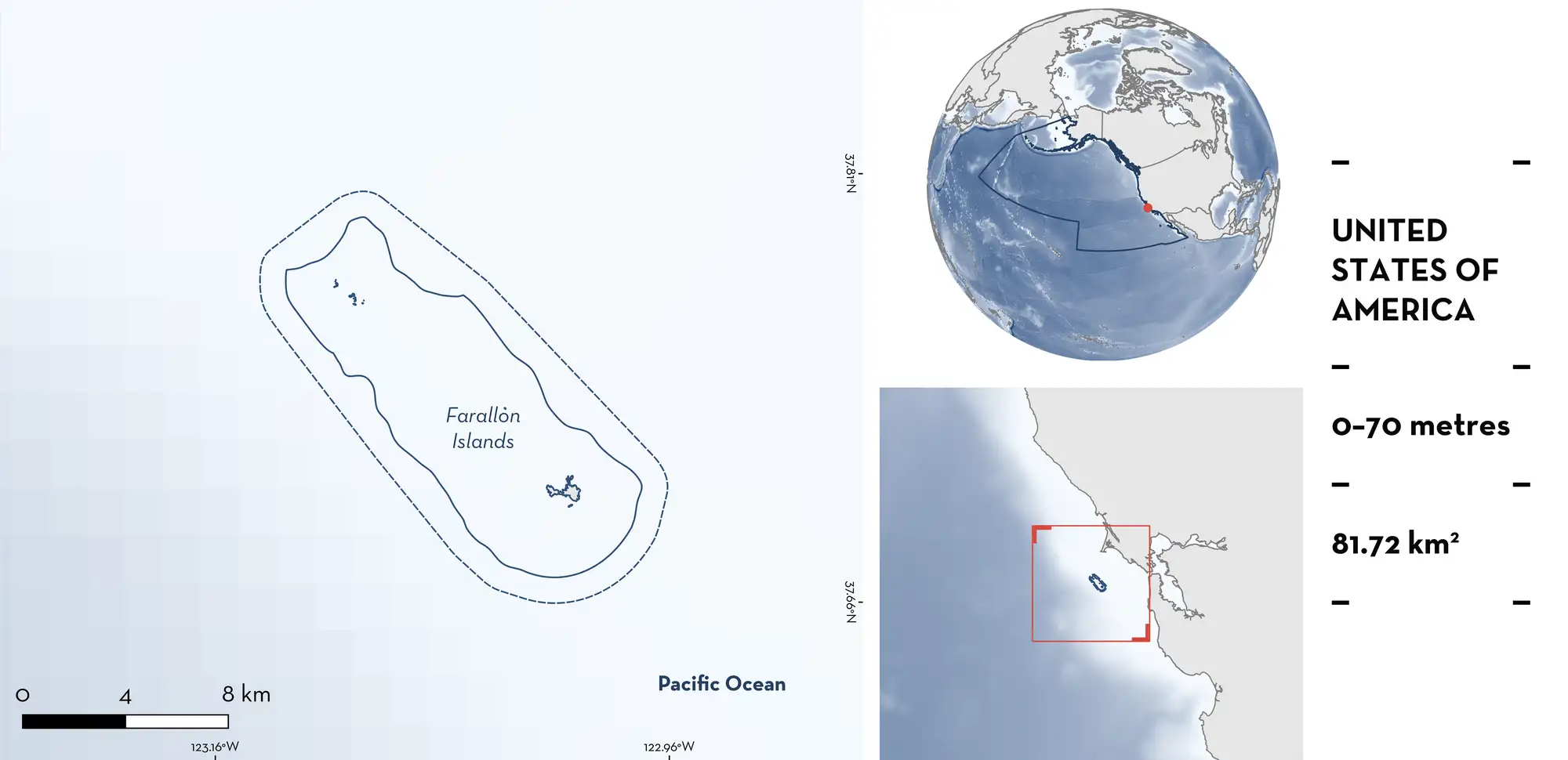
Farallon Islands is located off northern California, United States of America. It is situated ~48 km west of San Francisco. The area comprises multiple islands and islets and is characterised by rocky reefs, boulder fields, and mixed substrates. It is influenced by seasonal upwelling. The area overlaps with three protected areas. Within this area there are: threatened species and feeding areas (White Shark Carcharodon carcharias).
Download factsheet
Farallon Islands
DESCRIPTION OF HABITAT
Farallon Islands is located off northern California, United States of America. This area is situated ~48 km west of San Francisco on the continental shelf. This archipelago consists of rocky granite islands and islets with the surrounding seafloor characterised by rocky reefs, boulder fields, and mixed substrates (Karl et al. 2001).
The area is situated within a highly productive upwelling region influenced by the California Current System. The southward-flowing California Current transports cold, nutrient-poor subarctic water along the coast, while seasonal upwelling driven by northwesterly winds (strongest March–August) brings cold, nutrient-rich water from depths of 100–200 m to the surface (Huyer 1983; Checkley & Barth 2009). This upwelling supports high primary productivity and sustains a rich marine food web. The region also experiences the poleward-flowing California Undercurrent at depth (100–300 m), which is present year-round but most coherent during the upwelling season (Noble & Ramp 2000). Sea surface temperatures exhibit strong seasonal variability, ranging from 10–12°C during upwelling periods to 14–16°C during fall and winter relaxation events.
The area overlaps with the Southeast Farallon Island State Marine Reserve, the Southeast Farallon Island State Marine Conservation Area, and the Southeast Farallon Island Special Closure (UNEP-WCMC & IUCN 2026).
This Important Shark and Ray Area is pelagic and is delineated from inshore and surface waters (0 m) to 70 m based on the bathymetry of the area.
CRITERION A
VULNERABILITY
One Qualifying Species considered threatened with extinction according to the IUCN Red List of Threatened Species regularly occurs in the area. This is the Vulnerable White Shark (Rigby et al. 2022).
CRITERION C
SUB-CRITERION C2 – FEEDING AREAS
Farallon Islands is an important feeding area for one shark species.
Observations of predation on pinnipeds by White Sharks have been regularly recorded on a seasonal basis in the area between 1970–2025 through standardised visual surveys occurring from the island’s highest peak (Ainley et al. 1981; Klimley et al. 1992; Brown et al. 2010). The island hosts large breeding populations of California Sea Lion Zalophus californianus and Northern Elephant Seal Mirounga angustirostris, known prey of White Sharks, particularly during the boreal autumn (September–November) when juvenile Northern Elephant Seals are abundant (Pyle et al. 1996; Klimley et al. 1992). Predation events on each species are observed every season (Brown et al. 2010; Tietz 2026). On average, 31.9 ± 17.5 predation events are observed annually from the standardised visual surveys (Tietz 2026).
Since the early 1980s, dedicated boat-based White Shark surveys have also been conducted annually at Southeast Farallon Island from September to December to photo-identify individual White Sharks and deploy acoustic and satellite tags. Surveys are weather-dependent and typically occur at least weekly during this period. Acoustic receiver effort has been variable in this area, with consistent effort from 2006–2015, and variable effort up to 2026 due to logistical constraints, though a receiver currently remains in place at the island. Residency measures were calculated for each year of an individual shark’s tag deployment period, with ‘number of days detected at a site’ divided by 365 days.
These efforts have found that White Sharks regularly and predictably use this area during their annual migration between mid-August to late-December (Jorgensen et al. 2010; Andrzejaczek et al. 2025). From 2006–2022, 355 sub-adult and adult White Sharks were tracked with acoustic tags amounting to over 760,000 detections on a coastal array of receivers (Andrzejaczek et al. 2025). Of these, 19.4% of detections were at the Farallon Islands, with an average annual residency rate of 0.10 ± 0.08 per individual at this site. For sharks tagged at the Farallon Islands and tracked for longer than a year (n = 37), 77.8% of all days detected were at the Farallon Islands indicating repetitive site use by a number of individuals (Andrzejaczek et al. 2025).
Download factsheet
SUBMIT A REQUEST
ISRA SPATIAL LAYER REQUEST
To make a request to download the ISRA Layer in either a GIS compatible Shapefile (.shp) or Google Earth compatible Keyhole Markup Language Zipped file (.kmz) please complete the following form. We will review your request and send the download details to you. We will endeavor to send you the requested files as soon as we can. However, please note that this is not an automated process, and before requests are responded to, they undergo internal review and authorization. As such, requests normally take 5–10 working days to process.
Should you have questions about the data or process, please do not hesitate to contact us.