ISRA FACTSHEETS
ISRA FACTSHEETS
EUROPEAN ATLANTIC
Faro Shelf
Summary
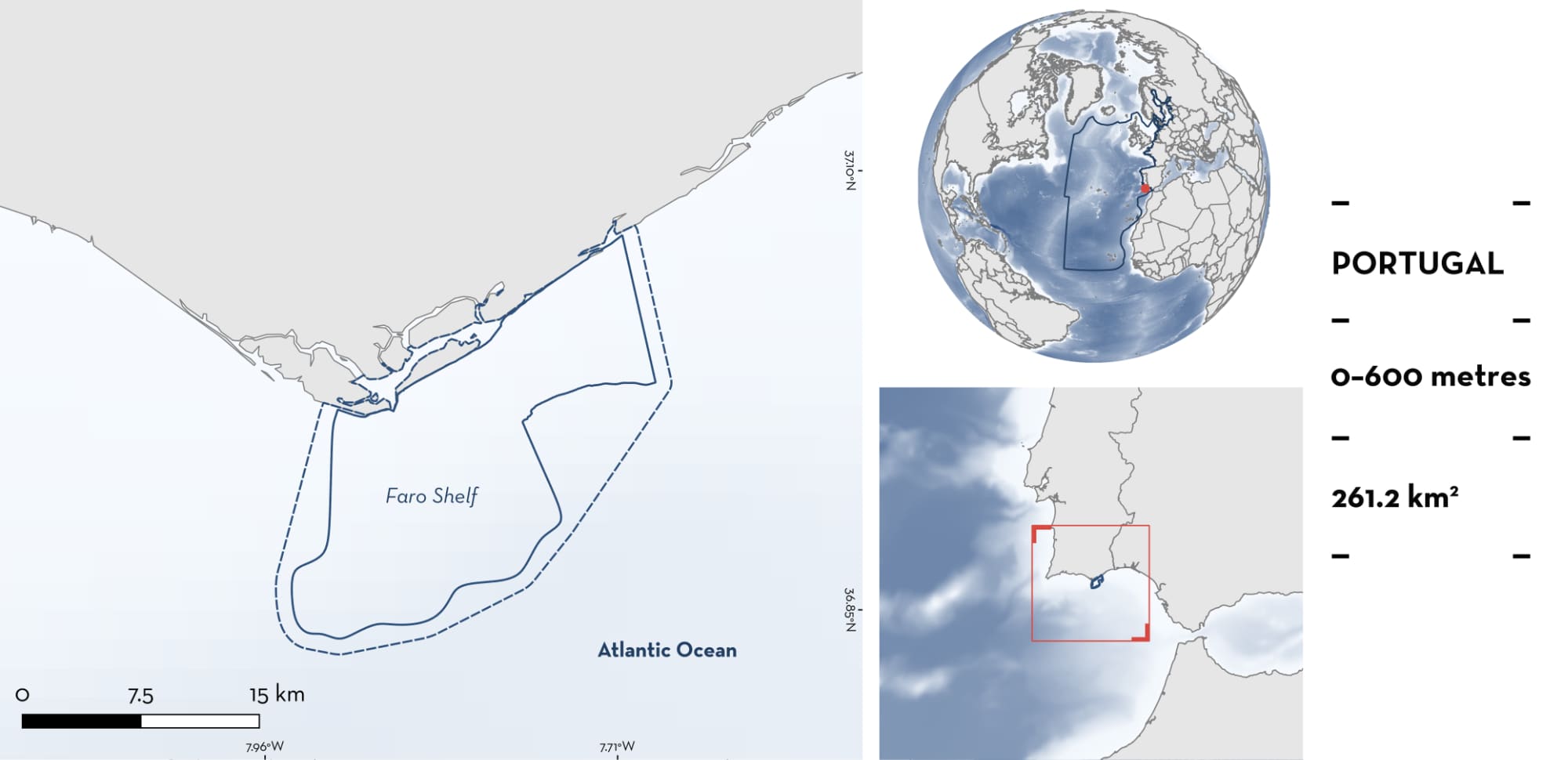
Faro Shelf is located on the south coast of Portugal. The area extends from Faro to Olhão and is characterised by a narrow continental shelf and the presence of rocky reefs, seagrass beds, kelp forest, and sand and mud substrates. Upwelling events produce high productivity during the boreal spring and summer, driven by local westerly winds. The area overlaps with an Ecologically or Biologically Significant Marine Area and a Key Biodiversity Area. Within this area there are: threatened species (e.g., Basking Shark Cetorhinus maximus); feeding areas (Basking Shark); and undefined aggregations (Spinetail Devil Ray Mobula mobular).
Download factsheet
Faro Shelf
DESCRIPTION OF HABITAT
Faro Shelf is located in the south coast of Portugal. The area extends from Faro to Olhão. It is characterised by a narrow continental shelf and the presence of rocky reefs, seagrass beds, kelp forest, and sand and mud substrates. The Ria Formosa Lagoon inputs freshwater to the area.
Upwelling events are more pronounced during the boreal spring and summer, driven by local westerly winds. These intrusions are associated with the eastward extension of the equatorward upwelling current along the southern shelf break (Fiúza 1983; Relvas & Barton 2002). Seasonal spawning aggregations, such as European Pilchard Sardina pilchardus in spring and summer, create temporary prey hotspots that attract marine megafauna (Garrido et al. 2008).
The area overlaps with the West Iberian Canyons and Banks Ecologically or Biologically Significant Marine Area (EBSA; CBD 2025) and the Ria Formosa–Oceânica Key Biodiversity Area (KBA 2025).
This Important Shark and Ray Area is benthic and pelagic and is delineated from inshore and surface waters (0 m) to 600 m based on the bathymetry of the area.
CRITERION A
VULNERABILITY
Two Qualifying Species considered threatened with extinction according to the IUCN Red List of Threatened Species regularly occur in the area. These are the Endangered Basking Shark (Rigby et al. 2021) and Spinetail Devil Ray (Marshall et al. 2022).
CRITERION C
SUB-CRITERION C2 – FEEDING AREAS
Faro Shelf is an important feeding area for one shark species.
Basking Sharks have been reported in the area since the 1990s. Incidental catches (n = 45) recorded by tuna pen operators between 1995–2015 revealed the seasonal presence of the species from March–October with a peak between March–May. Individuals measured between 100–900 cm total length (TL) with a mode of 500 cm TL. The seasonal presence of the species is related to upwelling-driven zooplankton blooms (Couto et al. 2017). Between 2022–2025, observations (n = 4) by tourist operators and scientists confirmed the presence of the species and feeding was recorded in all observations (S Graça Aranha pers. obs. 2022; Ocean Vibes unpubl. data 2025). In south Portugal, high phytoplankton and zooplankton biomass is observed during spring as a result of productive upwelling waters circulating around Cape St. Vincent up to the eastern Gulf of Cádiz (Cunha 2001; Reul et al. 2006). High feeding activity by other filter feeders like baleen whales is observed in late winter and spring in the area (Garrido et al. 2008; Ocean Vibes unpubl. data 2025; R Santos pers. comm. 2025). Similar patterns between high productivity areas and Basking Shark feeding have been recorded elsewhere (Sims & Quayle 1998).
CRITERION C
SUB-CRITERION C5 – UNDEFINED AGGREGATIONS
Faro Shelf is an important area for undefined aggregations of one ray species.
Between 2022–2024, tourist operators focused on whale watching (daily trips) recorded the presence of Spinetail Devil Ray in the area (46 observations). Individuals were recorded from April–October with a peak between July–September (Ocean Vibes unpubl. data 2025). While most of the sightings (67%) were of single individuals, aggregations of 3–5 individuals were observed in all years (Ocean Vibes unpubl. data 2025). Aggregations are relatively small compared to other reported aggregation sites in northern Europe, however, this is the only location in Portugal where they have regularly been recorded.
Download factsheet
SUBMIT A REQUEST
ISRA SPATIAL LAYER REQUEST
To make a request to download the ISRA Layer in either a GIS compatible Shapefile (.shp) or Google Earth compatible Keyhole Markup Language Zipped file (.kmz) please complete the following form. We will review your request and send the download details to you. We will endeavor to send you the requested files as soon as we can. However, please note that this is not an automated process, and before requests are responded to, they undergo internal review and authorization. As such, requests normally take 5–10 working days to process.
Should you have questions about the data or process, please do not hesitate to contact us.