
ISRA FACTSHEETS
ISRA FACTSHEETS
EUROPEAN ATLANTIC
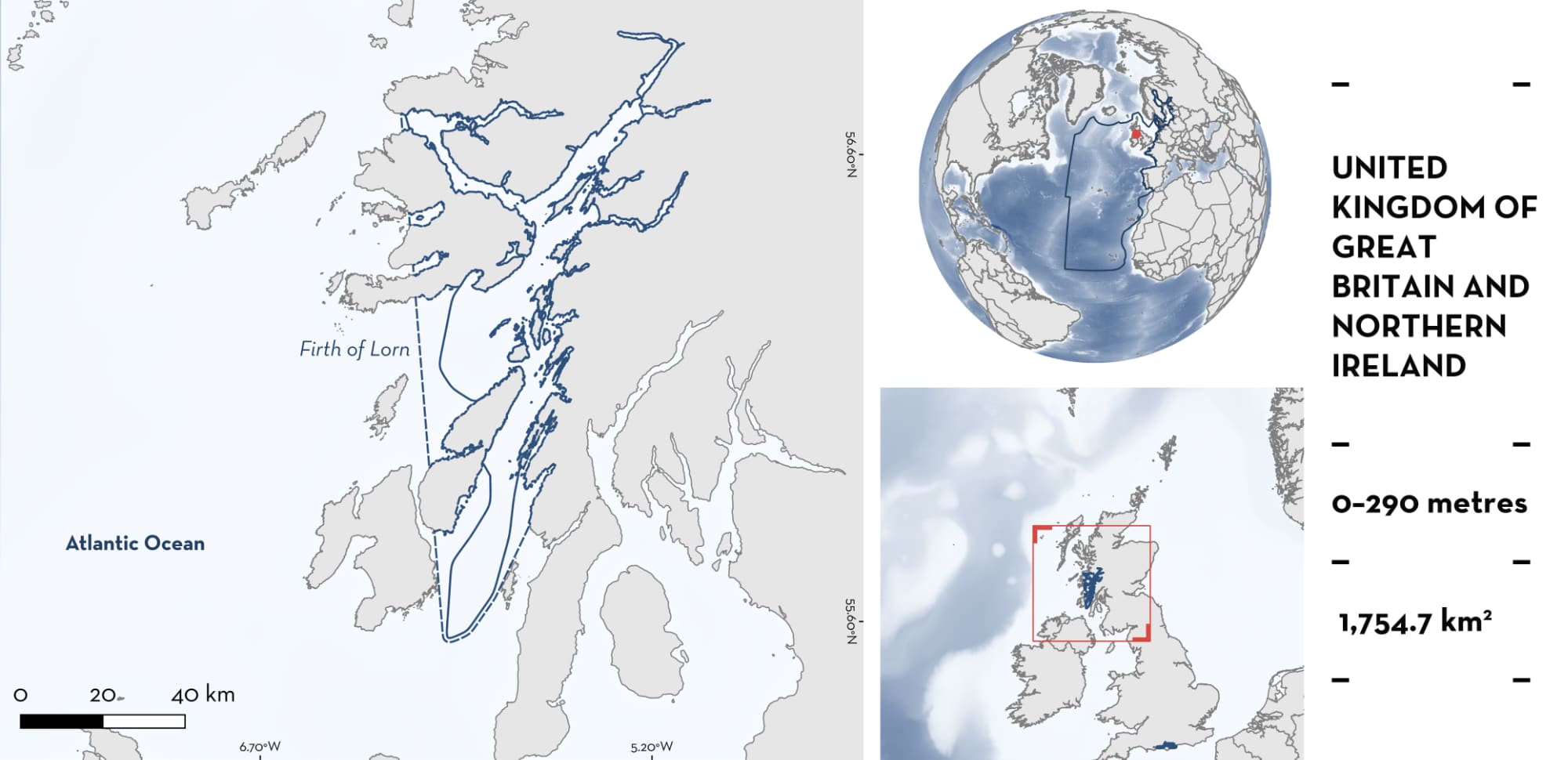
Firth of Lorn
Summary
Firth of Lorn is located on the west coast of Scotland, United Kingdom of Great Britain and Northern Ireland. The area overlaps with the Sound of Jura and encompasses various lochs including Loch Sunart, Loch Etive, and Loch Melfort. The habitat is characterised by sandy and muddy substrate within glacial fjords. It is influenced by the mix of saltwater from the sea and freshwater from rivers in various locations. Within this area there are: threatened species (e.g., Flapper Skate Dipturus intermedius); reproductive areas (Flapper Skate); and undefined aggregations (e.g., Spiny Dogfish Squalus acanthias).
Download factsheet
Firth of Lorn
DESCRIPTION OF HABITAT
Firth of Lorn is located on the west coast of Scotland, United Kingdom of Great Britain and Northern Ireland. The area encompasses various lochs including Loch Etive, Loch Sunart, and Loch Melfort and overlaps with the Sound of Jura. It supports a rich mosaic of marine habitats shaped by its glacial history, complex bathymetry, and varying hydrodynamic conditions. Deep fjordic basins contain muddy and sandy substrates (Taylor et al. 2025). Rocky reef and coarse substrate habitats are found throughout the area, including along the slopes and channel edges of lochs, including Loch Melfort, and offer shelter and suitable substrates for skate egg deposition (C Rickard pers. obs. 2025). Shallower areas support kelp forests and maerl beds. Areas of high flow near sills and narrows sustain diverse filter-feeding communities, including sponges, hydroids, and bryozoans.
The area is influenced in various locations by the mix of saltwater from the sea, and freshwater from various rivers across lochs. Within the lochs (e.g., Loch Sunart), there are narrow channels around small islands, resulting in very fast following currents (Scottish Government 2014).
This Important Shark and Ray Area is benthic and pelagic and is delineated from inshore and surface waters (0 m) to 290 m based on the bathymetry of the area and the depth range of Qualifying Species in the area.
CRITERION A
VULNERABILITY
Two Qualifying Species considered threatened with extinction according to the IUCN Red List of Threatened Species regularly occur in the area. These are the Vulnerable Spiny Dogfish (Finucci et al. 2020) and the Critically Endangered Flapper Skate (Ellis et al. 2024).
CRITERION C
SUB-CRITERION C1 – REPRODUCTIVE AREAS
Firth of Lorn is an important reproductive area for one ray species.
There are numerous locations within the area where Flapper Skate egg cases are regularly observed through recreational snorkelling, SCUBA diving, and remotely operated vehicle (ROV) surveys (D Ainsley pers. obs. 2025; C Rickard pers. obs. 2025; Skate Spotter unpubl. data 2025; Shark Trust unpubl. data. 2025). The identification of these egg cases is confirmed through species-specific guides (Shark Trust unpubl. data. 2025). For example, sightings of Flapper Skate egg cases in Loch Melfort within the area have been recorded since the 1980s (Shark & Skate Scotland unpubl. data 2025) with additional high resolution in-situ egg case contemporary data available.
Sightings of freshly laid egg cases around Campbell Rock in Loch Melfort are seasonal between October–May (C Rickard pers. obs. 2025). Between April 2021 and March 2025, recreational SCUBA divers reported at least 245 egg cases in the area (Shark & Skate Scotland unpubl. data 2025). Monthly dive surveys were also conducted from January 2022 to July 2024 within this area, in addition to some exploratory dives in the wider area. Egg cases were recorded in 2021 (n = 21 egg cases during one dive, and 5–6 egg cases from one ROV deployment), 2022 (n = 97 from 12 monthly survey dives), 2023 (n = 14 egg cases from 13 dives), 2024 (n = 57 egg cases from 10 dives), and 2025 (>50 egg cases from one dive). Egg cases were from a mixture of developmental stages, with some recently laid and some hatched (Shark & Skate Scotland unpubl. data 2025).
Additional observations of in-situ Flapper Skate egg cases within this area are submitted by citizen scientists to dedicated databases. For example, an additional 20 Flapper Skate egg cases have been recorded in this area by citizen scientists since 2016 (Shark Trust unpubl. data. 2016). Further, since 2011, at least 229 additional egg case observations have been recorded by citizen scientists through diving/snorkeling activities throughout the area and reported to a species-specific sightings database and photo-identification catalogue (Skate Spotter unpubl. data 2025). Female Flapper Skates carrying eggs have also been observed within this area (Thorburn et al. 2023). Immature individuals are also observed in this area (Neat et al. 2014; Pinto et al. 2016; Lavender et al. 2021; Scottish Shark Tagging Programme unpubl. data 2025; Skate Spotter unpubl. data 2025).
CRITERION C
SUB-CRITERION C5 – UNDEFINED AGGREGATIONS
Firth of Lorn is important for undefined aggregations of one shark and one ray species.
Spiny Dogfish (also known as Spurdog) exhibits exceptional residency within Loch Etive, on a spatial scale smaller than anywhere else globally. This area is globally important in this regard as it has the highest known residency of the species (Thorburn et al. 2015, 2025). The aggregation of Spiny Dogfish attracts recreational anglers targeting the species, and scientists who undertake dedicated research trips for the species (using hook-and-line). Between 2010–2020, 255 Spiny Dogfish were caught from various dedicated research surveys in this area. Spiny Dogfish were caught in 2010 (n = 7), 2011 (n = 27), 2014 (n = 114), 2016 (n = 51), and 2020 (n = 56) (Thorburn et al. 2015, 2025; Project SIORC unpubl. data. 2025; Scottish Shark Tagging Programme unpubl. data. 2025). Across the 43 research days in this period, aggregations (determined by three or more individuals being caught from hook-and-line in one trip, lasting a few hours) were reported on 18 days. Aggregations were reported in 2010 (n = 7 days), 2011 (n = 3), 2014 (n = 3), 2016 (n = 3), and 2020 (n = 2). Numbers of animals captured ranged between 3–57 individuals (mean = 16). Furthermore, acoustic data demonstrate year-round residency of Spiny Dogfish in this area, and aggregation behaviour is evidenced by a high number of detections of multiple individuals around different stations within the area, every day (Thorburn et al. 2025). Spiny Dogfish tagged with acoustic transmitters were male (n = 22), measuring 33–75 cm total length (TL), and female (n = 29), measuring 32.0–99.5 cm TL (Thorburn et al. 2025). Spiny Dogfish were detected on each receiver, spanning the entrance of the loch into the deep basin. This is one of the only known locations within the United Kingdom of Great Britain of Northern Ireland with regular and predictable observations of the species year-round. Further information is required to determine the nature and function of these aggregations.
Since monitoring began in 1978, 3,860 Flapper Skates have been recorded in this area. Of these, 2,833 (73.4%) have been recorded since 2010 (Scottish Shark Tagging Programme unpubl. data 2025; Skate Spotter unpubl. data 2025). Higher resolution aggregation data (as indicated by a high number of individuals caught using hook-and-line in a few hours) are available for 1978–2025. Between 1978–2009, aggregations of three or more individuals were recorded in 23 years (n = 223 instances across 828 days of effort). Of these, there were three instances of aggregations of ten or more individuals recorded across three years. Between 2010–2016, aggregations of three or more individuals were recorded in almost every year (n = 113 instances across 247 days of effort). Flapper Skate aggregations were recorded in 2010 (n = 43), 2011 (n = 24), 2012 (n = 10), 2013 (n = 7), 2014 (n = 13), and 2015 (n = 16). Of these, aggregations of ten or more individuals were recorded on four instances across two years. These aggregations are the most regular and predictable across the United Kingdom of Great Britain and Northern Ireland. Firth of Lorn is a critical habitat for Flapper Skate, year-round, given that acoustic detection data demonstrate year-round residency of Flapper Skate across multiple life stages (Neat et al. 2014; Pinto et al. 2016; Lavender et al. 2021). Flapper Skate are observed within the entire depth range of this area (Thorburn et al. 2021). Complementary genetic studies have revealed limited connectivity with other populations (Schwank et al. 2023). Further, there are a number of long-term recaptures, with 248 individuals caught on more than five separate occasions. The most notable case is a Flapper Skate recorded 33 times, demonstrating strong site fidelity or recurring presence in area (Skate Spotter unpubl. data 2025). Since 1978, 2,615 immature Flapper Skate, measuring <160 cm TL, have been recorded through hook-and-line captures (both by recreational anglers and scientists) (Neat et al. 2014; Lavender et al. 2021; Scottish Shark Tagging Programme unpubl. data 2025; Skate Spotter unpubl. data 2025). Of these, most (n = 1,801, 67.3%) have been recorded since 2010. Since 1978, aggregations of five or more immature Flapper Skate have been recorded on 294 days, with most (n = 275) recorded since 2010. Further information is needed to understand the nature and function of these aggregations.
Download factsheet
SUBMIT A REQUEST
ISRA SPATIAL LAYER REQUEST
To make a request to download the ISRA Layer in either a GIS compatible Shapefile (.shp) or Google Earth compatible Keyhole Markup Language Zipped file (.kmz) please complete the following form. We will review your request and send the download details to you. We will endeavor to send you the requested files as soon as we can. However, please note that this is not an automated process, and before requests are responded to, they undergo internal review and authorization. As such, requests normally take 5–10 working days to process.
Should you have questions about the data or process, please do not hesitate to contact us.

