ISRA FACTSHEETS
ISRA FACTSHEETS
EUROPEAN ATLANTIC
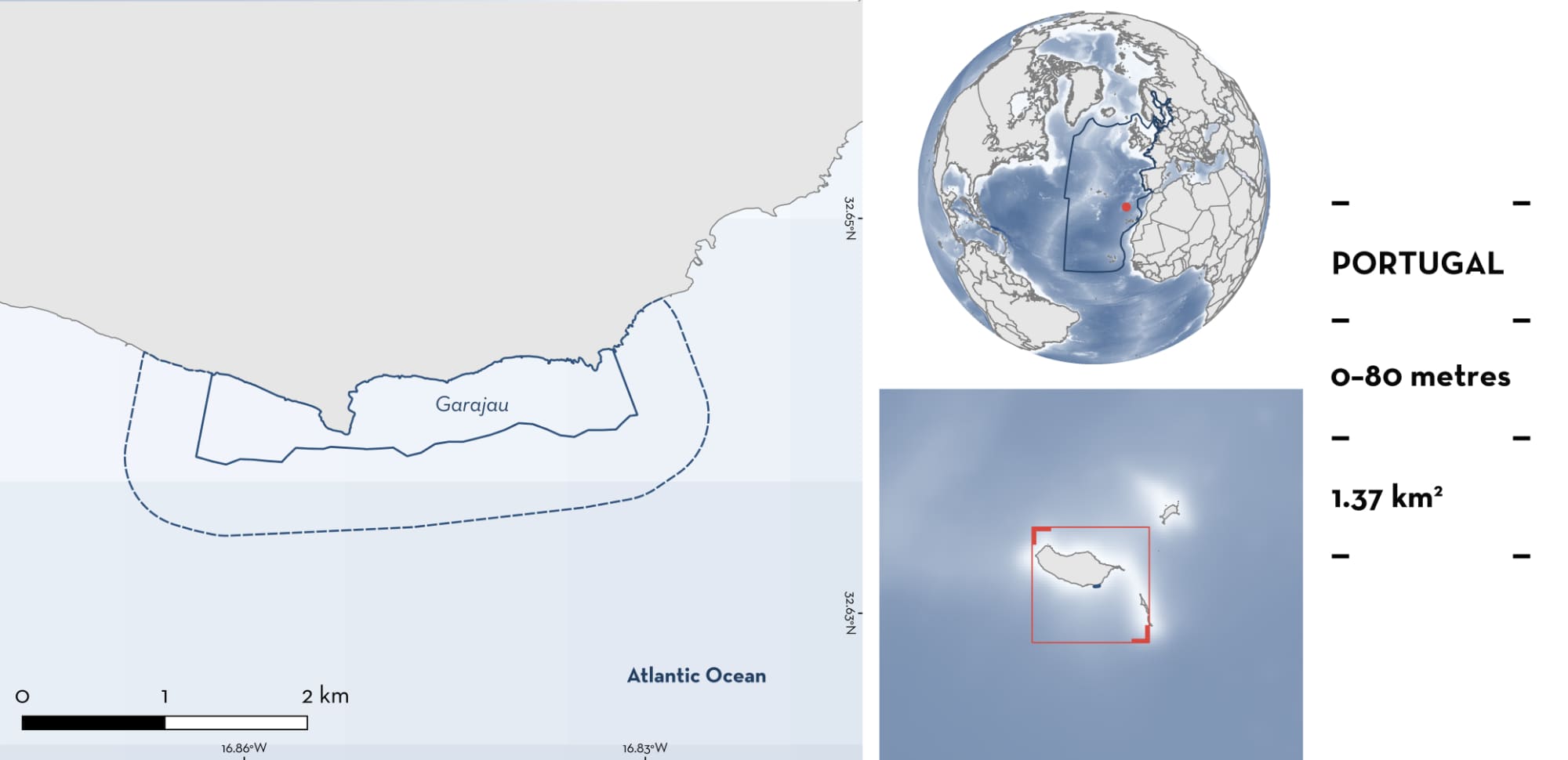
Garajau
Summary
Garajau is located on the southern coast of Madeira Island, Portugal. The habitat is characterised by rocky and sandy substrate. The transition zone from rocky to sandy substrates is quite distinct and features a steep slope, with some abrupt walls. The area overlaps with the Garajau Nature Reserve (Reserva Natural Parcial do Garajau). Within this area there are: threatened species and reproductive areas (Common Stingray Dasyatis pastinaca).
Download factsheet
Garajau
DESCRIPTION OF HABITAT
Garajau is located on the southern coast of Madeira Island, Portugal. It is situated between the beaches of Lazareto and Ponta da Oliveira. The habitat is characterised by gently sloping rocky substrate with sandy patches, down to a depth of 22 m (Muñoz-Duque et al. 2024). Beyond this depth, the substrate is mostly fine sand or crushed shell. The transition zone from rocky to sandy substrates is quite distinct and features a steep slope, with some abrupt walls (Serviço do Parque Natural da Madeira 2010).
The area is influenced by the cold Canary Island Current. Sea water temperatures can reach 24°C in the boreal summer and drop to around 17°C in winter (Serviço do Parque Natural da Madeira 2010).
The area overlaps with the Garajau Nature Reserve (Reserva Natural Parcial do Garajau) (UNEP-WCMC & IUCN 2025).
This Important Shark and Ray Area is benthic and pelagic and is delineated from inshore and surface waters (0 m) to 80 m based on the depth range of habitat in the area.
CRITERION A
VULNERABILITY
One Qualifying Species considered threatened with extinction according to the IUCN Red List of Threatened Species regularly occurs in the area. This is the Vulnerable Common Stingray (Jabado et al. 2021).
CRITERION C
SUB-CRITERION C1 – REPRODUCTIVE AREAS
Garajau is an important reproductive area for one ray species.
Based on observations from the diving community between 2021–2024, and records from social media, Common Stingrays are observed year-round within this area. However, the use of this area for reproductive purposes occurs between May–June (AJ McIvor unpubl. data 2021–2024). Recreational divers visit Garajau daily, almost year-round, but most commonly in the summer months (AJ McIvor unpubl. data 2021–2024). Aggregations of 3–15 Common Stingrays are observed between late spring through early summer (May–June) when pregnant females (determined from visual observation of extended abdomens) are observed resting together or within aggregations related to mating attempts (almost always a single female, with 5–7 males) (AJ McIvor unpubl. data 2021–2024). Two aggregations, formed by a pregnant female and ~10 mature males attempting to bite her pectoral fin, were recorded and shared on social medial in 2022 and 2024 along with additional records of females with mating scars. This is the only known area with regular observations of Common Stingray reproductive activities across the Madeira Archipelago.
Download factsheet
SUBMIT A REQUEST
ISRA SPATIAL LAYER REQUEST
To make a request to download the ISRA Layer in either a GIS compatible Shapefile (.shp) or Google Earth compatible Keyhole Markup Language Zipped file (.kmz) please complete the following form. We will review your request and send the download details to you. We will endeavor to send you the requested files as soon as we can. However, please note that this is not an automated process, and before requests are responded to, they undergo internal review and authorization. As such, requests normally take 5–10 working days to process.
Should you have questions about the data or process, please do not hesitate to contact us.