ISRA FACTSHEETS
ISRA FACTSHEETS
AUSTRALIA AND SOUTHEAST INDIAN OCEAN
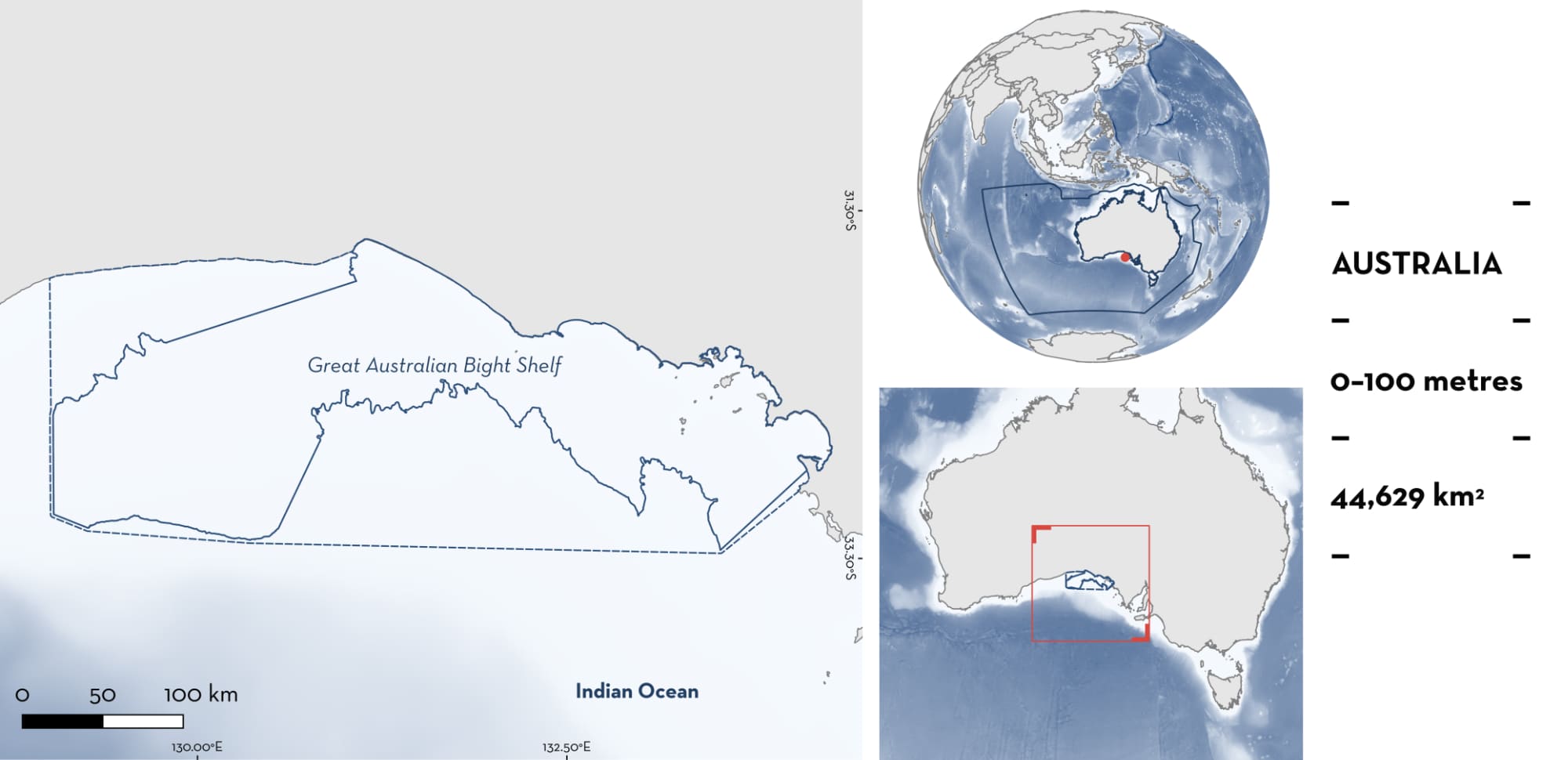
Great Australian Bight Shelf
Summary
Great Australian Bight Shelf is located in South Australia, Australia. The area is a large oceanic bight with multiple bays and islands and is characterised by a wide continental shelf with sandy, muddy, and gravel substrates. This area overlaps with two protected areas. Within this area there are: threatened species and reproductive areas (Tope Galeorhinus galeus).
Download factsheet
Great Australian Bight Shelf
DESCRIPTION OF HABITAT
Great Australian Bight Shelf is located in South Australia, Australia. It extends from the South Australia/Western Australia border in the west to Streaky Bay in the east. The area is a large oceanic bight with multiple bays and islands with minimum freshwater input as no rivers flow into the area. It is characterised by a wide continental shelf with sandy, muddy, and gravel substrates (Edyvane 2000).
Oceanographically, inshore areas are dominated by a southwest swell produced by westerly low-pressure cyclones coming from the south of the Australian mainland. The broader area is dominated by an anti-cyclonic gyre that produces strong upwelling in the east side that, along with the influence of the Leeuwin Current, brings warm, nutrient poor, and low salinity waters between April–May, contributing to a high marine biodiversity and productivity of the region (Edyvane 2000).
The area overlaps with the Murat Marine Park and the Great Australian Bight Marine Park (Parks Australia 2025).
This Important Shark and Ray Area is benthic and pelagic and is delineated from inshore and surface waters (0 m) to 100 m based on the bathymetry of the area.
CRITERION A
VULNERABILITY
One Qualifying Species considered threatened with extinction according to the IUCN Red List of Threatened Species regularly occurs in the area. This is the Critically Endangered Tope (Walker et al. 2020).
CRITERION C
SUB-CRITERION C1 – REPRODUCTIVE AREAS
Great Australian Bight Shelf is an important reproductive area for one shark species.
Fishing surveys, catch data, and tagging experiments have revealed the regular presence of pregnant Tope in the area since the 1940s (Olsen 1954, 1959; West & Stevens 2001; Walker 2005; Walker et al. 2008; Braccini et al. 2009; Rogers et al. 2017; McMillan et al. 2019). It has been hypothesised that pregnant females aggregate on the continental shelf, and that they remain there during the gestation period before moving to Bass Strait and Tasmania to give birth (Olsen 1954, 1959; Walker 2005). Between 1941–1956, large catches of pregnant females in the Great Australian Bight reportedly produced declines in the population. After those studies, the presence of pregnant females in the Great Australian Bight was reported from catch data and tagging experiments between the 1970s and 1990s (Walker et al. 1997; Walker 1999; Braccini et al. 2009).
Between 2007–2008, fishing surveys and monitoring of commercial fisheries conducted across southern Australia confirmed the presence of pregnant females in this area (Braccini et al. 2009). In October–November 2007, an aggregation of 291 females was caught in the area in a single set. Of these, 13% (n = 38) were pregnant with uterine eggs and 1% (n = 3) had near-term embryos. During this study, 583 individuals were recorded in the area, the largest number of individuals caught in southern Australia along with Bass Strait (n = 481). Catch rates for Tope >140 cm total length (TL) increased since the 1980s in the area compared to other sites. In Australia, size-at-maternity is reported at 142 cm TL (Walker 2005) indicating that mostly breeding females were caught in the area. Catch rate was higher for larger individuals in this area (mostly females; 2,957 individuals/1,000 km lift hours) compared to offshore areas of the Great Australian Bight and the rest of South Australian waters (27 individuals/1,000 km lift hours; Braccini et al. 2009). Given that parturition occurs every three years (Walker 2005), the low number of pregnant females with near-term embryos at this time is consistent with about a third of the pregnant females having departed for the nursery areas in Victoria, Bass Strait, and Tasmania by the end of November.
More recent tagging experiments showed the contemporary presence of pregnant females in the area (Rogers et al. 2017; McMillan et al. 2019). In January 2012, 32 Tope were tagged with satellite tags in the area (Rogers et al. 2017). Of these, ten were females measuring 147–170 cm TL caught at depths of 40–49 m. Another two females were dead when landed and dissection showed that they were pregnant (Knuckey et al. 2014). Sizes of pregnant females were similar to those of tagged individuals, suggesting that those were potentially pregnant. In addition, one neonate Tope with an open umbilical scar was caught. Five of the ten tagged females stayed in mid-shelf waters (50–100 m) inside the area while another four moved outside the area to the outer shelf in the Great Australian Bight (100–150 m depths). The largest tracking duration was 44 days and some of the sharks moved to eastern locations which coincides with the hypothesis that pregnant Tope move to parturition sites in Bass Strait and Tasmania (Rogers et al. 2017). In December 2015 and 2017, eight pregnant females were tagged with satellite transmitters in the area. Pregnancy was determined visually based on the triangular shape of late-term pregnant females and in-utero movements of embryos that could be felt externally. In addition, in 2017 pregnancy was validated with ultrasound. All pregnant females stayed in the area up to one year after tagging (McMillan et al. 2018) which coincides with the 12-month gestation reported for the species (Walker 2005). Both studies suggest that some pregnant female may pup in the area while most of them move to the known pupping areas in the states of Victoria and Tasmania (McMillan et al. 2018, 2019).
Download factsheet
SUBMIT A REQUEST
ISRA SPATIAL LAYER REQUEST
To make a request to download the ISRA Layer in either a GIS compatible Shapefile (.shp) or Google Earth compatible Keyhole Markup Language Zipped file (.kmz) please complete the following form. We will review your request and send the download details to you. We will endeavor to send you the requested files as soon as we can. However, please note that this is not an automated process, and before requests are responded to, they undergo internal review and authorization. As such, requests normally take 5–10 working days to process.
Should you have questions about the data or process, please do not hesitate to contact us.