
ISRA FACTSHEETS
ISRA FACTSHEETS
AUSTRALIA AND SOUTHEAST INDIAN OCEAN
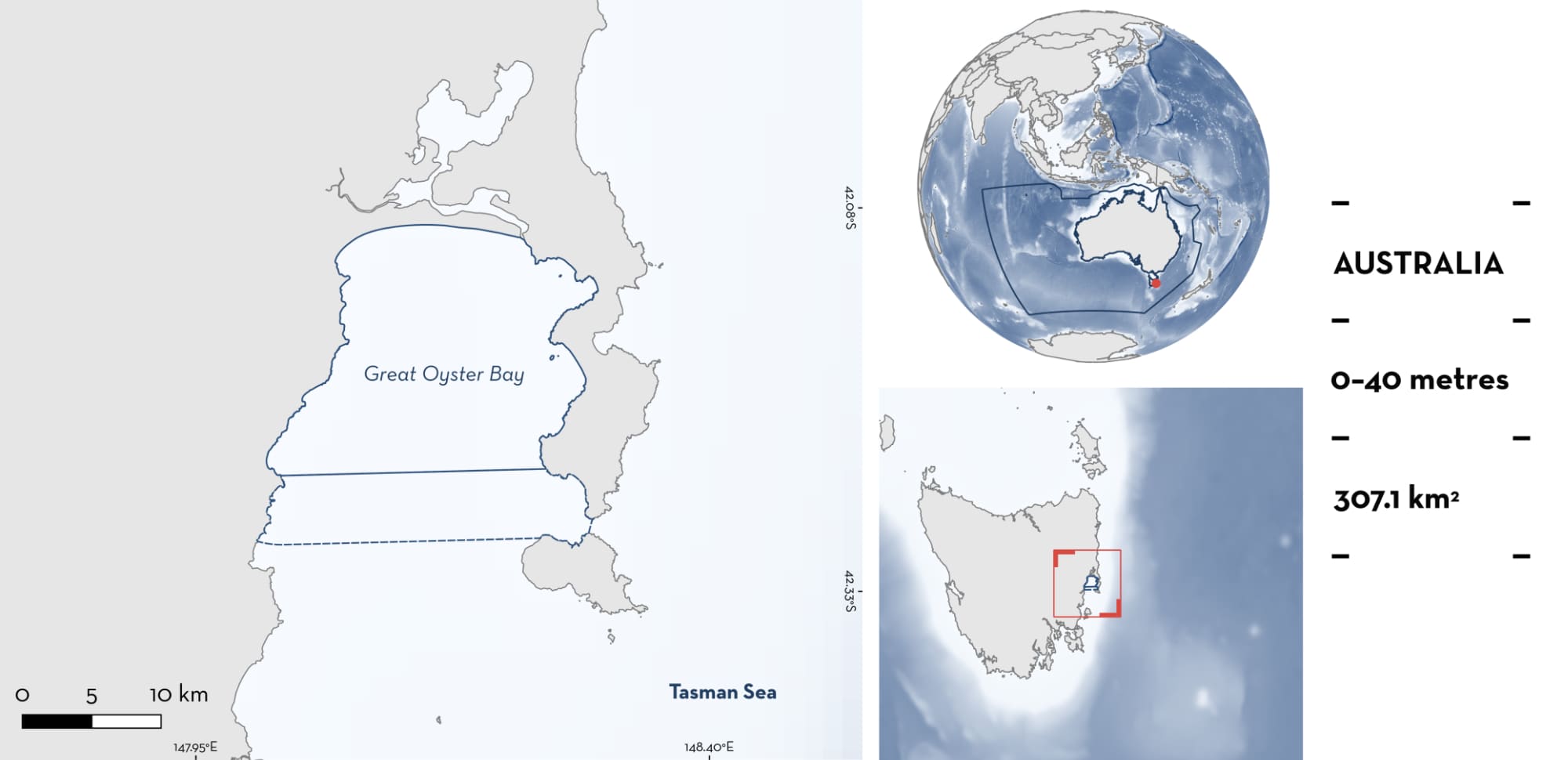
Great Oyster Bay
Summary
Great Oyster Bay is located on the east coast of Tasmania, Australia. It is a semi-enclosed bay with minimal freshwater input from Moulting Lagoon and is characterised by intertidal flats with seagrass beds, kelp beds, and sandy substrates. This area overlaps with Freycinet National Park and Mayfield Bay Conservation Area and with the Great Oyster Bay Shark Refuge Area. Within this area there are: threatened species and reproductive areas (Tope Galeorhinus galeus).
Download factsheet
Great Oyster Bay
DESCRIPTION OF HABITAT
Great Oyster Bay is located on the east coast of Tasmania, Australia. It is a semi-enclosed bay open to the Tasman Sea in the south and bounded to the east by the Freycinet Peninsula. In the north, the area is adjacent to Moulting Lagoon, an estuary that receives freshwater input from the Aspley and Swan rivers. The area is characterised by intertidal flats with seagrasses beds, kelp beds, and sandy substrates (DPIPWE 2010; Ewing et al. 2018). Circulation in the area is wind driven and sea surface temperature ranges between 9–22°C in August and January, respectively (DPIPWE 2010).
This area overlaps with Freycinet National Park and Mayfield Bay Conservation Area (TPWS 2025)., and the Great Oyster Bay Shark Refuge Area (Tasmanian Government 2025).
This Important Shark and Ray Area is benthic and pelagic and is delineated from inshore and surface waters (0 m) to 40 m based on the bathymetry of the area.
CRITERION A
VULNERABILITY
One Qualifying Species considered threatened with extinction according to the IUCN Red List of Threatened Species regularly occurs in the area. This is the Critically Endangered Tope (Walker et al. 2020).
CRITERION C
SUB-CRITERION C1 – REPRODUCTIVE AREAS
Great Oyster Bay is an important reproductive area for one shark species.
Fishing surveys and catch data have revealed the regular presence of neonate and young-of-the-year (YOY) Tope in the area since the 1940s (Olsen 1954, 1959; Stevens & West 1997; Walker et al. 2008). In southern Australia, this area was recognised as one of six major nursery areas for the species across Victoria and Tasmania (Olsen 1954; Stevens & West 1997; Walker 2005; Walker et al. 2008, 2020).
Between 1947–1953, 11 areas across Victoria and Tasmania were surveyed with handlines and gillnets to look for potential nursery areas for Tope (Olsen 1954). In Great Oyster Bay, four Tope measuring 37–40 cm total length (TL) were caught by handline. These individuals were classified as neonate/YOY. Reported size-at-birth for the species is 30–40 cm TL (Ebert et al. 2021) and YOY size in this region was set at 55 cm TL (Olsen 1954; Moulton et al. 1992). Subsequently, between 1992–1996, 25 areas were also surveyed in Tasmania to explore nursery areas for this species (Stevens & West 1997). In Great Oyster Bay, 52 sets (75 m long gillnet) were deployed in the area and 119 Tope were captured. Of these, 23 (19.3%) were classified as YOY based on their size and 53 (44.5%) were classified as one year old sharks (up to 80 cm TL; Stevens & West 1997). Great Oyster Bay had the second largest number of individuals and catch-per-unit-effort of neonate/YOY in Tasmania after the Pittwater/Storm Bay Estuary. Neonate/YOY Tope were recorded mostly in the austral summer, between January–March (Stevens & West 1997).
Population declines of Tope have been recorded since the 1950s across Australia (Walker 1999; Braccini et al. 2009). Great Oyster Bay has been proclaimed a Shark Refuge Area in Tasmania since the 1960s which means that any catch of shark or ray species is forbidden. Lack of reports and surveys focused on monitoring neonate/YOY Tope are related to this prohibition. However, records from recreational fishing forums and citizen science between 2019–2023 have revealed that these life stages are still incidentally caught in the area (Fishbrain 2025; iNaturalist 2025). These records confirm the contemporary importance of this area for reproductive purposes of this species. Despite the records of neonates and YOY, no pregnant females were recorded across all studies conducted in the area.
Download factsheet
SUBMIT A REQUEST
ISRA SPATIAL LAYER REQUEST
To make a request to download the ISRA Layer in either a GIS compatible Shapefile (.shp) or Google Earth compatible Keyhole Markup Language Zipped file (.kmz) please complete the following form. We will review your request and send the download details to you. We will endeavor to send you the requested files as soon as we can. However, please note that this is not an automated process, and before requests are responded to, they undergo internal review and authorization. As such, requests normally take 5–10 working days to process.
Should you have questions about the data or process, please do not hesitate to contact us.

