ISRA FACTSHEETS
ISRA FACTSHEETS
EUROPEAN ATLANTIC
Gruta do Ilhéu das Cabras
Summary
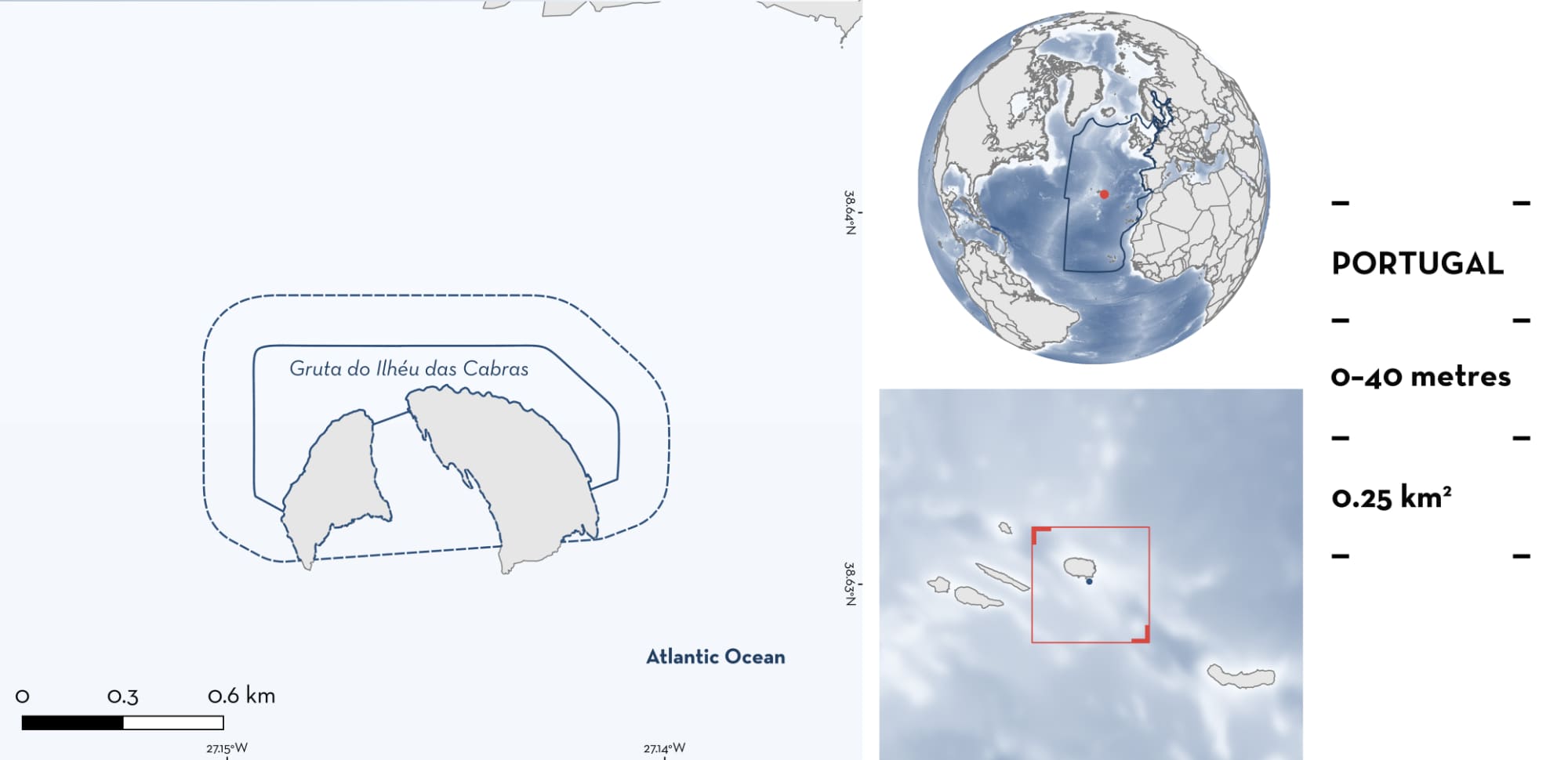
Gruta do Ilhéu das Cabras is located within the municipality of Angra do Heroísmo on Terceira Island, Azores, Portugal. This coastal cave, formed by an ancient submarine volcano, is characterised by semi-submerged cavities, a mixture of boulder and cobble deposits, sandy substrate, and rocky reefs. Within this area there are: threatened species and undefined aggregations (Common Eagle Ray Myliobatis aquila).
Download factsheet
Gruta do Ilhéu das Cabras
DESCRIPTION OF HABITAT
Gruta do Ilhéu das Cabras is located within the municipality of Angra do Heroísmo on Terceira Island, Azores, Portugal. It is situated on the northern face of the western islet (Ilhéu das Cabras). This coastal cave, formed by an ancient submarine volcano, is characterised by semi-submerged cavities, a mixture of boulder and cobble deposits, sandy substrate, and rocky reefs (Barcelos 2024). At low tide, the above-surface entrance reaches ~4 m in height and slightly less in width. The area is generally sheltered from the prevalent southerly winds and waves (Barcelos 2024).
This Important Shark and Ray Area is benthic and pelagic and is delineated from surface waters (0 m) to 40 m based on the bathymetry of the area.
CRITERION A
VULNERABILITY
One Qualifying Species considered threatened with extinction according to the IUCN Red List of Threatened Species regularly occurs in the area. This is the Critically Endangered Common Eagle Ray (Jabado et al. 2021).
CRITERION C
SUB-CRITERION C5 – UNDEFINED AGGREGATIONS
Gruta do Ilhéu das Cabras is an important area for undefined aggregations of one ray species.
During 2002–2003, year-round underwater visual censuses were conducted to count Common Eagle Rays within aggregations in this area. Surveys were undertaken opportunistically four times a month (total surveys = 221). Between June–September, aggregations of an average of eight individuals were observed in 123 surveys (55.7% of surveys), while between October–May, the average was one individual observed in 98 surveys (44.3% of surveys) (Barreiros & Rodeia 2004). Individuals were mostly swimming inside and along the entrance of the cave in the area during the day while during the night (n = 12 surveys) they were mostly resting on the substrate (Barreiros & Rodeia 2004). Of 23 individuals marked with tags designed to visually allow identification (ranging in size, 63–157 cm disc width), 12 individuals were recorded within the area every year from 2003–2006 (Barreiros & Rodeia 2004; JP Barreiros unpubl. data 2003–2006). Although no further dedicated surveys were undertaken, aggregations of 10–30 Common Eagle Rays have been regularly recorded within the area by recreational divers in ~75% of dives between July and September during 2006–2025 (JP Barreiros unpubl. data 2006–2025). Although no mating behaviour was observed, captured individuals showed mature gonads during the summer months and the sex ratio was 1:4.3 (male:female) in 2002 and 1:4.5 in 2003 suggesting a potential reproductive purpose of the area. Further information is required to understand the nature and function of these aggregations.
Download factsheet
SUBMIT A REQUEST
ISRA SPATIAL LAYER REQUEST
To make a request to download the ISRA Layer in either a GIS compatible Shapefile (.shp) or Google Earth compatible Keyhole Markup Language Zipped file (.kmz) please complete the following form. We will review your request and send the download details to you. We will endeavor to send you the requested files as soon as we can. However, please note that this is not an automated process, and before requests are responded to, they undergo internal review and authorization. As such, requests normally take 5–10 working days to process.
Should you have questions about the data or process, please do not hesitate to contact us.