ISRA FACTSHEETS
ISRA FACTSHEETS
EUROPEAN ATLANTIC
Gulf of Cádiz Slope
Summary
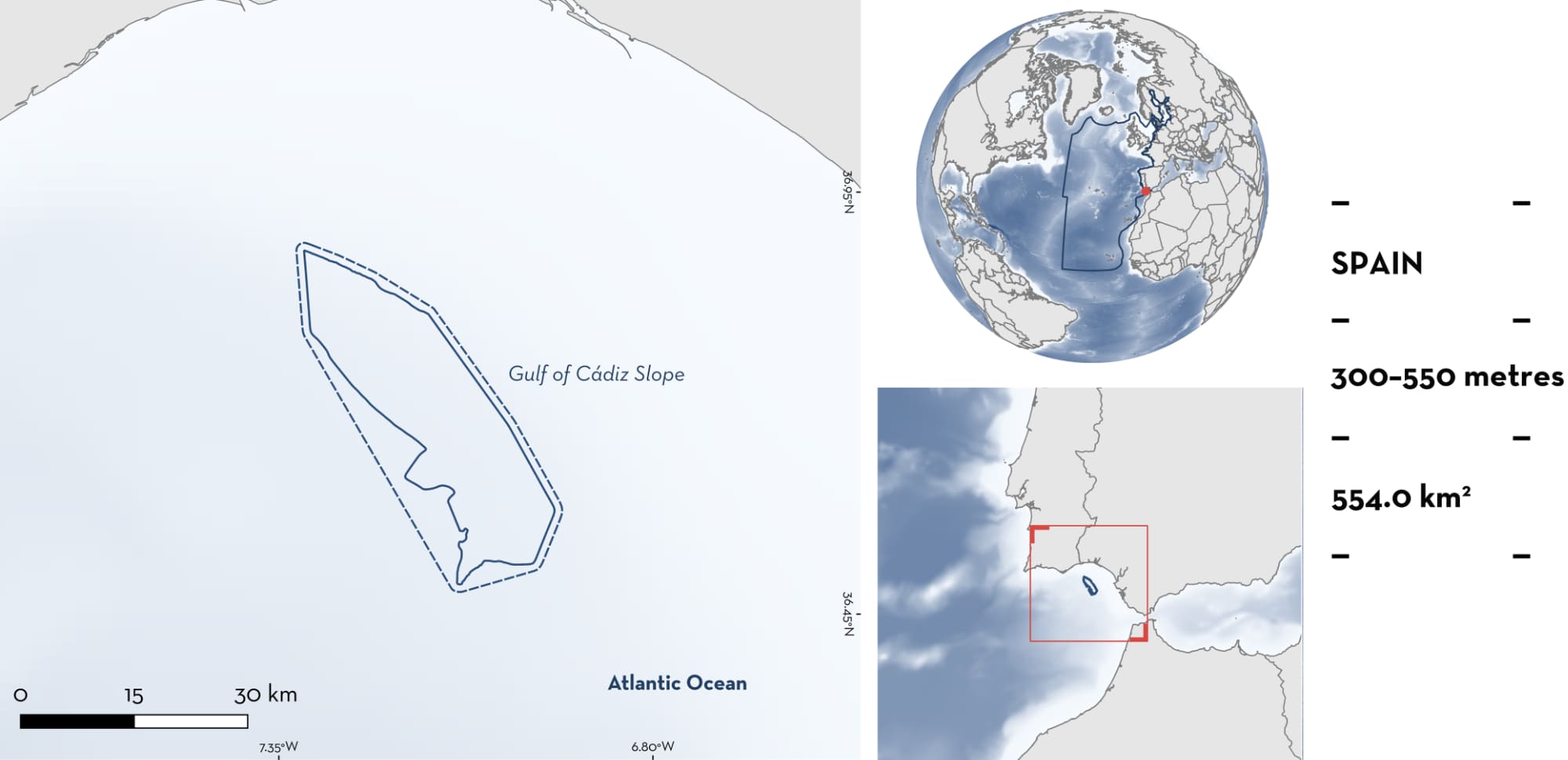
Gulf of Cádiz Slope is located in the northeast Atlantic Ocean, offshore of Cádiz Province in Spain. The area encompasses part of the upper continental slope of the Iberian margin. It is characterised by a soft slope with fine sandy, silty, and muddy substrates. The area is influenced by the Mediterranean Outflow Water, creating a strong bottom current flowing towards the west and northwest above the North Atlantic Deep Water. The area overlaps with the Gulf of Cádiz Ecologically or Biologically Significant Marine Area. Within this area there are: range-restricted species (Atlantic Sawtail Catshark Galeus atlanticus) and reproductive areas (e.g., Blackmouth Catshark Galeus melastomus).
Download factsheet
Gulf of Cádiz Slope
DESCRIPTION OF HABITAT
Gulf of Cádiz Slope is located in the northeast Atlantic Ocean, offshore of Cádiz Province, Spain. The area encompasses part of the upper continental slope of the Iberian margin. It is characterised by a soft slope with fine sands changing to silty and muddy contourite substrates in channels and submarine canyons (Delgado et al. 2013).
The area is influenced by the Mediterranean Outflow Water, which is relatively warm (12.5–14°C) and highly saline (36.2‰) creating a strong bottom current flowing towards the west and northwest above the North Atlantic Deep Water (Nelson et al. 1999; Delgado et al. 2013).
The area overlaps with the Gulf of Cádiz Ecologically or Biologically Significant Marine Area (EBSA; CBD 2025).
This Important Shark and Ray Area is benthic and subsurface and is delineated from 300–550 m based on the bathymetry of the area.
CRITERION B
RANGE RESTRICTED
This area holds the regular presence of the Atlantic Sawtail Catshark as a range-restricted species. Catch data were collected annually between 2000–2024 (except 2021) through surveys conducted from November–March, excluding January (García-Ruiz et al. 2015; ICES 2025). This species was regularly encountered during benthic trawl surveys in the Gulf of Cádiz, using a Baka trawler with a horizontal opening ~21 m and a vertical opening of 1.8 m during daytime 1-h hauls with a towing speed of three knots (García-Ruiz et al. 2015; ICES 2025). This area hosts the highest density of neonates and young-of-the-year Atlantic Sawtail Catshark captures in the Gulf of Cádiz (ICES 2025). Individuals were caught between 359–502 m depth. This species occurs primarily in the Iberian Coast Large Marine Ecosystem (LME) and marginally in the Canary Current and Mediterranean Sea LMEs.
CRITERION C
SUB-CRITERION C1 – REPRODUCTIVE AREAS
Gulf of Cádiz Slope is an important reproductive area for two shark species.
Neonate and young-of-the-year (YOY) Atlantic Sawtail Catshark and Blackmouth Catshark are regularly captured in this area. Between 2000–2024 (excluding 2021), benthic trawl surveys in the Gulf of Cádiz were conducted during daytime (García-Ruiz et al. 2015; ICES 2025). Surveys were conducted annually from November–March, excluding January (García-Ruiz et al. 2015; ICES 2025). Catch data were collected on the number of individuals, size (total length; TL), and sex.
Between 2000–2024, a total of 841 Atlantic Sawtail Catsharks were caught in the area (ICES 2025). Of these, 36% (n = 305) were neonates/YOY measuring 13–25 cm TL (ICES 2025). Size-at-birth for the species is ~15 cm TL, while size-at-maturity for the species ranges from 33–45 cm TL (Ebert et al. 2021), and although size-at-one year is not known for this species, the related Blackmouth Catshark is up to ~23 cm TL for YOY (Baptista et al. 2010), suggesting these were neonates and YOY. Individuals in this size range were observed in 18 of the 23 years surveyed, and during contemporary years, numbers were: 2011 (n = 24), 2012 (n = 1), 2013 (n = 14), 2015 (n = 31), 2016 (n = 21), 2017 (n = 20), 2018 (n = 1), 2019 (n = 27), 2020 (n = 52), 2022 (n = 15), 2023 (n = 26), and 2024 (n = 24) (ICES 2025). The surveys in this area were not year-round, so additional temporal data are required to confirm seasonality in reproductive behaviour (ICES 2025). Individuals were caught between 359–502 m depth. Although there are records of neonate/YOY Atlantic Sawtail Catshark in the rest of the Gulf of Cádiz, this area has the highest known catch records of the species at this life history stage in the south Atlantic region of Spain.
Between 2000–2024, a total of 3,142 Blackmouth Catsharks were caught in the area (ICES 2025). Of these, 58% (n = 1,821) were neonates/YOY measuring 10–25 cm TL (ICES 2025). Size-at-maturity for the species ranges from 33–45 cm TL (Ebert et al. 2021), and size-at-birth is estimated at 8.5 cm TL, attaining up to ~23 cm TL for YOY (Baptista et al. 2010), suggesting these were neonates and YOY. Individuals in this size range were observed during all surveyed years, and during contemporary years, numbers were: 2010 (n = 33), 2011 (n = 112), 2012 (n = 25), 2013 (n = 74), 2014 (n = 89), 2015 (n = 92), 2016 (n = 138), 2017 (n = 125), 2018 (n = 71), 2019 (n = 94), 2020 (n = 143), 2022 (n = 107), 2023 (n = 106), and 2024 (n = 140) (ICES 2025). The surveys in this area were not year-round so additional temporal data are required to confirm seasonality in reproductive behaviour (ICES 2025). Individuals were caught between 311–502 m depth. Although there are records of neonate/YOY Blackmouth Catshark in the rest of the Gulf of Cádiz, this area has the highest known catch records of the species at this life history stage in the south Atlantic region of Spain.
Download factsheet
SUBMIT A REQUEST
ISRA SPATIAL LAYER REQUEST
To make a request to download the ISRA Layer in either a GIS compatible Shapefile (.shp) or Google Earth compatible Keyhole Markup Language Zipped file (.kmz) please complete the following form. We will review your request and send the download details to you. We will endeavor to send you the requested files as soon as we can. However, please note that this is not an automated process, and before requests are responded to, they undergo internal review and authorization. As such, requests normally take 5–10 working days to process.
Should you have questions about the data or process, please do not hesitate to contact us.