
ISRA FACTSHEETS
ISRA FACTSHEETS
AUSTRALIA AND SOUTHEAST INDIAN OCEAN
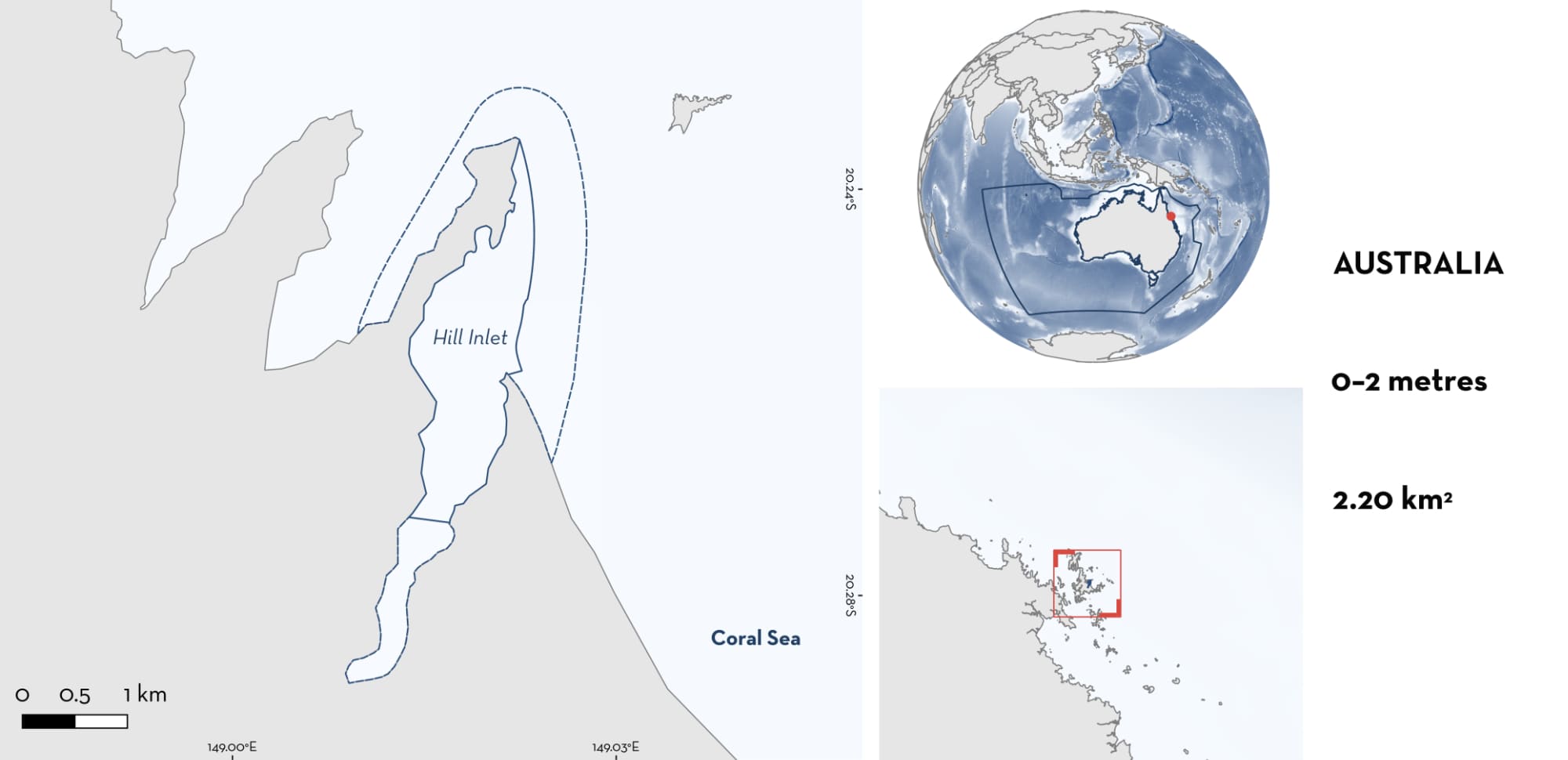
Hill Inlet
Summary
Hill Inlet is located in Queensland, Australia. The area is situated on the eastern side of Whitsunday Island, just north of Whitehaven Beach. The habitat is characterised by shallow shifting sandy substates, heavily influenced by semi-diurnal tidal fluctuations. The waters are fringed by mangroves and rocky headlands. This area overlaps with the Great Barrier Reef Marine Park. Within this area there are: threatened species and undefined aggregations (Broad Cowtail Stingray Pastinachus ater).
Download factsheet
Hill Inlet
DESCRIPTION OF HABITAT
Hill Inlet is located in Queensland, Australia. The area is situated on the eastern side of Whitsunday Island, just north of Whitehaven Beach (Tourism and Events Queensland 2025). The habitat is characterised by shallow shifting sandy substates, heavily influenced by semi-diurnal tidal fluctuations. The waters are fringed by mangroves, primarily Grey Mangrove Avicennia marina, and rocky headlands.
The broader region is influenced by the East Australian Current, the poleward flowing western boundary current of the South Pacific Gyre (Suthers et al. 2011). The East Australian Current flow is strongest in the austral summer, and the formation of eddies along this coastline fluctuate seasonally (Ridgway & Hill 2009).
The area overlaps with the Great Barrier Reef Marine Park – Conservation Park Zone (UNEP-WCMC & IUCN 2025).
This Important Shark and Ray Area is benthic and is delineated from inshore and surface waters (0 m) to 2 m based on the bathymetry of the area.
CRITERION A
VULNERABILITY
One Qualifying Species considered threatened with extinction according to the IUCN Red List of Threatened Species regularly occurs in the area. This is the Vulnerable Broad Cowtail Stingray (Sherman et al. 2021).
CRITERION C
SUB-CRITERION C5 – UNDEFINED AGGREGATIONS
Hill Inlet is an important area for undefined aggregations of one ray species.
Between 1970-2025, there were 38 opportunistic records of Broad Cowtail Stingrays submitted from within the area to the citizen science database iNaturalist (iNaturalist 2025). Most of these records were from 2022 to 2025 (n = 32; 84.2%). Broad Cowtail Stingrays are observed sporadically in the broader region around Whitsunday Island (n = 47 records), however, Hill Inlet appears to be the hotspot for the species in this region with 80.9% of sightings from this area (iNaturalist 2025).
Broad Cowtail Stingrays are thought to feed in the area, with sailing charters planning their visit to Hill Inlet on the rising tide when they observe rays coming into the shallows to presumably feed on the Light-blue Soldier Crab Mictyris longicarpus and other infauna (Wings Sailing Charters 2025). Broad Cowtail Stingrays can often be seen foraging in aggregations in the shallow waters of this area and are visible from the Hill Inlet lookout as dark shapes moving slowly through the clear water (Sailing Whitsundays 2025), presumed to be foraging behaviour. Broad Cowtail Stingrays are observed daily in the shallows of Hill Inlet onboard tours around the Whitsunday Islands (Ocean Rafting 2025). It is proposed that the abundant prey in the mangroves of the area, coupled with the warm shallow waters, provide ideal foraging habitat for this species. In addition to the observations of foraging behaviour in this area, high numbers of stingray feeding pits are also observed on the low tide from the Hill Inlet lookout (J Funnell pers. obs. 2025). Given that Broad Cowtail Stingrays are the abundant ray in Hill Inlet, these pits are presumed to be from this species.
Most of the tour operators from the Whitsunday Islands region mention stingrays at Hill Inlet as one of the highlights of their tours (e.g., Ocean Rafting). All available images online confirm Broad Cowtail Stingrays as the species observed, with aggregations of two to 20+ individuals observed in a single image, supporting the regular and predictable nature of their aggregations in the area. Further information is needed to confirm the nature and function of these aggregations.
Download factsheet
SUBMIT A REQUEST
ISRA SPATIAL LAYER REQUEST
To make a request to download the ISRA Layer in either a GIS compatible Shapefile (.shp) or Google Earth compatible Keyhole Markup Language Zipped file (.kmz) please complete the following form. We will review your request and send the download details to you. We will endeavor to send you the requested files as soon as we can. However, please note that this is not an automated process, and before requests are responded to, they undergo internal review and authorization. As such, requests normally take 5–10 working days to process.
Should you have questions about the data or process, please do not hesitate to contact us.

