
ISRA FACTSHEETS
ISRA FACTSHEETS
AUSTRALIA AND SOUTHEAST INDIAN OCEAN
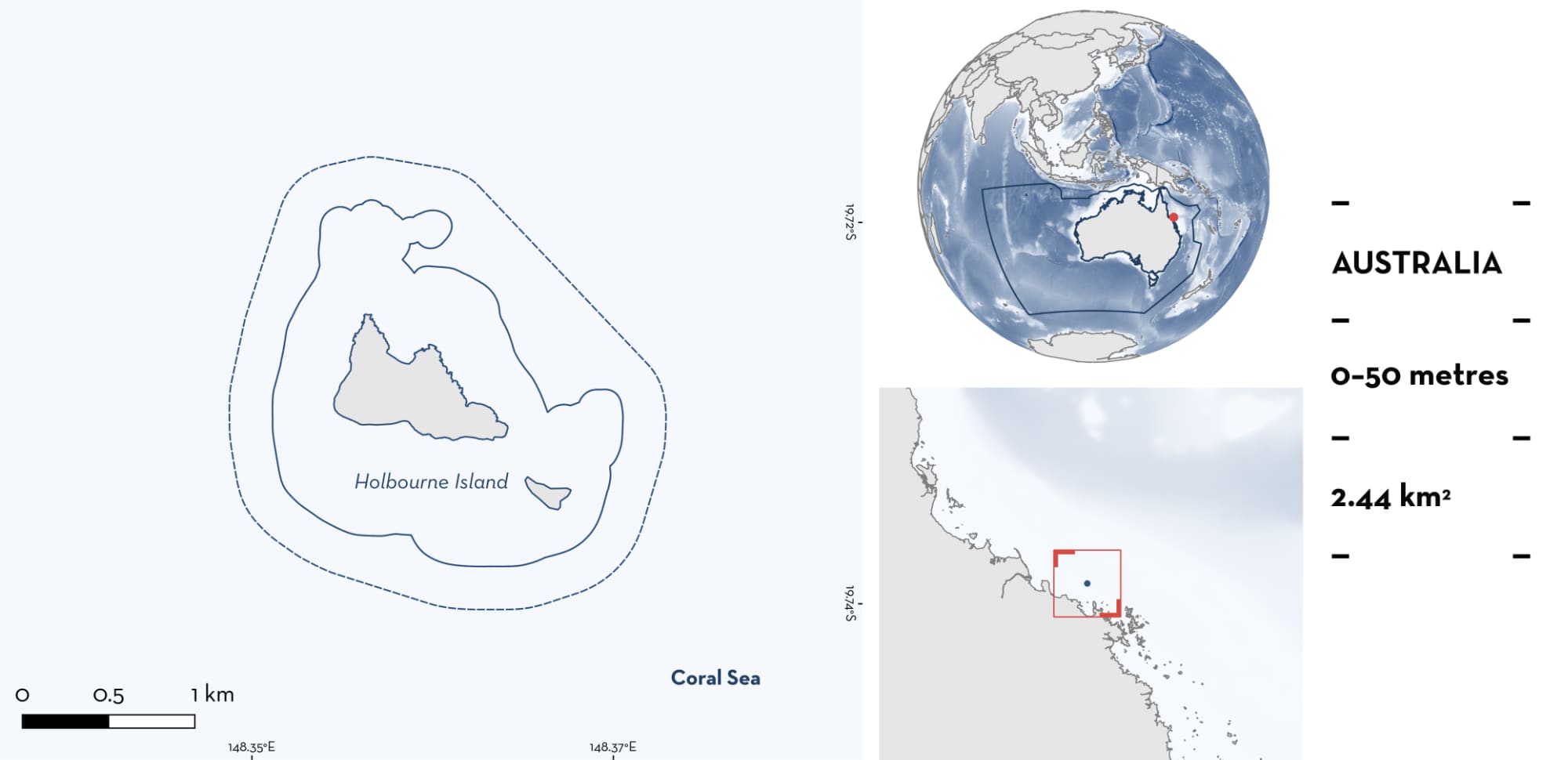
Holbourne Island
Summary
Holbourne Island is located in Queensland, Australia. It is situated ~30 km off the coast of Bowen. The area comprises the coral reef around the island. The habitat is characterised by a reef slope with high coral cover. It is mainly influenced by tidal currents and southeasterly trade winds and waves. Within this area there are: threatened species and undefined aggregations (Reef Manta Ray Mobula alfredi).
Download factsheet
Holbourne Island
DESCRIPTION OF HABITAT
Holbourne Island is located in Queensland, Australia. It is situated ~30 km off the coast of Bowen. This rocky island lies on the mid continental shelf, inshore of the Great Barrier Reef. The area comprises the reef slope of the fringing coral reef that surrounds Holbourne Island. The habitat is characterised by rich coral cover but was impacted by severe tropical cyclone Debbie in March 2017 and a low level of Crown-of-Thorns Starfish (Acanthaster planci) over the past five years (2021–2025) (T & A Ayling pers. obs. 2025).
Tidal currents are usually the dominant driver of water flow around this island and reef, running south during flood tides and north during ebb tides, but this area is also influenced by southeasterly trade winds and waves, with a general northward bias, particularly during April–September (Ryan et al. 2018). The East Australian Current also sometimes intrudes onto the shelf in this region, leading to temporary southward bias (Choukroun et al. 2010).
This Important Shark and Ray Area is benthic and pelagic and is delineated from 0–50 m based on the bathymetry of the area.
CRITERION A
VULNERABILITY
One Qualifying Species considered threatened with extinction according to the IUCN Red List of Threatened Species regularly occurs in the area. This is the Vulnerable Reef Manta Ray (Marshall et al. 2022).
CRITERION C
SUB-CRITERION C5 – UNDEFINED AGGREGATIONS
Holbourne Island is an important area for undefined aggregations of one ray species.
Reef Manta Rays are regularly observed using cleaning stations in this area (T Ayling pers. obs. 2018–2025). Cleaning stations are parts of the reef where cleaner fishes remove parasites and dead skin off Reef Manta Rays (Armstrong et al. 2021), an important behaviour for this species with individuals spending up to 8 h being cleaned per day in some locations (Venables et al. 2020). Divers visited Holbourne Island an average of twice per year from 2008–2025 and observed Reef Manta Rays almost every time, either on dives or from the boat (T Ayling pers. obs. 2008-2025). They were seen using cleaning stations on almost every dive since the cleaning stations were discovered in 2018. There are at least three cleaning stations in the area, and usually one, but up to four individuals are observed at a time. On one occasion, a courtship train of nine individuals was seen in this area. Sightings are recorded year-round (T Ayling pers. obs. 2008-2025). Opportunistic sightings from the area were submitted for photo-identification between 2021–2023, and from these 13 individual Reef Manta Rays (five females and eight males) have been recorded (Project Manta unpubl. data 2025). This is the only location along a ~550 km stretch of coast, between Hook Island (Whitsunday Islands) and Port Douglas, with a known regular and predictable cleaning station for Reef Manta Rays, highlighting its importance.
Download factsheet
SUBMIT A REQUEST
ISRA SPATIAL LAYER REQUEST
To make a request to download the ISRA Layer in either a GIS compatible Shapefile (.shp) or Google Earth compatible Keyhole Markup Language Zipped file (.kmz) please complete the following form. We will review your request and send the download details to you. We will endeavor to send you the requested files as soon as we can. However, please note that this is not an automated process, and before requests are responded to, they undergo internal review and authorization. As such, requests normally take 5–10 working days to process.
Should you have questions about the data or process, please do not hesitate to contact us.

