ISRA FACTSHEETS
ISRA FACTSHEETS
EUROPEAN ATLANTIC
Hy-Brasil
Summary
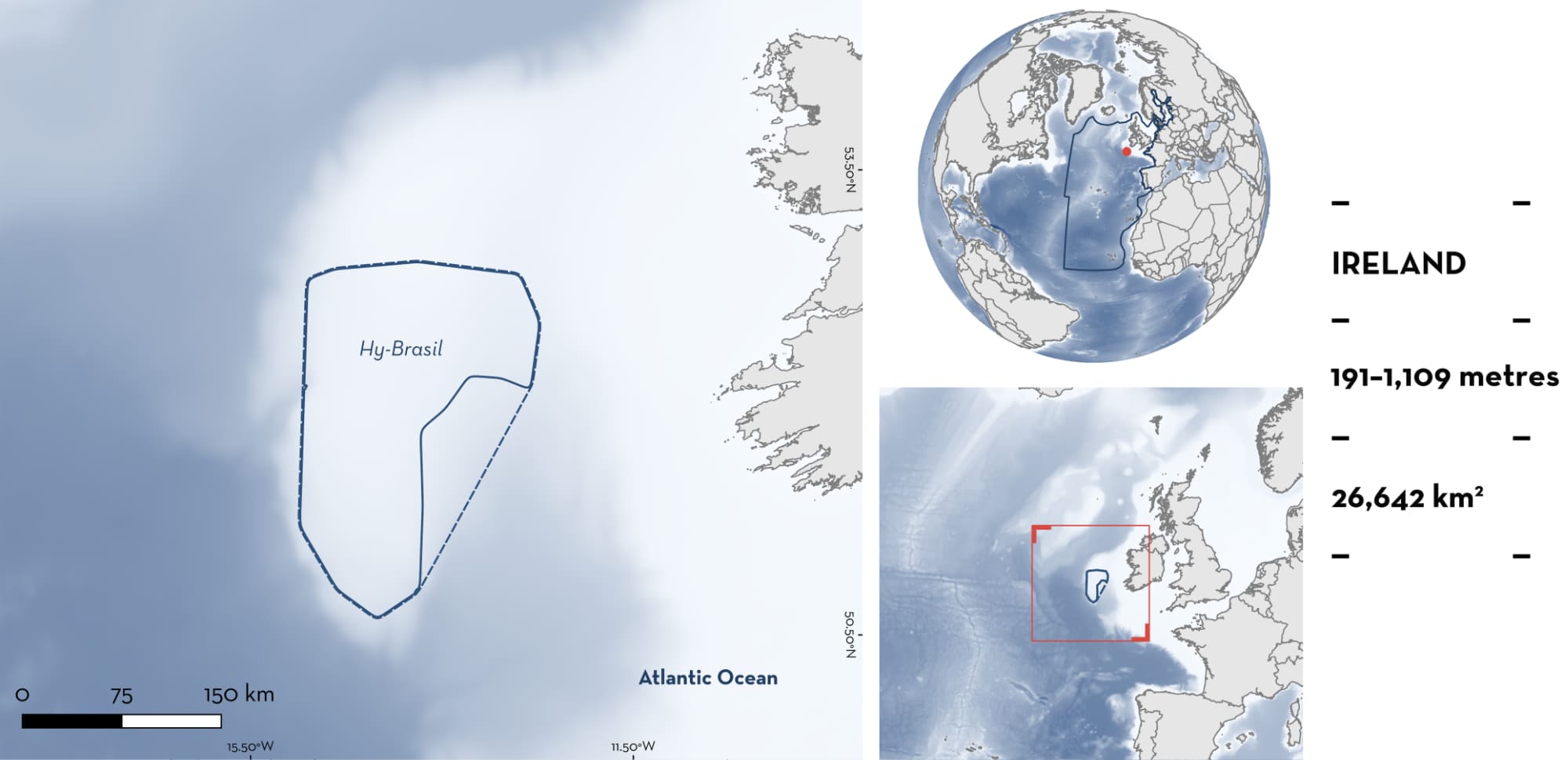
Hy-Brasil is located on the Irish continental shelf, ~200 kilometres west of Ireland. The area is characterised by seamounts and two large canyons and a diverse benthos. It is influenced by current circulation patterns, causing the accumulation of nutrient rich waters. The north of the area is dominated by hard ground, with small areas of soft sediment, while the southern part has soft sediment with occasional boulders and pebbles. Within this area there are: reproductive areas (e.g., Bluntnose Sixgill Shark Hexanchus griseus).
Download factsheet
Hy-Brasil
DESCRIPTION OF HABITAT
Hy-Brasil is a raised area on the Irish continental shelf, ~200 km west of Ireland. It lies at the continental margin of the Northeast Atlantic and it slopes into the Rockall Trough to the west and Porcupine Seabight to the east. A large canyon runs through the area in a northeast-southwest direction, with depth ranging from ~500 m to >2,500 m. A second canyon occurs in the south of the area with depths >2,000 m. The area is characterised by seamounts midway long the main channel (NPWS 2024a). The benthos is characterised by black, soft and gorgonian corals, as well as sponges (including encrusting forms), desmospongia, and glass sponges (NPWS 2024b). The substrate in the north of Hy-Brasil is dominated by hard ground, with small areas of soft sediment. The southern part of the area has soft sediment with occasional boulders and pebbles. Throughout the bank there are terraces, cliffs, overhangs, and boulders (NPWS 2024a).
Current circulation patterns around the Irish margin cause the accumulation of nutrient rich waters on the tops of banks, providing enriched food sources to the canyons and carbonate mounds occurring at the bank.
This Important Shark and Ray Area is pelagic and subsurface and is delineated from 191–1,109 m based on the bathymetry of the area.
CRITERION C
SUB-CRITERION C1 – REPRODUCTIVE AREAS
Hy-Brasil is an important reproductive area for two shark species.
Data were obtained from the Database of Trawl Surveys (DATRAS; ICES 2025). These surveys are conducted annually as part of an internationally coordinated bottom trawl survey programme.
Between 2010–2024, 583 neonate Blackmouth Catsharks were recorded from these trawl surveys (ICES 2025). The size-at-birth for Blackmouth Catsharks is unknown, but these individuals measured <17 cm total length (TL), which is similar to the size-at-birth for congeners (Broadfin Sawtail Catshark Galeus nipponensis, 13 cm TL; Gecko Catshark G. eastmani, <17 cm TL; Atlantic Sawtail Catshark G. atlanticus, 15 cm TL; Ebert et al. 2021). These neonates were found in the area every year from 2010–2024 (2010: n = 23; 2011: n = 27; 2012: n = 30; 2013: n = 56; 2014: n = 87; 2015: n = 91; 2016: n = 72; 2017: n = 32; 2018: n = 48; 2019: n = 23; 2020: n = 7; 2021: n = 30; 2022: n = 21; 2023: n = 20; and 2024: n = 16). These data were collected from standardised surveys which are conducted annually in September and October. Additional temporal data are required to confirm seasonality of the reproductive use of this area by this species. Further, in July 2021, the Marine Institute of Ireland’s SeaRover survey deployed a remotely operated vehicle (ROV) and captured footage of thousands of live Blackmouth Catshark egg cases within the area (Marine Institute 2022) highlighting the use of this area by pregnant females.
Overall, 175 Bluntnose Sixgill Sharks were recorded within the area (ICES 2025). The vast majority (90%; n = 156) of them are estimated to be neonate/young-of-the-year (YOY) measuring <130 cm TL (size-at-birth of this species is estimated 61–74 cm TL; size-at-maturity is estimated at 310–330 cm TL for males and 400 cm TL for females; Ebert et al. 2021). Of these, 45 (28.8%) could be classed as neonates measuring <74 cm TL. Neonate/YOY Bluntnose Sixgill Sharks were recorded within this area every year from 2010–2024 (ICES 2025). In 8 of the 15 years in which Bluntnose Sixgill Sharks were captured in this area, all individuals were YOY/neonate (2010: n = 7; 2012: n = 13; 2013: n = 21; 2015: n = 6; 2018: n = 5; 2019: n = 13; 2020: n = 8; and 2021: n = 1). In the remaining 7 years in which Bluntnose Sixgill Sharks were captured in this area, the large majority of individuals captured were either YOY or neonate (2011: n = 9 out of 10; 2014: n = 8 out of 11; 2016: n = 14 out of 17; 2017: n = 6 out of 7; 2022: n = 4 out of 8; 2023: n = 8 out of 12; and 2024: n = 9 out of 15).
Download factsheet
SUBMIT A REQUEST
ISRA SPATIAL LAYER REQUEST
To make a request to download the ISRA Layer in either a GIS compatible Shapefile (.shp) or Google Earth compatible Keyhole Markup Language Zipped file (.kmz) please complete the following form. We will review your request and send the download details to you. We will endeavor to send you the requested files as soon as we can. However, please note that this is not an automated process, and before requests are responded to, they undergo internal review and authorization. As such, requests normally take 5–10 working days to process.
Should you have questions about the data or process, please do not hesitate to contact us.