ISRA FACTSHEETS
ISRA FACTSHEETS
EUROPEAN ATLANTIC
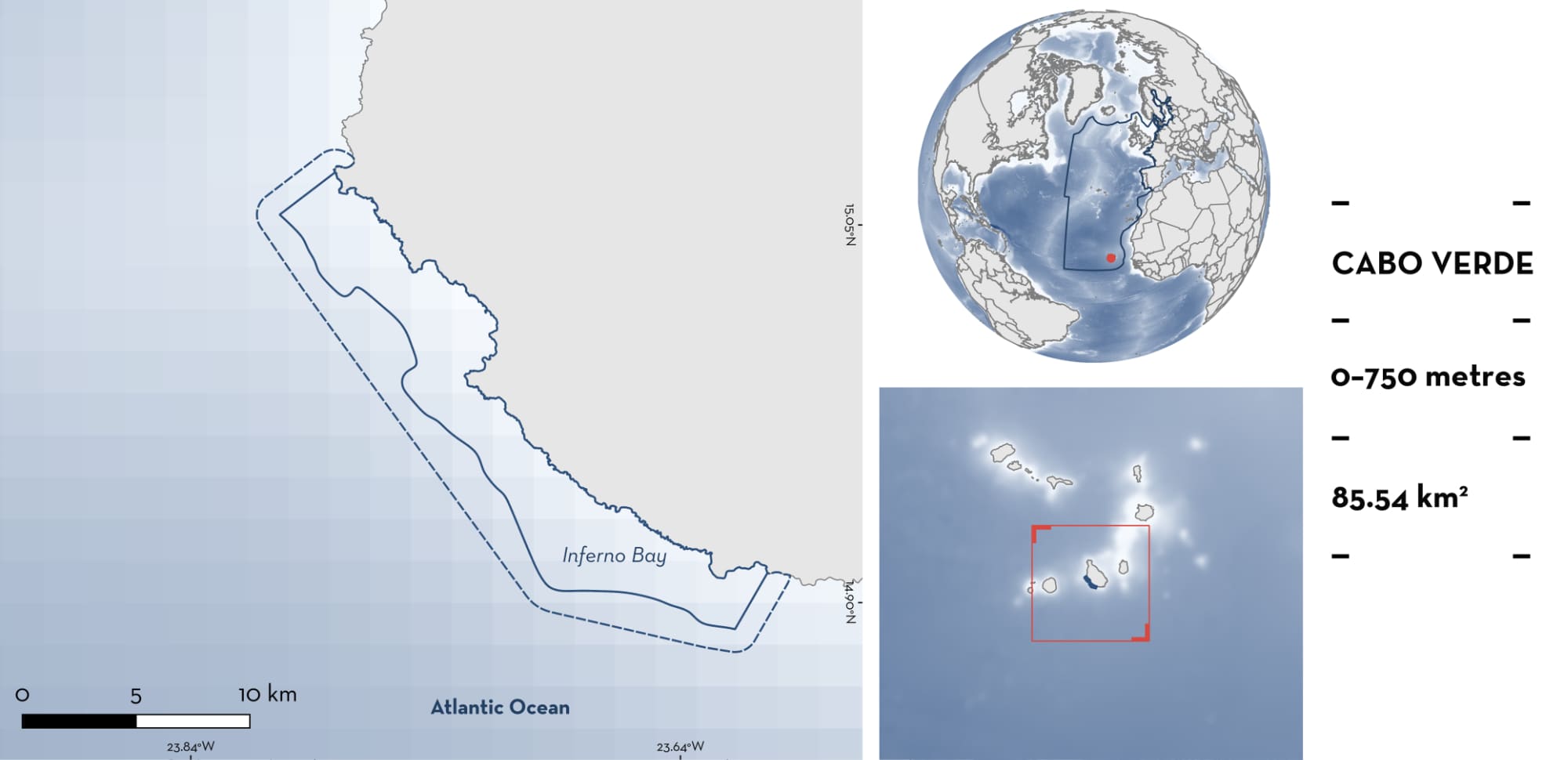
Inferno Bay
Summary
Inferno Bay is located on the southwestern coast of Santiago Island, Cabo Verde. The area is characterised by a steep slope, hard substrate, rocky reefs, and black coral forests. From November to June, colder waters reach Cabo Verde, transporting nutrients from upwelling zones off northwest Africa. Within this area there are: threatened species and undefined aggregations (Sicklefin Devil Ray Mobula tarapacana).
Download factsheet
Inferno Bay
DESCRIPTION OF HABITAT
Inferno Bay is located on Santiago Island, Cabo Verde. It lies on the southwestern coast of the island, which is the largest in the archipelago. The area is characterised by a steep slope, hard substrate, rocky reefs, and black coral forests (Koivunen et al. 2024).
Between July and November, the intensity and position of the St. Helena and Azores anticyclones result in a predominantly south-westerly current along the southern islands. This brings warmer waters (24–27°C) to the region. From November to June, colder waters (≤23°C) reach Cabo Verde, transporting nutrients from upwelling zones off northwest Africa. These nutrient-rich waters create favourable conditions for primary productivity around the islands (Almada 1994).
This Important Shark and Ray Area is pelagic and is delineated from surface waters (0 m) to 750 m based on the bathymetry of the area.
CRITERION A
VULNERABILITY
One Qualifying Species considered threatened with extinction according to the IUCN Red List of Threatened Species regularly occurs in the area. This is the Endangered Sicklefin Devil Ray (Marshall et al. 2022).
CRITERION C
SUB-CRITERION C5 – UNDEFINED AGGREGATIONS
Inferno Bay is an important area for undefined aggregations of one ray species.
Based on records from weekly recreational dives undertaken year-round in 1985 and 2008, twice weekly between November 2008–April 2015, and daily between November 2018–April 2019 (weather permitting), aggregations of 20–30 Sicklefin Devil Rays are regularly and predictably observed between November–April within this area. Aggregations of >100 individuals have also been observed during the same period (JS Pinto pers. obs. 1985–2019; AF Sobral & P Afonso pers. comm. 2018). Additionally, in May 2023, one Baited Remote Underwater Video Survey deployment within this area opportunistically recorded an aggregation of >70 individuals (Lantuna Association unpubl. data 2023). This is the only area across the Cabo Verde archipelago where regular aggregations of Sicklefin Devil Ray have been reported (SJ Delgado Pires pers. obs. 2025).
Download factsheet
SUBMIT A REQUEST
ISRA SPATIAL LAYER REQUEST
To make a request to download the ISRA Layer in either a GIS compatible Shapefile (.shp) or Google Earth compatible Keyhole Markup Language Zipped file (.kmz) please complete the following form. We will review your request and send the download details to you. We will endeavor to send you the requested files as soon as we can. However, please note that this is not an automated process, and before requests are responded to, they undergo internal review and authorization. As such, requests normally take 5–10 working days to process.
Should you have questions about the data or process, please do not hesitate to contact us.