ISRA FACTSHEETS
ISRA FACTSHEETS
MEDITERRANEAN AND BLACK SEAS REGION
Iskenderun and Mersin Bays
Summary
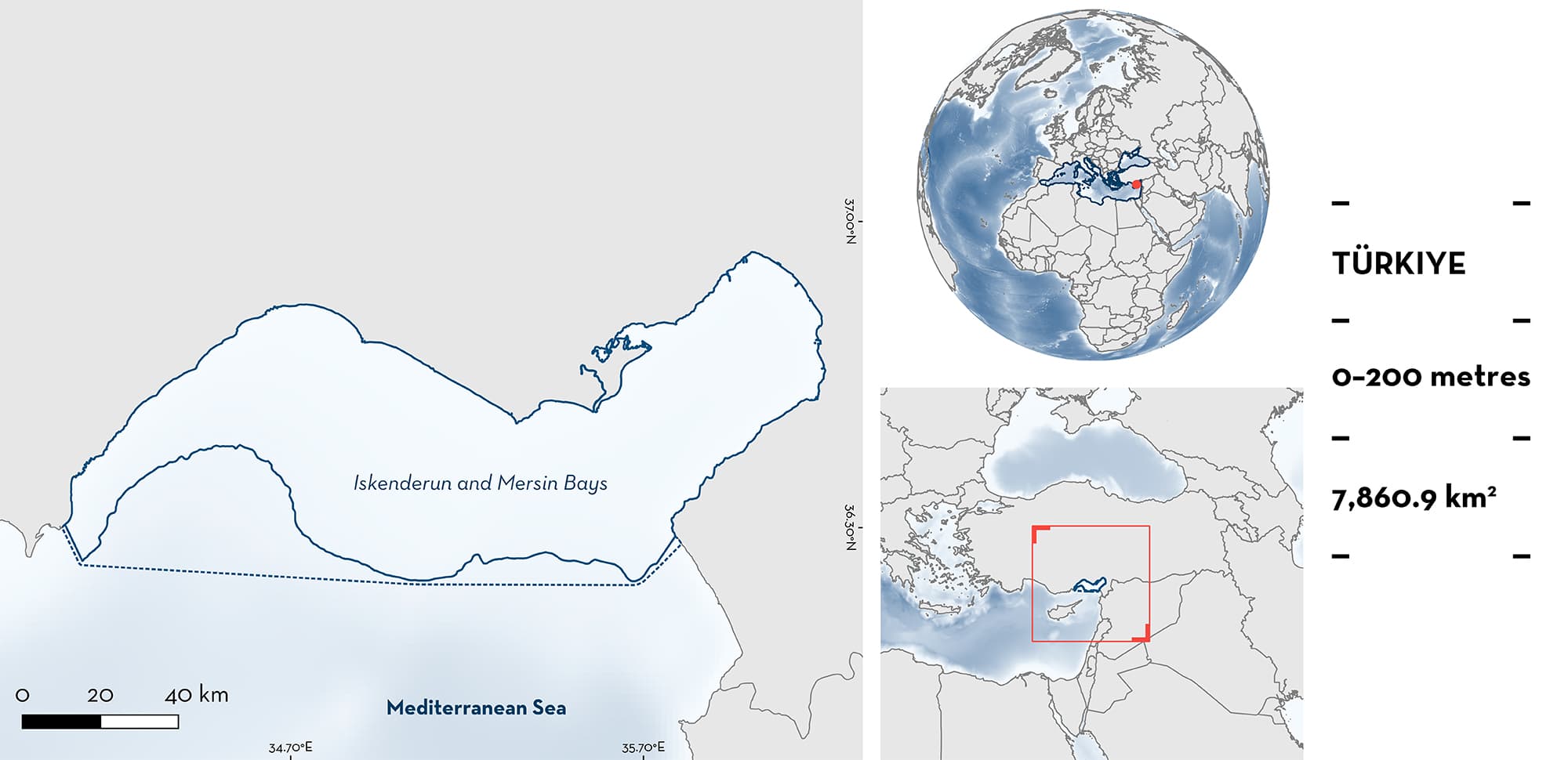
Iskenderun and Mersin Bays is located along the southern coast of Türkiye in the Cilician Sea. The area is characterised by sandy and muddy substrates and receives large freshwater input of nutrient-rich waters resulting in brackish waters along the coast. The area overlaps with the North-East Levantine Ecologically or Biologically Significant Marine Area, nine Key Biodiversity Areas, and two Ramsar sites. Within the area there are: threatened species (e.g., Blackchin Guitarfish Glaucostegus cemiculus); reproductive areas (e.g., Common Guitarfish Rhinobatos rhinobatos); and feeding areas (Common Stingray Dasyatis pastinaca).
Download factsheet
Iskenderun and Mersin Bays
DESCRIPTION OF HABITAT
Iskenderun and Mersin Bays has a wide and productive continental shelf that extends to ~180 km off the coastline and constitutes suitable habitat for many demersal species (Gücü & Bingel 1995). The area is characterised by sandy and muddy substrates. Large freshwater input result in some brackish water habitats along the coast. This area is one of the most productive regions in the eastern Mediterranean, especially in the inshore part of Iskenderun Bay (Polat 2002), due to the nutrient-rich freshwater input from the Ceyhan River. Sea surface temperatures range between 16–30°C, with the warmest temperatures in August and the coolest temperatures in January. A strong thermocline is formed in the bays from April to November due to the excessive warming of surface waters. During the boreal summer, open sea surface waters high in salinity enter the bays, resulting in surface water that is more saline than bottom water. Cooler surface waters and strong winds from November onwards break the stratification and mix the waters in the bay. Primary production is higher in winter and spring and lower in summer (Salihoglu et al. 1996; Mavruk 2015).
The area overlaps with the North-East Levantine Sea Ecologically or Biologically Significant Marine Area (CBD 2023), and nine Key Biodiversity Areas (KBAs): Ceyhan Delta, Seyhan Delta, Sugözü – Akkum, Kazanli, Alata Dunes, Limonlu Basin, Göksu Delta, Bozyazi Coast, and Gazipasa – Anamur Coast (KBA 2023a, 2023b, 2023c, 2023d, 2023e, 2023f, 2023g, 2023h, 2023i). In addition, the area overlaps with two Ramsar sites, Göksu Delta and Yumurtalik Lagoons.
This Important Shark and Ray Area is delineated from surface waters (0 m) to a depth of 200 m based on the bathymetry of the area.
CRITERION A
VULNERABILITY
Seven Qualifying Species considered threatened with extinction according to the IUCN Red List of Threatened SpeciesTM regularly occur in the area. Threatened sharks comprise two Endangered species; threatened rays comprise four Critically Endangered species and one Vulnerable species (IUCN 2023).
CRITERION C
SUB-CRITERION C1 – REPRODUCTIVE AREAS
Iskenderun and Mersin Bays is an important reproductive area for two shark and five ray species.
The presence of Sandbar Shark neonates across multiple years supports the presence of an important reproductive area. Between 2010–2014, 23 neonates measuring <72 cm in total length (TL) (size-at-birth, 40–75 cm TL; Ebert et al. 2021) were caught by pelagic longlines and trawlers operating within the area at depths of 25–125 m (Başusta 2016). In addition, eight neonates with unhealed umbilical scars (54–62 cm TL), were caught in longlines in 2017 near the area of influence from the Ceyhan River (Başusta et al. 2021), at depths between 7–9 m. One young-of-the-year (YOY; 68 cm TL) was caught in 2019 (Ergüden et al. 2020), confirming the regular presence of these life stages within the area. In addition, juveniles have been reported in the area across multiple years (Başusta 2016).
Between 2012–2015, 155 Common Smoothhounds were caught by gillnets and longlines within the area (Ozcan & Başusta 2018). Based on vertebral band counts, four individuals measured 44.3–47.6 cm TL, close to the reported size-at-birth for the species (34–42 cm TL; Ebert et al. 2021) and were estimated to be YOY (age group 0). In addition, 43 and 75 individuals were estimated as one and two years old, respectively.
Between 2010–2012, 94 Duckbill Eagle Rays were collected in the area as bycatch from trawlers and purse seiners operating at depths of 35–50 m (Başusta & Aslan 2018). Most individuals (n = ∼75) were neonates, ranging between 10–40 cm disc width (DW), which is within the size-at-birth range for the species (25–45 cm DW; Last et al. 2016). In addition, one neonate was caught at <30 m depth in 2018 in the area, confirming that neonates were still present (Başusta & Başusta 2019).
Based on vertebral band counts of Common Stingrays caught as bycatch in trawlers in the area between 1999–2003, neonates (n = 10) and YOY were present in the area (Ismen 2003; Yeldan et al. 2008). In addition, during 2010–2011, individuals measuring ~15 cm DW, close to the reported size-at-birth for the species (~12 cm DW; Last et al. 2016), were reported as bycatch in the area (Başusta et al. 2012a), and nine individuals (16–19 cm DW) were categorised as one year old (Girgin & Başusta 2016), confirming the continuous use of the area by these early life stages. Recent monitoring confirms that these life-stages still occur in the area (I. Saygu unpubl. data 2023).
Between 2010–2012, 291 Blackchin Guitarfish were collected from commercial gill nets, longlines, and trawls within the area (Başusta et al. 2012a, 2020, Yemisken et al. 2014). For ~110 individuals, their sizes ranged 32–40 cm TL, which is close to the reported size-at-birth for the species (35 cm TL; Last et al. 2016). In addition, based on vertebral band counts, most of the individuals (∼190) were estimated to be YOY (age group 0; Başusta et al. 2020). Recent ongoing monitoring within the area focused on gathering local ecological knowledge of fishers and fisheries-dependent observations confirmed that individuals between 25–30 cm TL are commonly found in the area (I. Saygu unpubl. data 2023), suggesting that this is still an important area for neonates and YOY.
Neonate Common Guitarfish (n = 19) were collected from trawlers between 1999–2000, with measuring 22.2–28.0 cm TL. In addition, based on vertebral band counts (n = 80), 29 individuals were classified as age 0 (22.2–46.3 cm TL), and another 32 individuals were classified as age 1 (46–64 cm TL), with both ages representing most of the individuals sampled (Ismen et al. 2007). Between 2004–2005, pregnant females were observed between March and July and the pupping season has been reported for April-July (Cek et al. 2009; Demirhan et al. 2010). During this same period, from 97 individuals examined, 10 were classified as age 1 confirming the regular presence of these young individuals (Başusta et al. 2008). As with the Blackchin Guitarfish, recent monitoring confirmed that neonates are commonly found in the area (I. Saygu unpubl. data 2023).
The presence of pregnant female, near-term embryo, and neonate Lusitanian Cownose Ray has been reported within the area over multiple years (Başusta et al. 2012b, 2022; Tirasin & Başusta 2018). Two pregnant females were caught in December 2010 and April 2011 at depths <50 m; each of the females had one near-term embryo (19–24 cm DW). One neonate was caught in April 2011 and had a size (23 cm DW) similar to the reported size-at-birth for the species (~23 cm DW; Last et al. 2016). Furthermore, 36 pregnant females were reported in the area in 2013 (Tirasin & Başusta 2018).
CRITERION C
SUB-CRITERION C2 – FEEDING AREAS
Iskenderun and Mersin Bays is an important feeding area for one ray species.
Stomach content analysis of Common Stingrays (n = 344) between 1999–2003 showed that this species feeds primarily on crustaceans, including Peregrine Shrimp Metapenaeus stebbingis, Pistol Shrimp Alpheus glaber, and Lesser Swimming Crab Charybdis longicollis (Yeldan et al. 2008). This area is one of the main demersal fishing grounds for the Peregrine Shrimp, with higher catches reported between October and May at depths <30 m (Kumlu et al. 1999). This suggests that these rays take advantage of the high prey availability in the area during those months. The contemporary presence of this species has been reported between 2010–2015 (Yaglioglu et al. 2015; Girgin & Başusta 2016; Yeldan & Gundogdu 2018), suggesting that this process still occurs in the area.
Download factsheet
SUBMIT A REQUEST
ISRA SPATIAL LAYER REQUEST
To make a request to download the ISRA Layer in either a GIS compatible Shapefile (.shp) or Google Earth compatible Keyhole Markup Language Zipped file (.kmz) please complete the following form. We will review your request and send the download details to you. We will endeavor to send you the requested files as soon as we can. However, please note that this is not an automated process, and before requests are responded to, they undergo internal review and authorization. As such, requests normally take 5–10 working days to process.
Should you have questions about the data or process, please do not hesitate to contact us.