ISRA FACTSHEETS
ISRA FACTSHEETS
CENTRAL AND SOUTH AMERICAN PACIFIC REGION
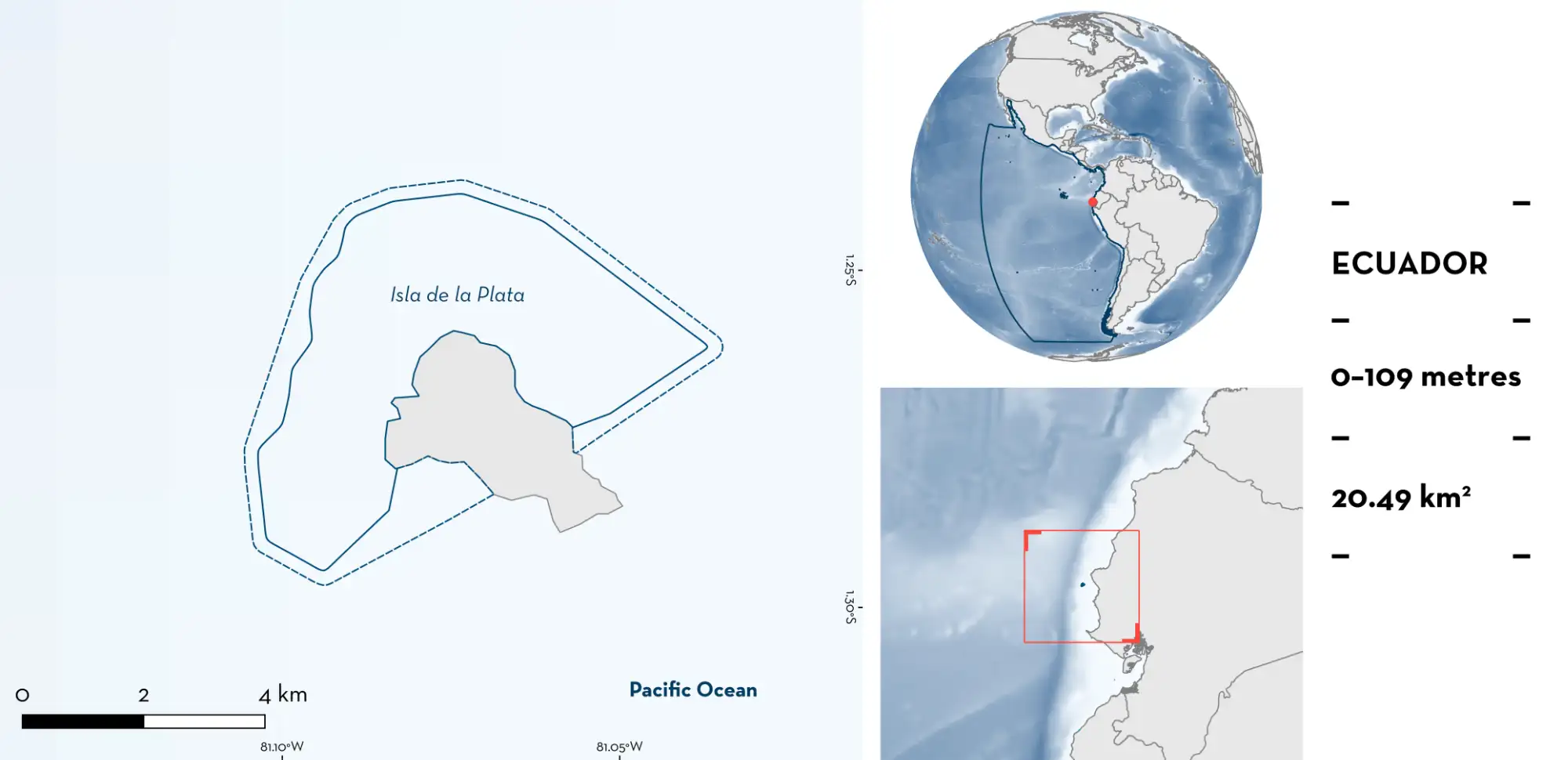
Isla de la Plata
Summary
Isla de la Plata is a small island located ~25 km from mainland Ecuador. It is situated on the continental shelf, with surrounding waters characterised by sandy benthos with coral and rocky reef patches to around 30 m depth. The area overlaps with the Parque Nacional Machalilla, an Ecologically or Biologically Significant Marine Area, and a Key Biodiversity Area. In this area there are: threatened species and undefined aggregations (Oceanic Manta Ray Mobula birostris).
Download factsheet
Isla de la Plata
DESCRIPTION OF HABITAT
Isla de la Plata is a small island located ~25 km from mainland Ecuador. The area is located on the continental shelf, approximately 5 km from the shelf-edge, where the depth (~ 200 m) drops sharply. The surrounding waters are characterised by sandy benthos with coral and rocky reef patches to ~ 30 m depth. The island is fringed with shallow rocky reefs between 5–15 m depth with inter-dispersed sandy areas.
The area encompasses the north and west sides of the island, where the bathymetry rapidly descends to >100 m (Harty et al. 2022). It is influenced by the Humboldt Current System, where the merger of coastal and equatorial currents generates upwelling, resulting in high productivity, especially during June–September when the Equatorial Front (the transition zone between water-masses characterised by a large temperature gradient) is at its strongest (Flachier et al. 1997). The increased productivity leads to high zooplankton abundance, which supports a large and diverse food web (Pennington et al. 2006). Inter-annual variability is driven primarily by the El Niño–Southern Oscillation (Burgess 2017).
This area overlaps with one Ecologically or Biologically Significant Marine Area (EBSA), the Carnegie Ridge-Equatorial Front (CBD 2026), the Machalilla National Park (UNEP-WCMC & IUCN 2026), and the Coastal Ecuador Marine Corridor Key Biodiversity Area (KBA 2026).
This Important Shark and Ray Area is delineated from inshore surface waters (0 m) to a depth of 109 m based on the maximum depth used by the Qualifying Species in the area.
CRITERION A
VULNERABILITY
One Qualifying Species considered threatened with extinction according to the IUCN Red List of Threatened Species regularly occurs in the area. This is the Endangered Oceanic Manta Ray (Marshall et al. 2022).
CRITERION C
SUB-CRITERION C5 – UNDEFINED AGGREGATIONS
Isla de la Plata is an important aggregation area for Oceanic Manta Rays.
This area hosts the largest known global population of Oceanic Manta Rays, which occur seasonally between June–October (Burgess 2017; Harty et al. 2022). Photo-identification data collected between 2005–2018 indicate that ~ 2,800 individuals use this area, with estimated annual abundances of 949–7,650 females and 5,226–9,340 males (Harty et al. 2022). Multi-year resightings of 158 individuals were recorded, with a 13-year maximum period between resightings of an individual. Individuals are mostly males, and visual estimates of maturity show that 82.5% are mature, 8.4% are subadults, 1.2% juveniles, and 6.9% that have not been sexed (Harty et al. 2022).
Drivers of these aggregations are poorly understood, but research suggests that Isla de la Plata provides both a good cleaning and social environment during the day, and the island’s proximity to the continental shelf-edge provides Oceanic Manta Rays with access to productive nearby habitats (continental shelf edge) to feed during the night (Burgess et al. 2016, 2018; Guerrero & Hearn 2017). Stable isotope and fatty acid analyses showed that Oceanic Manta Rays around Isla de la Plata are not feeding predominantly on surface zooplankton; instead, the majority of dietary intake is mesopelagic in origin (Burgess et al. 2016, 2018). In other parts of the world, this species uses deep waters to feed (Stewart et al. 2016).
Oceanic Manta Rays might be also occupying this seasonal area for reproductive purposes. Adult females have been observed in consecutive years (2012–2015) with fresh mating scars on their pectoral fins, and at least eight individuals have been reported to appear pregnant, based on their distended dorsal areas (Guerrero & Hearn 2017; Palomino et al. 2020). Moreover, in-situ ultrasounds have been conducted, which validate the observations of pregnancy in Oceanic Manta Rays found within the area (Guerrero 2019). Photo-identification data found a relatively low 21 of 2,803 individuals showing mating injuries, however, the authors note mating scars are hard to determine from ventral photographs (Harty et al. 2022). Hence, more information is needed to understand the nature and function of these aggregations.
Download factsheet
SUBMIT A REQUEST
ISRA SPATIAL LAYER REQUEST
To make a request to download the ISRA Layer in either a GIS compatible Shapefile (.shp) or Google Earth compatible Keyhole Markup Language Zipped file (.kmz) please complete the following form. We will review your request and send the download details to you. We will endeavor to send you the requested files as soon as we can. However, please note that this is not an automated process, and before requests are responded to, they undergo internal review and authorization. As such, requests normally take 5–10 working days to process.
Should you have questions about the data or process, please do not hesitate to contact us.