ISRA FACTSHEETS
ISRA FACTSHEETS
AUSTRALIA AND SOUTHEAST INDIAN OCEAN
Kakadu Rivers
Summary
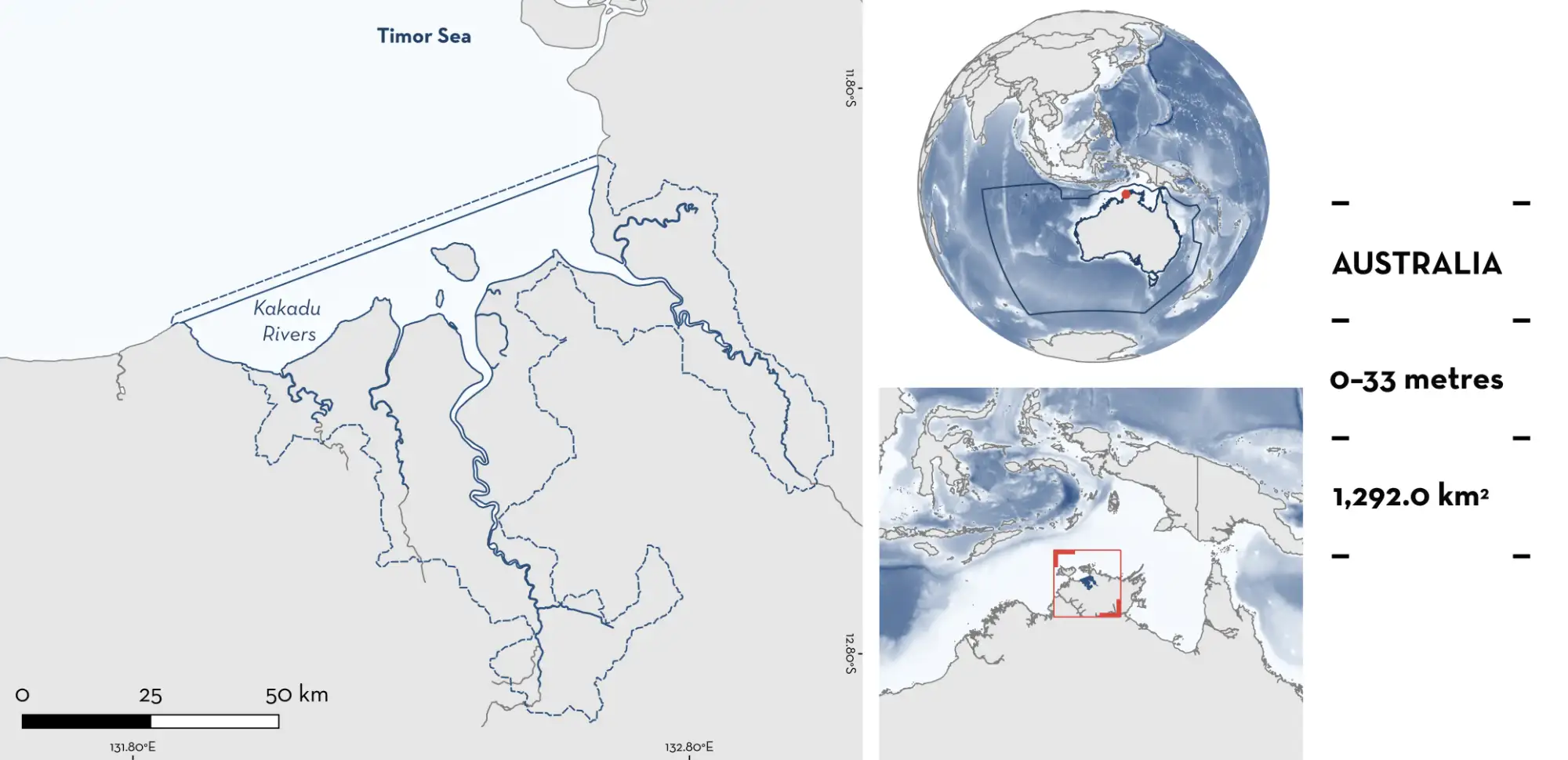
Kakadu Rivers is located in the Northern Territory, Australia. The area encompasses the estuarine and tidal reaches of the Wildman, West Alligator, South Alligator, and East Alligator rivers. It is characterised by muddy substrates, mudflats exposed at high tide, highly turbid waters, and fringing vegetation ranging from mangroves to tropical monsoon riparian forest. This area is a highly dynamic estuarine-riverine environment heavily influenced by a large tidal range (up to 5.5 m) and freshwater inflow during the wet season. The area overlaps with a Key Biodiversity Area, a Ramsar Site, and a National Park. Within the area there are: threatened species (e.g., Northern River Shark Glyphis garricki); and reproductive areas (e.g., Speartooth Shark Glyphis glyphis).
Download factsheet
Kakadu Rivers
DESCRIPTION OF HABITAT
Kakadu Rivers is located in the Northern Territory, Australia. The area encompasses the estuarine and tidal reaches of the ‘Alligator Rivers’, comprising the West Alligator, South Alligator, and East Alligator rivers along with the nearby Wildman River. The mouths of each of the Alligator Rivers sit in proximity to each other, while the Wildman River is separated from the West Alligator River by West Alligator Head. All rivers flow into Van Diemen Gulf, a shallow semi-enclosed water body opening to the Timor Sea via two straits (one between the Cobourg Peninsula and Melville Island to the north of the area, and the other between Melville Island and Gunn Point to the west of the area). Habitats are dominated by muddy substrates with large areas of mudflat exposed at low tide, with fringing vegetation of mangroves and floodplain grasslands (Wolanski & Chappell 1996; Every et al. 2017). Coastal areas also include some sandy beaches and rocky coral reefs along with Field and Barron islands at the mouth of the South Alligator River. Habitats of upper reaches of the East Alligator River included in this area transition to sandy substrates, rocky escarpments, and tropical monsoon forest.
Kakadu Rivers is a highly dynamic estuarine-riverine environment heavily influenced by very large semi-diurnal tides (tidal range up to 5.5 m; Wolanski & Chappell 1996). Tidal influence is up to 100 km upriver (e.g., South Alligator River; Wolanski & Chappell 1996). The region experiences a wet-dry monsoonal climate with nearly all rainfall occurring in the wet season (~November–April; Every et al. 2017). During these months, the rivers are influenced by freshwater flows. During the dry season, tides push marine/brackish water upriver. Subsequently, salinity and turbidity are highly variable seasonally, and the rivers and nearshore coastal zones of the area can be extremely turbid (Wolanski & Chappell 1996; Every et al. 2017). Tropical storms and cyclonic activity are frequent during the wet season.
This area overlaps with the Alligator Rivers Floodplains Key Biodiversity Area (KBA 2025), Kakadu National Park Ramsar Site (Wetland of International Importance; Ramsar 2025), and Kakadu National Park (Parks Australia 2025).
This Important Shark and Ray Area is benthic and pelagic and is delineated from inshore and surface waters (0 m) to 33 m based on the bathymetry of the area.
CRITERION A
VULNERABILITY
Three Qualifying Species considered threatened with extinction according to the IUCN Red List of Threatened Species regularly occur in the area. These are the Vulnerable Bull Shark (Rigby et al. 2021), Northern River Shark (Kyne et al. 2021a), and Speartooth Shark (Kyne et al. 2021b).
CRITERION C
SUB-CRITERION C1 – REPRODUCTIVE AREAS
Kakadu Rivers is an important reproductive area for three shark species.
Targeted surveys were conducted for euryhaline sharks and rays in Kakadu Rivers between 2012–2015 (Feutry et al. 2014, 2015, 2017, 2020; Kyne 2014; Every et al. 2017, 2019; Constance 2025; Constance et al. 2025; PM Kyne et al. unpubl. data 2012–2015). Surveys and sampling targeted river sharks (Northern River Shark, Speartooth Shark) and Largetooth Sawfish primarily using rod-and-line for sharks, and 29 or 58 m long gillnets (4–6-inch mesh size) for sawfish. The study area (i.e., Kakadu Rivers) covered all four rivers from lower estuarine reaches to the upper limits of the area in each river. Sampling effort was however higher in the South Alligator River as the primary field site due to its accessibility, with lower but roughly similar effort between the other rivers. An acoustic receiver array was deployed to cover the South Alligator River (with additional gates at the mouth of the other rivers) and monitor survival and movements of Northern River Sharks and Speartooth Sharks (Constance 2025; Constance et al. 2025). Animals were measured (total length; TL), sexed, and tagged with passive integrated transponder (PIT) tags to monitor recaptures.
Early life-stage Bull Sharks were caught incidentally during euryhaline shark and ray surveys (Kyne 2014; Every et al. 2017, 2019; PM Kyne et al. unpubl. data 2012–2014). The size-at-birth for the species is 56–81 cm TL and young-of-the-year (YOY) can measure up to 99 cm TL (Pillans et al. 2020; Ebert et al. 2021). Between 2012–2014, a total of 148 Bull Sharks were caught, ranging in size 69.5–139.5 cm TL (mean ± standard deviation = 90.9 ± 14.8 cm TL) and comprised 41 neonates (27.7%), 68 YOY (45.9%), and 39 juveniles (26.4%). No adults were caught. Early life-stages (neonates and YOY combined; n = 109) represented 73.6% of Bull Sharks and were caught in January 2012 (n = 6), August 2012 (n = 25), February 2013 (n = 4), March 2013 (n = 12), April 2013 (n = 4), June 2013 (n = 1), July 2013 (n = 2), August 2013 (n = 3), September 2013 (n = 2), October 2013 (n = 3), November 2013 (n = 1), December 2013 (n = 10), January 2014 (n = 17), February 2014 (n = 6), April 2014 (n = 2), May 2014 (n = 7), September 2014 (n = 3), and October 2014 (n = 1) (Kyne 2014; Every et al. 2017, 2019; PM Kyne et al. unpubl. data 2012–2014). Bull Sharks were encountered in the East Alligator (n = 48 total; n = 25 neonate/YOY), South Alligator (n = 95; n = 81 neonate/YOY), West Alligator (n = 1 YOY), and Wildman (n = 4; n = 2 YOY) rivers in the area.
Bull Sharks in Australia remain in river and estuary habitats for up to five years (Werry et al. 2011; Niella et al. 2022), highlighting that juveniles, in addition to neonates and YOY, are still largely restricted to the area, with the larger juveniles potentially making some movements into adjacent marine waters (Smoothey et al. 2023). Although there are numerous rivers across northern Australia that also regularly host early life-stage Bull Sharks, these river systems are individually important. Bull Sharks in Australia display natal philopatry, with females returning to particular river systems to pup (Tillett et al. 2012; Lubitz 2023). For example, half-sibling pairs were found within a river on Australia’s east coast up to seven cohorts apart, highlighting the long-term natal philopatry of females (Lubitz 2023). Therefore, river systems such as this area, represent discrete portions of habitat that are important to Bull Sharks.
Northern River Sharks were the most abundant shark species caught throughout the area (Kyne 2014; Every et al. 2017, 2019; Feutry et al. 2020; Constance 2025; Constance et al. 2025; PM Kyne et al. unpubl. data 2012–2015). Between 2012–2015, a total of 372 Northern River Sharks were caught. Sharks ranged 52–182 cm TL (mean ± standard deviation = 96.1 ± 24.7 cm TL) and comprised 28 neonates (7.5%), 46 YOY (12.4%), 276 juveniles (74.2%), and 22 adults (5.9%; pregnancy was not recorded in females). Published size-at-birth for both river shark species is 50–65 cm TL (Pillans et al. 2009). Age-and-growth data are not available for Northern River Sharks. However, a YOY size threshold of 75 cm TL is used here, based on the threshold for the closely related Speartooth Shark (Kyne et al. 2026), which has the same size-at-birth (Pillans et al. 2009). Size-at-maturity for Northern River Shark is 142 cm TL (Pillans et al. 2009; PM Kyne et al. unpubl. data 2012–2025). Early life-stages (neonates and YOY combined; n = 74) represented 19.9% of sharks and were recorded in January 2012 (n = 2), February 2012 (n = 2), August 2012 (n = 1), February 2013 (n = 2), March 2013 (n = 5), May 2013 (n = 2), June 2013 (n = 6), July 2013 (n = 5), August 2013 (n = 3), September 2013 (n = 9), October 2013 (n = 13), November 2013 (n = 2), January 2014 (n = 2), February 2014 (n = 2), April 2014 (n = 6), May 2014 (n = 2), September 2014 (n = 3), October 2014 (n = 3), and September 2015 (n = 4) (Kyne 2014; Every et al. 2017, 2019; Feutry et al. 2020; Constance 2025; Constance et al. 2025; PM Kyne et al. unpubl. data 2012–2015). Northern River Sharks were encountered in the East Alligator (n = 17 total; n = 5 YOY), South Alligator (n = 213; n = 57 neonate/YOY), West Alligator (n = 41; n = 7 neonate/YOY), and Wildman (n = 47; n = 5 neonate/YOY) rivers in the area.
Speartooth Sharks are regularly encountered throughout the area (Feutry et al. 2014, 2017; Constance 2025; Constance et al. 2025; PM Kyne et al. unpubl. data 2012–2015). Between 2012–2015, a total of 94 Speartooth Sharks were caught. Sharks ranged 63–162 cm TL (mean ± standard deviation = 102.8 ± 24.3 cm TL) and comprised one neonate (1.1%), four YOY (4.2%), and 89 juveniles (94.7%; estimated age, 2–8 years old). Early life-stages (neonates and YOY combined; n = 5) represented 5.3% of sharks and were sampled in February 2012 (n = 1), February 2013 (n = 1), March 2013 (n = 2), and May 2014 (n = 1) (Feutry et al. 2014, 2017; Constance 2025; Constance et al. 2025; PM Kyne et al. unpubl. data 2012–2015). The use of the area for reproductive purposes is supported by the spread of juvenile age-classes encountered, including a high number of individuals estimated as 2-yr old (n = 32; 34.0% of Speartooth Sharks) and 3-yr old (n = 23; 24.5%) based on Kyne et al. (2026). It is unknown where females give birth as very few adult Speartooth Sharks have been observed (none in the Northern Territory). Speartooth Sharks were encountered in the East Alligator (n = 6 total), South Alligator (n = 84; n = 5 neonate/YOY), West Alligator (n = 2), and Wildman (n = 2) rivers in the area.
Juveniles of both Northern River Sharks and Speartooth Sharks, including neonates and YOY, are habitat specialists of brackish, highly turbid waters of large tidal rivers and estuaries and remain in these habitats throughout their juvenile years (Pillans et al. 2009; Constance 2025). Both river shark species undergo daily tidally-driven movements, where they move upstream with incoming tides and downstream with outgoing tides, and seasonal movements, where they penetrate the river to the upper reaches of Kakadu Rivers in the dry season, before abruptly moving downstream to the estuarine and coastal zone of the area with the first wet season flood events (Pillans et al. 2009; Constance 2025). Multiple sharks have been recorded via acoustic telemetry moving between the rivers of this area demonstrating the connectivity and shared brackish turbid water habitat which is preferred by these species (Constance 2025). Kakadu Rivers is part of the Van Diemen Gulf population of both species which is genetically distinct and reproductively isolated (Feutry et al. 2014, 2017, 2020; PM Kyne et al. unpubl. data 2025). This highlights the importance of each breeding location across their limited geographic ranges (northern Australia and southern Papua New Guinea).
Download factsheet
SUBMIT A REQUEST
ISRA SPATIAL LAYER REQUEST
To make a request to download the ISRA Layer in either a GIS compatible Shapefile (.shp) or Google Earth compatible Keyhole Markup Language Zipped file (.kmz) please complete the following form. We will review your request and send the download details to you. We will endeavor to send you the requested files as soon as we can. However, please note that this is not an automated process, and before requests are responded to, they undergo internal review and authorization. As such, requests normally take 5–10 working days to process.
Should you have questions about the data or process, please do not hesitate to contact us.