
ISRA FACTSHEETS
ISRA FACTSHEETS
ASIA REGION
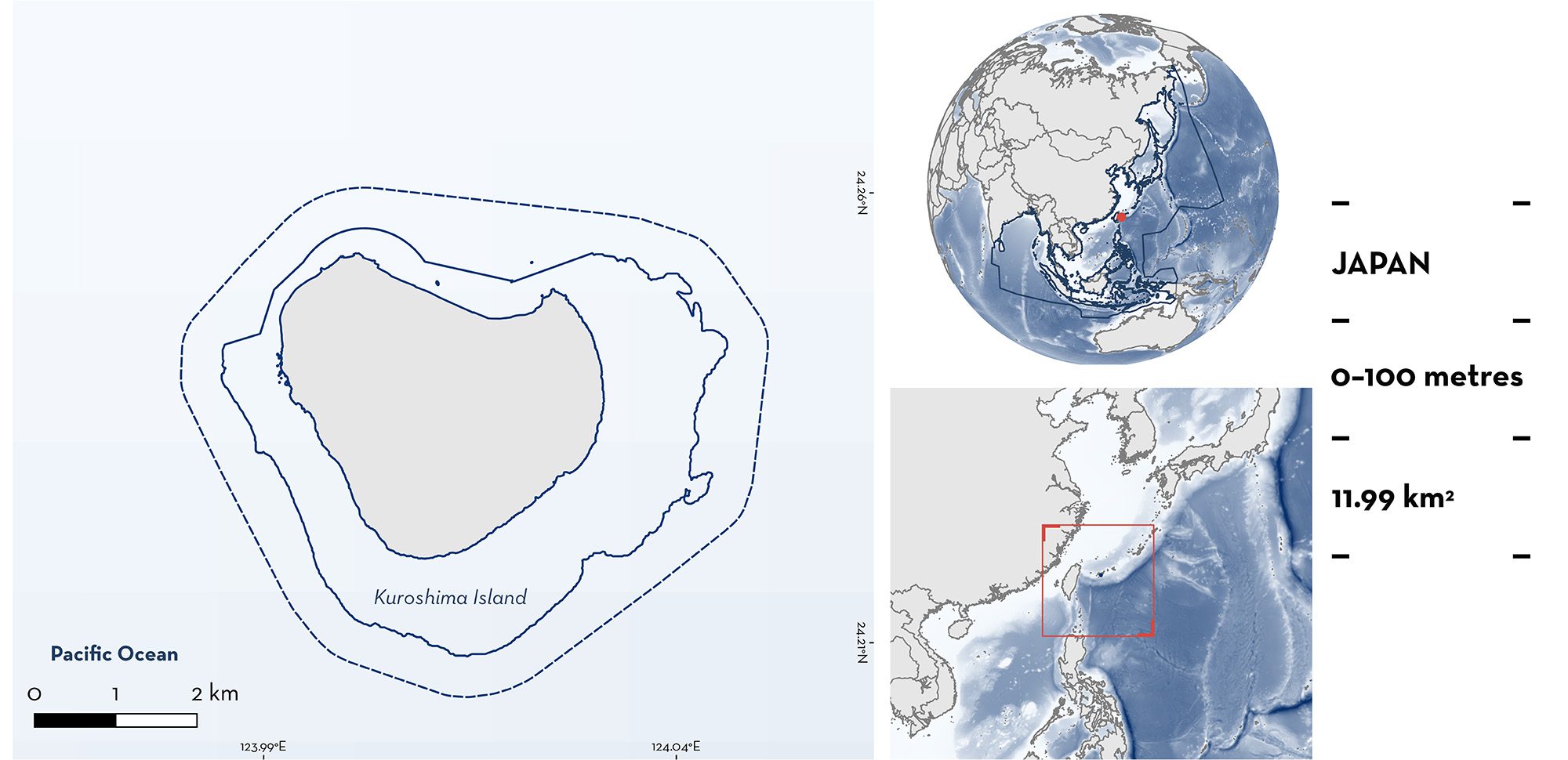
Kuroshima Island
Summary
Kuroshima Island is a small island located in the Yaeyama Archipelago in Japan. The island is surrounded by coral reef with a shallow inner side (<5 m deep) and a deeper outer reef (>20 m). The area is influenced by the Kuroshio Current. The area overlaps with one Key Biodiversity Area, one Ecologically or Biologically Significant Marine Area, and one National Park. Within this area there are: threatened species (e.g., Reef Manta Ray Mobula alfredi); reproductive areas (Sharptooth Lemon Shark Negaprion acutidens); and feeding areas (Reef Manta Ray).
Download factsheet
Kuroshima Island
DESCRIPTION OF HABITAT
Kuroshima Island is located in the Yaeyama Islands, Okinawa Prefecture, Japan. It is a small island located ~20 km southwest of Ishigaki port (Prime Scuba Ishigaki 2024). The Yaeyama Islands have a subtropical climate with the largest coral reef in Japan extending from Ishigaki Islands to Iriomote Island. Kuroshima Island is surrounded by a coral reef, enclosing a inner reef environment 2–3 m deep at low tide where seagrass and algae flourish. The outer reef is 10–20 m deep. During spring tide, the tidal range is about 2 m in the area (Kameda et al. 2023). The area is characterised by mild winters (months between December to February) due its location, with north wind and air temperatures of 15–20ºC (JMA 2024). The rainy season, known as Baiu, starts in early May and ends in late June (Okada & Yamazaki 2012). Tropical storms peak during the month of August and tropical cyclones affect the area during the boreal autumn (September–November) (JMA 2024).
The area is under the influence of the Kuroshio Current (Matsuda 1989). The Kuroshio Current is one of the western boundary currents of the subtropical North Pacific and is the dominating current in the East China Sea. It originates in the eastern Philippines, flows northward along the west boundary of the Pacific Ocean, and enters the East China Sea between Taiwan and Ishigaki (Zhang et al. 2012). This current is one of the most important routes for poleward heat transport and contributes greatly to the productivity of marine ecosystems along in the coastal regions of its route. The Kuroshio Current has significant spatial and temporal variability along its route, influencing biological resource availability off southwest Japan (Lizarbe Barreto et al. 2012; Andres et al. 2015; Morioka et al. 2019).
Kuroshima Island overlaps with the Yaeyama Island Key Biodiversity Area (KBA 2024), the Southwest Islands Ecologically or Biologically Significant Marine Area (EBSA; CBD 2024), and the Iriomote Ishigaki National Park (UNEP-WCMC 2024; Ministry of Environment, Government of Japan 2024).
This Important Shark and Ray Area is benthopelagic and is delineated from inshore and surface waters (0 m) to 100 m based on the bathymetry of the area.
CRITERION A
VULNERABILITY
Two Qualifying Species considered threatened with extinction according to the IUCN Red List of Threatened Species regularly occur in the area. These are the Endangered Sharptooth Lemon Shark (Simpfendorfer et al. 2021) and the Vulnerable Reef Manta Ray (Marshall et al. 2022).
CRITERION C
SUB-CRITERION C1 – REPRODUCTIVE AREAS
Kuroshima Island is an important reproductive area for one shark species.
Based on a mark-recapture experiment conducted in the area between August 2017 and October 2020, neonate and young-of-the-year (YOY) Sharptooth Lemon Sharks use the area during their first two years of life (A Yamamoto, K Kameda, N Suzuki unpubl. data 2020). Sharptooth Lemon Sharks are found regularly and predictably in the shallow waters around Kuroshima Island year-round with captures being higher between May and October (when sea surface temperature is >26ºC). During the study period, a total of 197 sharks were captured using longlines (n = 156) and gillnets (n = 71) in the shallow inner reef (5 m depth) around Kuroshima Island, and 141 were tagged and released. All animals captured were classified as immature (77.3 ± 11.4 cm total length [TL]). Size-at-maturity for this species is 220–240 cm TL (Ebert et al. 2021). Neonate and YOY individuals comprised 89.3% of records (45–91.5 cm TL; n = 176), followed by individuals up to two years of age (A Yamamoto et al. unpubl. data 2020). Size-at-birth for this species is 45–80 cm TL (Ebert et al. 2021), and the growth rate in Kuroshima Island was estimated to be 11.5 cm/year (A Yamamoto, K Kameda, N Suzuki unpubl. data 2020). During the recapture experiment, a total of 28 individuals where recaptured during an interval of between two and 354 days. Of these, 86.7% were recaptured within 3 km of their release site, indicating high residency (A Yamamoto, K Kameda, N Suzuki unpubl. data 2020).
CRITERION C
SUB-CRITERION C2 – FEEDING AREAS
Kuroshima Island is an important feeding area for one ray species.
Yaeyama Islands hold the largest known population of Reef Manta Rays in Japan where they can be seen year-round in different locations depending on the season (Kashiwagi 2014; Blue Japan 2024). Based on local ecological knowledge (LEK), Kuroshima Island is a well-known location to observe Reef Manta Rays (O’Malley et al. 2013) and aggregations up to 50 individuals can be observed feeding in the area on the outer reef off Nakamoto beach, east of Kuroshima Island (Selfish Ishigaki Island Marine Service 2024). Seasonal aggregations occur regularly and predictably during the winter between November–March when the is the main aggregation site in the Yaeyama Islands (Prime Scuba Ishigaki 2024). This is associated with manta ray reliance on dense prey assemblages occurring in the area (Kuroshima Institute 2007; Kashiwagi 2014; Blue Japan 2024; Prime Scuba Ishigaki 2024; Selfish Ishigaki Island Marine Service 2024). Reef Manta Rays are observed swimming with their mouths open and cephalic lobes in a funnel-like shape. Sightings are potentially linked to north wind and low water temperatures (K Kameda pers. obs. 2024).
Download factsheet
SUBMIT A REQUEST
ISRA SPATIAL LAYER REQUEST
To make a request to download the ISRA Layer in either a GIS compatible Shapefile (.shp) or Google Earth compatible Keyhole Markup Language Zipped file (.kmz) please complete the following form. We will review your request and send the download details to you. We will endeavor to send you the requested files as soon as we can. However, please note that this is not an automated process, and before requests are responded to, they undergo internal review and authorization. As such, requests normally take 5–10 working days to process.
Should you have questions about the data or process, please do not hesitate to contact us.

