ISRA FACTSHEETS
ISRA FACTSHEETS
NORTH AMERICAN PACIFIC
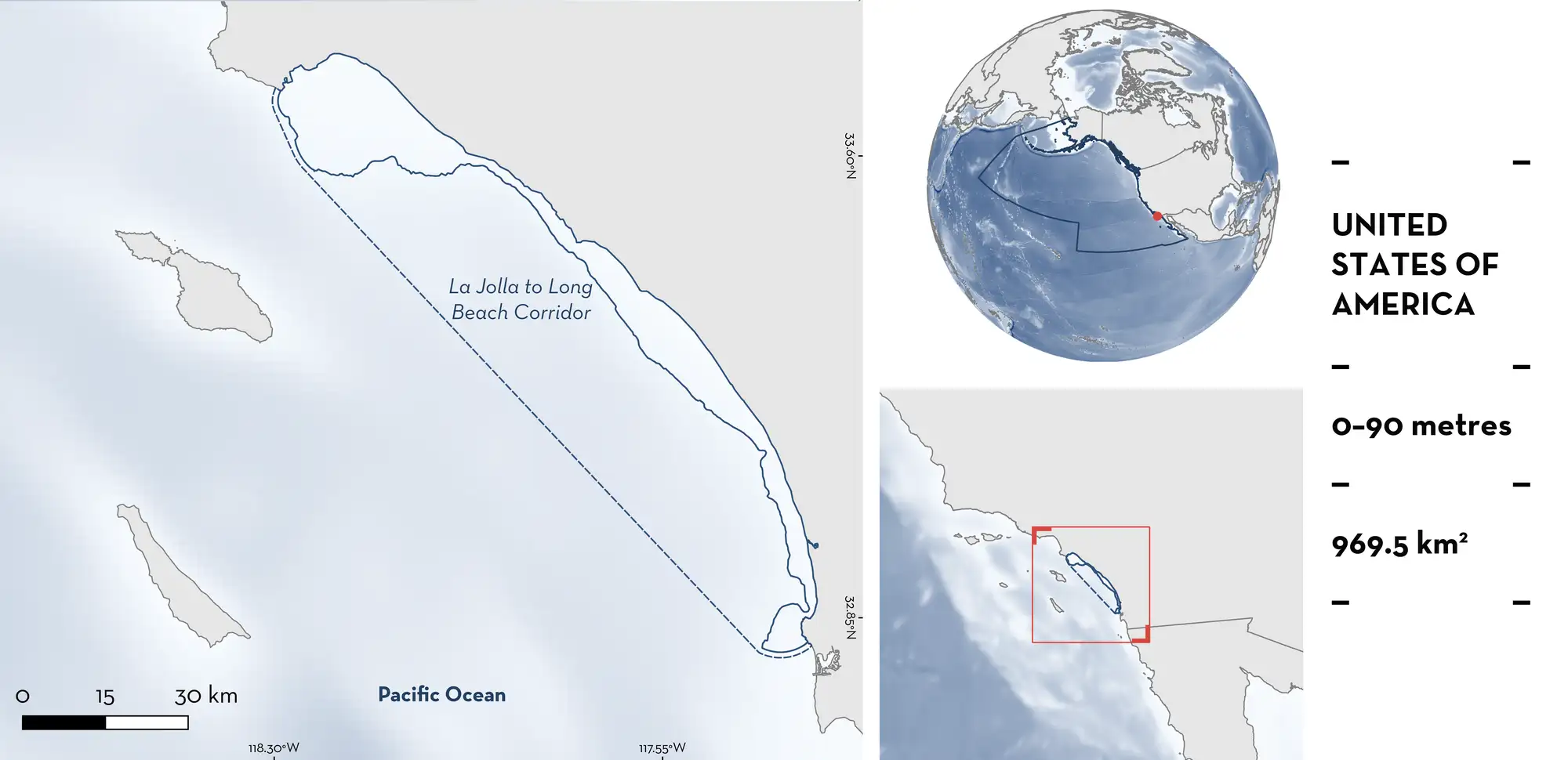
La Jolla to Long Beach Corridor
Summary
La Jolla to Long Beach Corridor is located in southern California, United States of America. This area is situated in the Southern California Bight and encompasses coastal waters from La Jolla in the south to Long Beach in the north. The habitat is characterised by sandy substrates with some rocky reefs and kelp forests. It is influenced by the Southern California Countercurrent, the Catalina Eddy, and weak upwelling. Within this area there are: areas important for movement (Shovelnose Guitarfish Pseudobatos productus).
Download factsheet
La Jolla to Long Beach Corridor
DESCRIPTION OF HABITAT
La Jolla to Long Beach Corridor is located in southern California, United States of America. This movement area is situated in the central part of the Southern California Bight and extends along ~150 km of coastline from La Jolla in the south to Long Beach in the north. The habitat is characterised mostly by sandy substrates, with areas of rocky reef that support kelp forests. La Jolla is an open cove that mimics a closed cove because of a submarine canyon that influences local wave dynamics (Nosal et al. 2013).
The area is influenced by complex circulation within the Southern California Bight, including the equatorward California Current offshore and the poleward-flowing Southern California Countercurrent nearshore, which advects warmer water from the south (Hickey 1993; Dong et al. 2009). These currents form a cyclonic gyre within the bight. Seasonal atmospheric forcing produces the Catalina Eddy, a cyclonic wind circulation pattern most common from April–September. Upwelling within the bight is comparatively weak relative to central California, contributing to the warmer nearshore waters that characterise this region.
This Important Shark and Ray Area is benthic and pelagic and is delineated from inshore and surface waters (0 m) to 90 m based on the global depth range of Qualifying Species and the bathymetry of the area.
CRITERION C
SUB-CRITERION C4 – MOVEMENT
La Jolla to Long Beach Corridor is an important movement area for Shovelnose Guitarfish.
Shovelnose Guitarfish regularly use this area to seasonally move among coastal locations (Gong et al. 2023). Twelve Shovelnose Guitarfish were tagged with acoustic transmitters in La Jolla in July–August of 2014, 2016, and 2017 and tracked for a six-year period between 2014–2020. Ten of these were mature females ranging from 123–147 cm total length (TL), and two individuals were mature males of 124 and 135 cm TL. The size-at-maturity for this species is 87–110 cm TL (Last et al. 2016). La Jolla is a boreal summer aggregation site for Shovelnose Guitarfish, as well as for other shark and ray species (Nosal et al. 2013, 2014). Almost all tracked Shovelnose Guitarfish (11 of 12 individuals) showed seasonal northward movements between La Jolla (in summer) to Long Beach (in winter). Four individuals showed this migration pattern consistently for at least three consecutive years after tagging. Some individuals continued further north past Long Beach, but the regular and predictable movements were limited to this area. Movements were driven mostly by photoperiod (Gong et al. 2023). Reproduction is a likely reason for the annual northward migration in winter and return movement to La Jolla in summer, given the species’ annual reproductive cycle (Márquez-Farías 2007; Gong et al. 2023), with mating and birthing likely happening within this movement corridor. A suspected Shovelnose Guitarfish nursery area has been studied between Huntington Beach and Long Beach, at the northern extent of the area, including the Bolsa Chica Ecological Reserve (Farrugia et al. 2011). There, scientific fishing surveys, comprising 144 beach seines and 218 longline sets between 2008–2009, captured 269 Shovelnose Guitarfish. Almost all (96%) were juveniles, and captures throughout the year, as well as passive acoustic telemetry of 23 individuals, suggest that juveniles have high site fidelity and do not seasonally migrate like the adults do (Farrugia et al. 2011). Combined, the data show that adult Shovelnose Guitarfish seasonally migrate through this area, potentially for reproductive purposes (Gong et al. 2023). This is the only area with evidence of regular movements for this range-restricted species that is distributed only in the California Current Large Marine Ecosystem (LME), the Gulf of California LME, and marginally in the Pacific Central-American Coast LME (Farrugia et al. 2016).
Download factsheet
SUBMIT A REQUEST
ISRA SPATIAL LAYER REQUEST
To make a request to download the ISRA Layer in either a GIS compatible Shapefile (.shp) or Google Earth compatible Keyhole Markup Language Zipped file (.kmz) please complete the following form. We will review your request and send the download details to you. We will endeavor to send you the requested files as soon as we can. However, please note that this is not an automated process, and before requests are responded to, they undergo internal review and authorization. As such, requests normally take 5–10 working days to process.
Should you have questions about the data or process, please do not hesitate to contact us.