ISRA FACTSHEETS
ISRA FACTSHEETS
AUSTRALIA AND SOUTHEAST INDIAN OCEAN
Lady Elliot Island
Summary
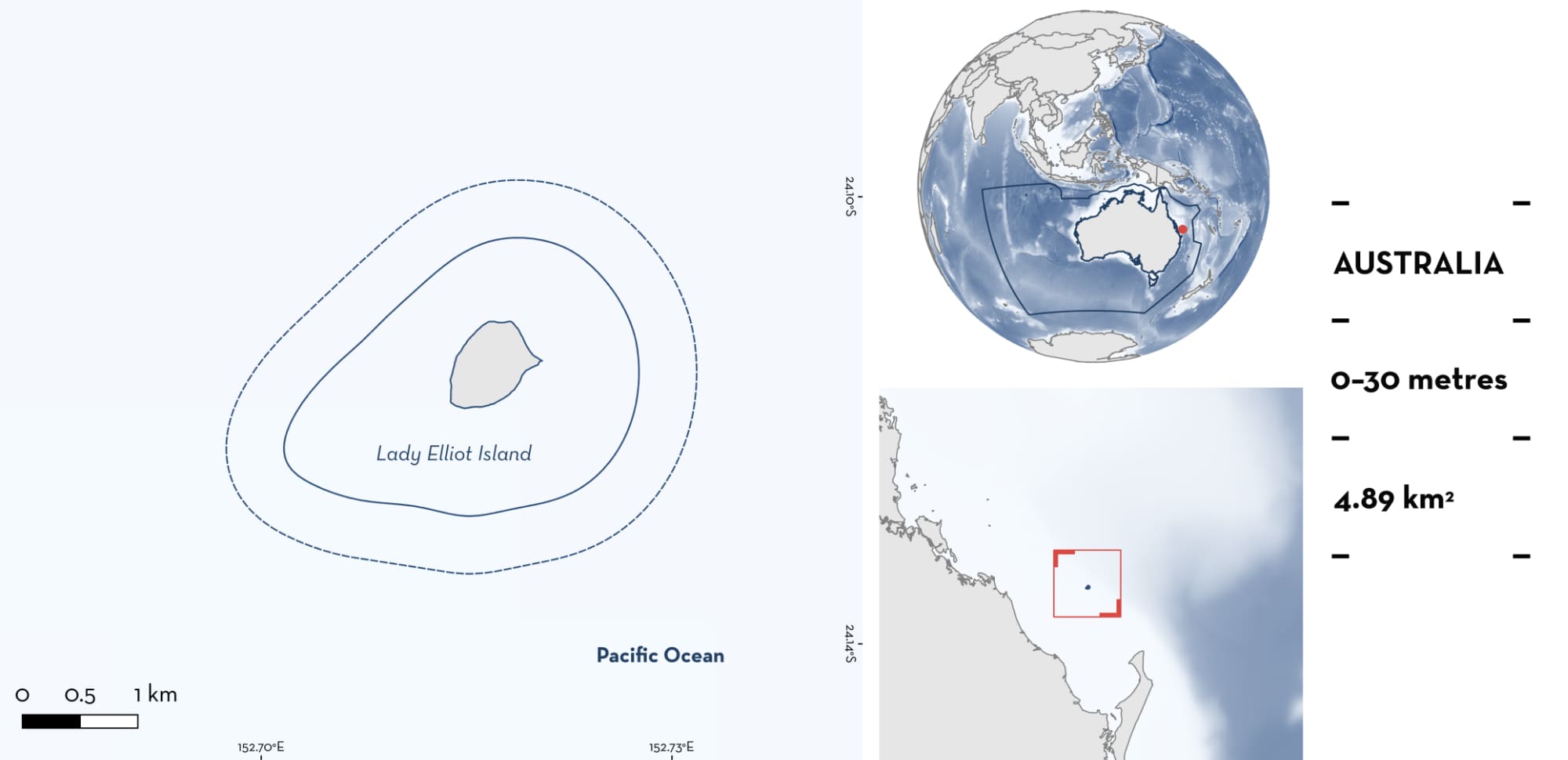
Lady Elliot Island is located in Queensland, Australia. The area surrounds a small coral cay island at the southern end of the Great Barrier Reef with a large reef flat and lagoon on its eastern side. On its western side, a narrow reef flat leads to scattered coral bommies. The area is influenced by the East Australian Current and the mesoscale oceanographic feature of the Capricorn Eddy bringing cooler, nutrient-enriched waters onto the shelf. It overlaps with the Capricornia Cays Key Biodiversity Area and the Great Barrier Reef Marine Park. Within the area there are: threatened species (e.g., Silvertip Shark Carcharhinus albimarginatus); range-restricted species (Epaulette Shark Hemiscyllium ocellatum); reproductive areas (Reef Manta Ray Mobula alfredi); feeding areas (Reef Manta Ray); and undefined aggregations (e.g., Spotted Eagle Ray Aetobatus ocellatus).
Download factsheet
Lady Elliot Island
DESCRIPTION OF HABITAT
Lady Elliot Island is located in Queensland, Australia. The area surrounds a small coral cay island at the southern end of the Great Barrier Reef with a large reef flat and lagoon on its eastern side, and a narrow reef flat on its western side leading to scattered coral bommies (AO Armstrong pers. obs. 2025). The habitat is characterised by hard and soft coral cover, and sandy substrates. The island itself is situated on the leeward (western) side of the main reef flat and is frequented by up to 50,000 breeding pairs of seabirds per year, resulting in high nutrient loads in the groundwater and potentially entering the surrounding reef waters (Erler et al. 2024).
The area is influenced by the East Australian Current, the poleward flowing western boundary current of the South Pacific Gyre (Suthers et al. 2011). The East Australian Current flow is strongest in the austral summer, and the formation of eddies along this coastline also fluctuates seasonally (Ridgway & Hill 2009). Lady Elliot Island is located in close proximity (~7 km) to the continental shelf and the mesoscale oceanographic feature of the Capricorn Eddy (Weeks et al. 2015). The Capricorn Eddy can trigger upwelling of cooler, nutrient-enriched waters onto the shelf and transport these waters to the reef zone.
The area overlaps with the Capricornia Cays Key Biodiversity Area (KBA 2025) and the Great Barrier Reef Marine Park – Marine National Park Zone (UNEP-WCMC & IUCN 2025).
This Important Shark and Ray Area is benthic and pelagic and is delineated from inshore and surface waters (0 m) to 30 m based on the bathymetry of the area.
CRITERION A
VULNERABILITY
Three Qualifying Species considered threatened with extinction according to the IUCN Red List of Threatened Species regularly occur in the area. These are the Endangered Spotted Eagle Ray (Finucci et al. 2024); and the Vulnerable Silvertip Shark (Rigby et al. 2024) and Reef Manta Ray (Marshall et al. 2022).
CRITERION B
RANGE RESTRICTED
This area holds the regular presence of Epaulette Sharks as a resident range-restricted species. This species occurs year-round in the area and is regularly encountered on the reef flat (AO Armstrong, J Blackmore, & CL Dudgeon pers. obs. 2025). Observations of this species are most common during reef walks at low-tide, between sunset and sunrise when the species is most active, with foraging behaviour and egg cases also observed (AO Armstrong, J Blackmore, & CL Dudgeon pers. obs. 2025). On average four sharks can be encountered during a 60-minute reef walk, with Epaulette Sharks observed on every reef walk, weather dependent. This area sits at the southern end of the species’ range, and is relatively isolated, with available habitat patchy and disconnected (CL Dudgeon pers. obs. 2025). Due to the area’s isolated location as a coral cay at the southern end of the Great Barrier Reef, and the availability of the species’ preferred habitat of shallow reef flat, this area provides important habitat for this range-restricted species comparative to the broader region. This species occurs primarily in the East Central Australian Shelf Large Marine Ecosystem (LME) and only marginally into the Northeast Australian Shelf LME.
CRITERION C
SUB-CRITERION C1 – REPRODUCTIVE AREAS
Lady Elliot Island is an important reproductive area for one ray species.
Between 1980–2025, over 1,700 Reef Manta Rays were identified on the east coast of Australia using photo-identification from sightings from citizen science and researcher surveys. A total of 1,147 of these individuals (67.5%) were sighted at Lady Elliot Island (Project Manta unpubl. data 2025). This was based on 7,007 encounters (69.8% of the sightings along the entire east coast of Australia; n = 10,038). Almost all sightings have been since 2007 when dedicated research surveys began around the island (99.6%; n = 6,979; Project Manta unpubl. data 2025). Reef Manta Rays are sighted at Lady Elliot Island year-round with a seasonal peak of sightings falling between May–October (Project Manta unpubl. data 2025). Observed behaviour was recorded for 2,195 sightings (31.3%). Of these, there were 159 observations of courtship (7%), 59 observations of mating scars on the pectoral fins (2.7%), and 230 instances of pregnancy reported based on visibly distended abdomens (Project Manta unpubl. data 2025). Four neonates were also recorded in the area (n = 1 in 2020, n = 1 in 2022, and n = 2 in 2025), assessed based on their size (<150 cm disc width; DW) and observations of false umbilical scars or wing creases (both signs of recent birth; Project Manta unpubl. data 2025). Size-at-birth for Reef Manta Rays is 130–150 cm DW (Last et al. 2016). Investigations into the population dynamics of Reef Manta Rays around the island found that there was a significant bias towards females in the sex ratio (1.2:1 female-to-male ratio; p < 0.05; proportion female = 0.56, 95% CI = 0.52–0.59), with females more commonly resighted than males (Couturier et al. 2014), adding support to the importance of this area for the reproduction of this species.
CRITERION C
SUB-CRITERION C2 – FEEDING AREAS
Lady Elliot Island is an important feeding area for one ray species.
Between 1980–2025, over 1,700 Reef Manta Rays were identified on the east coast of Australia using photo-identification from sightings from citizen science and researcher surveys. A total of 1,147 of these individuals (67.5%) were sighted at Lady Elliot Island (Project Manta unpubl. data 2025). This was based on 7,007 encounters (69.8% of the sightings along the entire east coast of Australia; n = 10,038). Almost all sightings have been since 2007 when dedicated research surveys began around the island (99.6%; n = 6,979; Project Manta unpubl. data 2025). Reef Manta Rays are sighted at Lady Elliot Island year-round with a seasonal peak of sightings falling between May–October (Project Manta unpubl. data 2025). Observed behaviour was recorded for 2,195 sightings (31.3%). Of these, there were 333 observations of feeding behaviour (Project Manta unpubl. data 2025), defined as swimming at the surface with an open mouth and cephalic lobes forming a funnel to aid prey capture (AO Armstrong unpubl. data 2025). In addition, in-situ analysis of the prey environment for Reef Manta Rays in the area found their food is dominated by copepod crustaceans, and foraging activity is related to the density of zooplankton in the water (Armstrong et al. 2016). The largest feeding aggregation observed off the island was in 2013 when a combination of oceanographic and weather events resulted in 150+ Reef Manta Rays observed feeding in proximity to the island (Weeks et al. 2015). However, regular feeding aggregations of 10+ Reef Manta Rays are observed off the south-western side of the island when the wind and currents concentrate the zooplankton in this part of the area (AO Armstrong pers. obs. 2025). Further, an investigation into Reef Manta Ray sightings using a logbook of records from around the island identified three main observed behaviours: cruising, cleaning, and feeding (Jaine et al. 2012). It was found that the peak in feeding observations was earlier in the season and preceded the peak in the other behaviours that followed in later months, suggesting the aggregation at this site is driven by food availability in the first instance. Reef Manta Rays are known to attend cleaning stations in proximity to feeding areas (Armstrong et al. 2021). From the sightings in the area where the observed behaviour was recorded (n = 2,195 sightings; 31.3%), 1,684 were of cleaning (76.7%; Project Manta unpubl. data 2025), demonstrating that this area provides habitat for multiple uses for this species.
CRITERION C
SUB-CRITERION C5 – UNDEFINED AGGREGATIONS
Lady Elliot Island is an important area for undefined aggregations of one shark and one ray species.
Between 2016–2023, monthly snorkel tours were conducted on the eastern side of the island, within the area (J Blackmore pers. obs. 2025). Observations are anecdotal, with no formal records maintained. Silvertip Sharks were observed year-round on almost all tours to this part of the area. Individual Silvertip Sharks comprised the most common observations, however, aggregations of up to four sharks are observed on a single 60-minute tour. Most sharks are seen cruising beyond the reef edge (J Blackmore pers. obs. 2025). Between 2020–2025, dedicated research trips were conducted three times a year in the area (February, June, October; CL Dudgeon & AO Armstrong pers. obs. 2025). During these fieldtrips, twice daily 60-minute SCUBA dives were conducted over an average seven-day duration (~42 dives per year). Silvertip Sharks were observed year-round on the eastern side of the island, within the area. Survey effort in this part of the area is weather dependent, with only ~10% of dives conducted on the eastern side of the area. On average, ~2 Silvertip Sharks are observed on a single dive (range 1–4 sharks), with at least one individual observed on every dive (CL Dudgeon & AO Armstrong unpubl. data 2025). However, 3–4 individuals were seen regularly and there are occasional citizen science reports of larger aggregations up to 100 Silvertip Sharks (I Christie & O Richardson pers. comm. 2025). The majority of sightings (~90%) are of sharks cruising along the reef edge, but cleaning was also regularly observed at a dive site called Hiro’s Cave (CL Dudgeon & AO Armstrong unpubl. data 2025). When cleaning, Silvertip Sharks are observed to swim with their pectoral fins splayed and their mouth open in an almost vertical manner across a coral reef outcrop, while cleaner wrasse clean them (AO Armstrong pers. obs. 2025). More information is needed to confirm the nature and function of these aggregations.
Between 2016–2023, daily snorkel tours were conducted in the area (J Blackmore pers. obs. 2025). Observations are anecdotal, with no formal records maintained. Spotted Eagle Rays were observed year-round on almost all tours. On average aggregations of five Spotted Eagle Rays are observed on a single 60-minute tour (range 1–50 rays). Most rays are seen cruising in small groups, and courtship behaviour has been observed on occasion (J Blackmore pers. obs. 2025). Between 2020–2025, dedicated research trips were conducted three times a year in the area (February, June, October; CL Dudgeon & AO Armstrong pers. obs. 2025). During these fieldtrips, twice daily 60-minute SCUBA dives were conducted over an average seven-day duration (~42 dives per year). Observations are anecdotal, with no formal records maintained. Spotted Eagle Rays were observed year-round in the area. On average, ~3 Spotted Eagle Rays are observed on a single dive (range 1–30+ rays) (CL Dudgeon & AO Armstrong unpubl. data 2025). However, there have been at least two citizen science reports of larger aggregations of 100+ Spotted Eagle Rays in 2019 and 2025 (J Somerville & B Young pers. comm. 2025). The majority of sightings (~90%) are of rays cruising in small groups, but individuals are also regularly observed cleaning, and pregnancy and courtship have also been recorded (CL Dudgeon & AO Armstrong unpubl. data 2025). In addition to these observations, there are 26 records of Spotted Eagle Rays from within the area on iNaturalist, including two records of aggregations (n = 4 individuals in 2017 and n = 13 individuals in 2024; iNaturalist 2025). The next available records of this species from iNaturalist are almost 100 km north of this area, highlighting its importance. However, more information is needed to confirm the nature and function of these aggregations.
Download factsheet
SUBMIT A REQUEST
ISRA SPATIAL LAYER REQUEST
To make a request to download the ISRA Layer in either a GIS compatible Shapefile (.shp) or Google Earth compatible Keyhole Markup Language Zipped file (.kmz) please complete the following form. We will review your request and send the download details to you. We will endeavor to send you the requested files as soon as we can. However, please note that this is not an automated process, and before requests are responded to, they undergo internal review and authorization. As such, requests normally take 5–10 working days to process.
Should you have questions about the data or process, please do not hesitate to contact us.