ISRA FACTSHEETS
ISRA FACTSHEETS
MEDITERRANEAN AND BLACK SEAS REGION
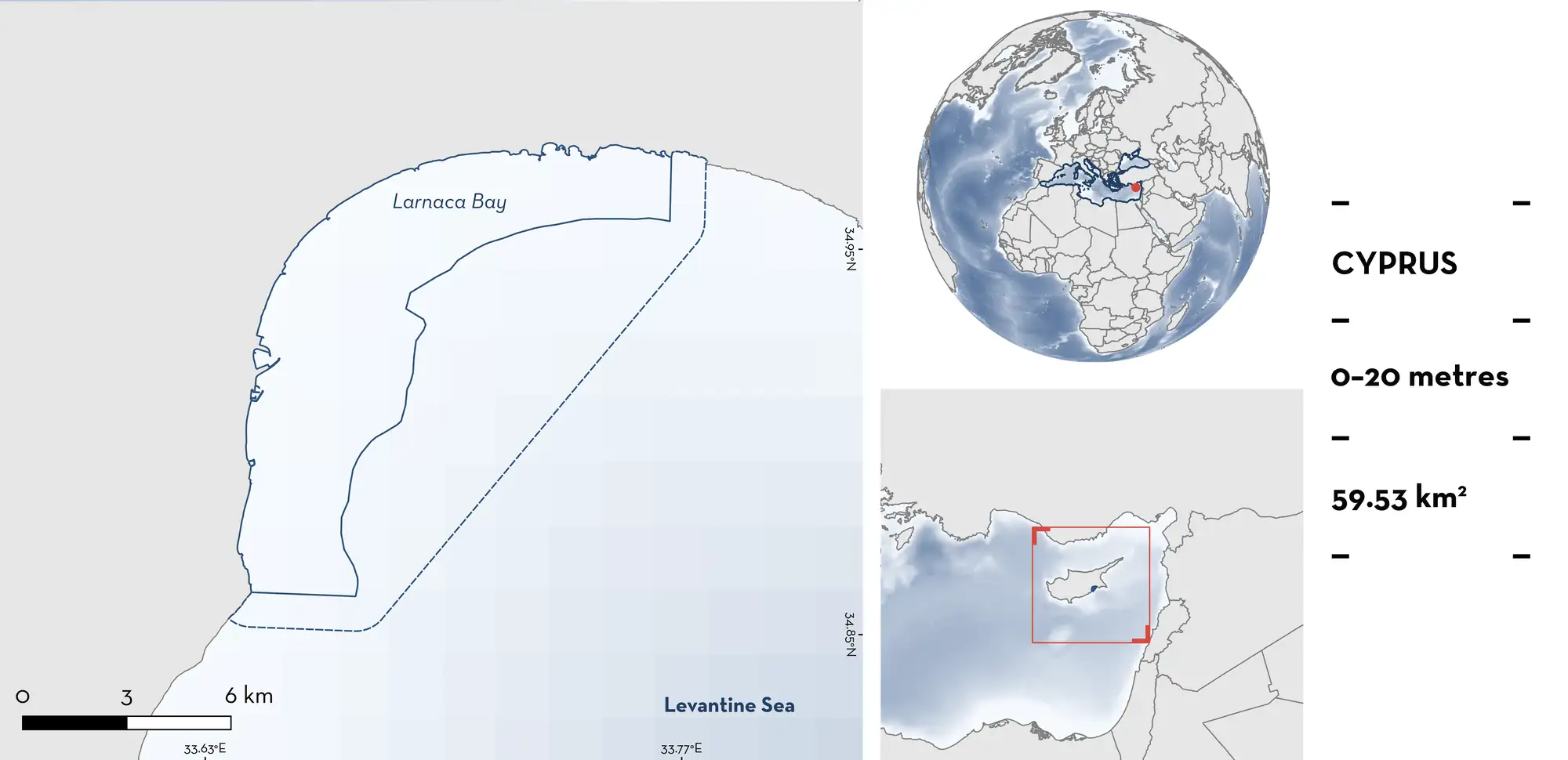
Larnaca Bay
Summary
Larnaca Bay is located along the southeast coast of Cyprus within the Levantine Basin. The area is characterised by sandy-muddy substrates, seagrass meadows, artificial coastal structures, and adjacent reef habitats, with localised hard substrata supporting macroalgal assemblages. Within this area there are: threatened species and reproductive areas (Blackchin Guitarfish Glaucostegus cemiculus).
Download factsheet
Larnaca Bay
DESCRIPTION OF HABITAT
Larnaca Bay is located along the southeast coast of Cyprus within the Levantine Basin. The area comprises an extensive open embayment characterised by sandy-muddy substrates, seagrass meadows (Neptune Grass Posidonia oceanica and Slender Seagrass Cymodocea nodosa), artificial coastal structures (e.g., port infrastructure and breakwaters), and adjacent reef habitats (Keramidas et al. 2018; DFMR 2022). Hard substrates support macroalgal assemblages dominated by brown algae of the Cystoseira complex and Sargassum genus, contributing to habitat complexity (Keramidas et al. 2018; DFMR 2022).
This Important Shark and Ray Area is benthic and is delineated from inshore and surface waters (0 m) to 20 m based on the bathymetry of the area.
CRITERION A
VULNERABILITY
One Qualifying Species considered threatened with extinction according to the IUCN Red List of Threatened Species regularly occurs in the area. This is the Critically Endangered Blackchin Guitarfish (Kyne & Jabado 2019).
CRITERION C
SUB-CRITERION C1 – REPRODUCTIVE AREAS
Larnaca Bay is an important reproductive area for one ray species.
Between December 2012 and December 2025, a total of 828 Blackchin Guitarfish were recorded across Cyprus from multiple data sources (The MECO project unpubl. data 2012–2025). These included citizen science observations collected from small-scale and recreational fishers, SCUBA divers, free divers, and beach users through the Mediterranean Elasmobranch Citizen Observations (MECO) project, as well as targeted scientific surveys and records from recreational fishing competitions (The MECO project unpubl. data 2012–2025). Blackchin Guitarfish records increased markedly after 2022, reflecting intensified research effort and the implementation of structured citizen science and research initiatives. Prior to this coordinated effort, available information was limited, and the species was widely regarded as rare in Cyprus, likely a consequence of underreporting and the absence of systematic monitoring.
Size-at-birth of the species is 20–35 cm total length (TL; Otero et al. 2019; Azrieli et al. 2024) and young-of-the-year (YOY) are =<60 cm TL (Başusta et al. 2020). Most recorded individuals corresponded to early life-stages, comprising 59 neonates and 591 YOY. Spatially, these early life-stages were strongly concentrated within three coastal bays: Larnaca Bay (southeast coast; 38% of all early life-stages recorded), Episkopi Bay (south coast; 13%), and Chrysochou Bay (northwest coast; 24%). Two other bays (Limassol Bay and Morphou Bay) were also surveyed but recorded only very small numbers of Blackchin Guitarfish (n = 18 and n = 1, respectively), highlighting the importance of the three bays where the species were more commonly encountered.
Early life-stages were observed in Larnaca Bay between 2015–2025, with a clear seasonal concentration during late boreal spring to autumn and a peak between August and November. Records were derived primarily from recreational fishers (shore-based angling and surf casting), complemented by targeted research activities. Between December 2015 and December 2025, a total of 250 early life-stage individuals (11 neonates; 239 YOY; 76.4% of all Blackchin Guitarfish recorded in Larnaca Bay) were recorded in the area, comprising 71 individuals between 2015 and 2022, 87 in 2023, 52 in 2024, and 34 in 2025 (The MECO project unpubl. data 2012–2025). These were documented across 53 sampling days, with daily counts reaching up to 26 individuals in a single day (12 December 2024). Size ranged from 18.5–60.0 cm TL, corresponding to neonates and YOY. The consistent presence of early life-stages across multiple years, combined with observations of neonates with umbilical scars, indicates recent parturition and recurrent use of the area as a nursery habitat. In addition to neonates and YOY, 48 juveniles and subadults were recorded in the bay, alongside 14 adults. Nine of these adults measured between 130 and 170 cm TL, corresponding to sexually mature individuals (Enajjar et al. 2012).
Download factsheet
SUBMIT A REQUEST
ISRA SPATIAL LAYER REQUEST
To make a request to download the ISRA Layer in either a GIS compatible Shapefile (.shp) or Google Earth compatible Keyhole Markup Language Zipped file (.kmz) please complete the following form. We will review your request and send the download details to you. We will endeavor to send you the requested files as soon as we can. However, please note that this is not an automated process, and before requests are responded to, they undergo internal review and authorization. As such, requests normally take 5–10 working days to process.
Should you have questions about the data or process, please do not hesitate to contact us.