ISRA FACTSHEETS
ISRA FACTSHEETS
POLAR WATERS REGION
Látra End Moraine
Summary
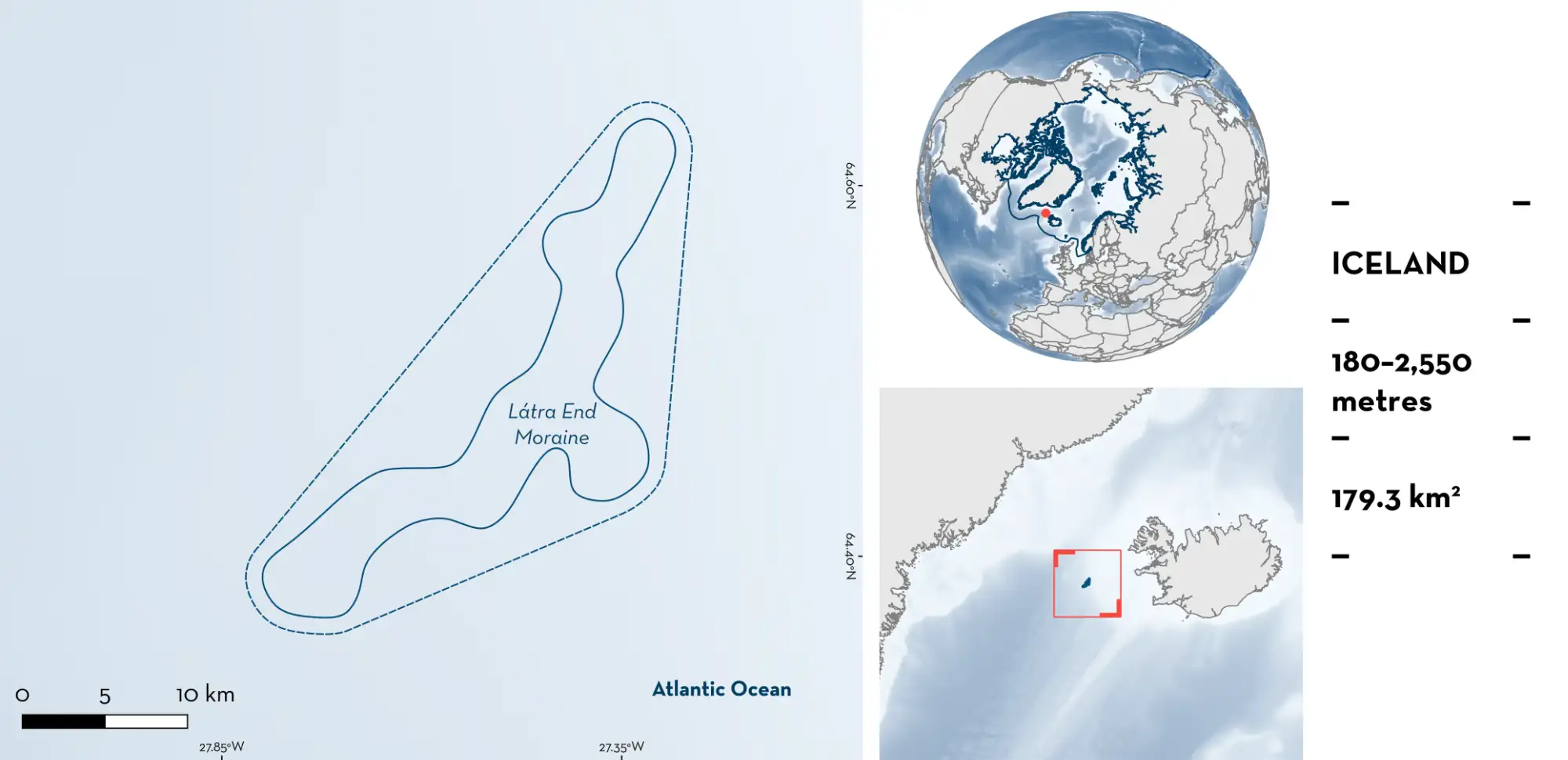
Látra End Moraine is situated off the west coast of Iceland, between the Látra Bank and Denmark Strait. This area is characterised by sand, silt, and clay substrates. This shelf is influenced by the warm and saline Irminger Current, which has strong seasonal variation in the inflow of Atlantic Water. Within this area there are: reproductive areas (Black Dogfish Centroscyllium fabricii).
Download factsheet
Látra End Moraine
DESCRIPTION OF HABITAT
Látra End Moraine is located ~400 km off the west coast of Iceland. It is situated between Iceland and Greenland, east of Denmark Strait and west of Látra Bank (Syvitski et al. 1999). It overlaps with the longest shelf moraine on the Icelandic Shelf which is the best-preserved frontal moraine found outside a trough (Spagnolo & Clark 2009). The sediment is a mixture of sand, silt, and clay (Ostmann et al. 2014).
The area is influenced by the Irminger Current which is a warm and saline component of the Atlantic Water inflow in the Nordic Sea (Logemann & Harms 2006; Oskarsson et al. 2009; Zhao et al. 2018). There is seasonal variation in the Atlantic Water transport, with a minimum in the late boreal spring and a maximum in summer (Zhao et al. 2018).
This Important Shark and Ray Area is benthic and pelagic and subsurface and is delineated from 180 m to 2,550 m based on the depth range of Qualifying Species.
CRITERION C
SUB-CRITERION C1 – REPRODUCTIVE AREAS
Látra End Moraine is an important reproductive area for one shark species.
Icelandic groundfish demersal trawl surveys were undertaken between 2010–2025 around the coast of Iceland (ICES unpubl. data. 2026). Surveys were undertaken across International Council for the Exploration of the Sea (ICES) statistical area 27.5.a (covering large proportions of the Icelandic Exclusive Economic Zone). Clusters of Black Dogfish at early life-stages were caught in distinct areas, suggesting the most suitable habitats for sustaining these animals therein are fragmented in Iceland.
Between 2010–2025, a total of 809 Black Dogfish were recorded in this area. Of these, 34 (4.2%) were classed as neonates/young-of-the-year (YOY) measuring less than or equal to 25 cm total length (TL) (ICES unpubl. data. 2026). The species has a size-at-birth of 15–20 cm TL (Ebert et al. 2021). Neonates/YOY were recorded in 2010 (n = 2), 2013 (n = 1), 2014 (n = 1), 2016 (n = 9), 2019 (n = 3), 2020 (n = 2), 2021 (n = 5), 2022 (n = 2), 2023 (n = 4), 2024 (n = 2), and 2025 (n = 3). The majority were caught in October (n = 32), with the other two neonate/YOY individuals being caught in September (ICES unpubl. data. 2026). Although the sample size is relatively small (likely due to fishing gear selectivity), this area hosts 65% of the 52 neonate/YOY Black Dogfish recorded in the broader moraine area, and 28% of the 121 neonate/YOY Black Dogfish recorded across all respective surveys in Iceland (of the 10,488 individuals of all life-stages recorded across the entire survey area; ICES unpubl. data. 2026). This also represents the highest cluster of captures of this species and life-stage from these surveys across Iceland.
Download factsheet
SUBMIT A REQUEST
ISRA SPATIAL LAYER REQUEST
To make a request to download the ISRA Layer in either a GIS compatible Shapefile (.shp) or Google Earth compatible Keyhole Markup Language Zipped file (.kmz) please complete the following form. We will review your request and send the download details to you. We will endeavor to send you the requested files as soon as we can. However, please note that this is not an automated process, and before requests are responded to, they undergo internal review and authorization. As such, requests normally take 5–10 working days to process.
Should you have questions about the data or process, please do not hesitate to contact us.