ISRA FACTSHEETS
ISRA FACTSHEETS
AUSTRALIA AND SOUTHEAST INDIAN OCEAN
Lidarnardi
Summary
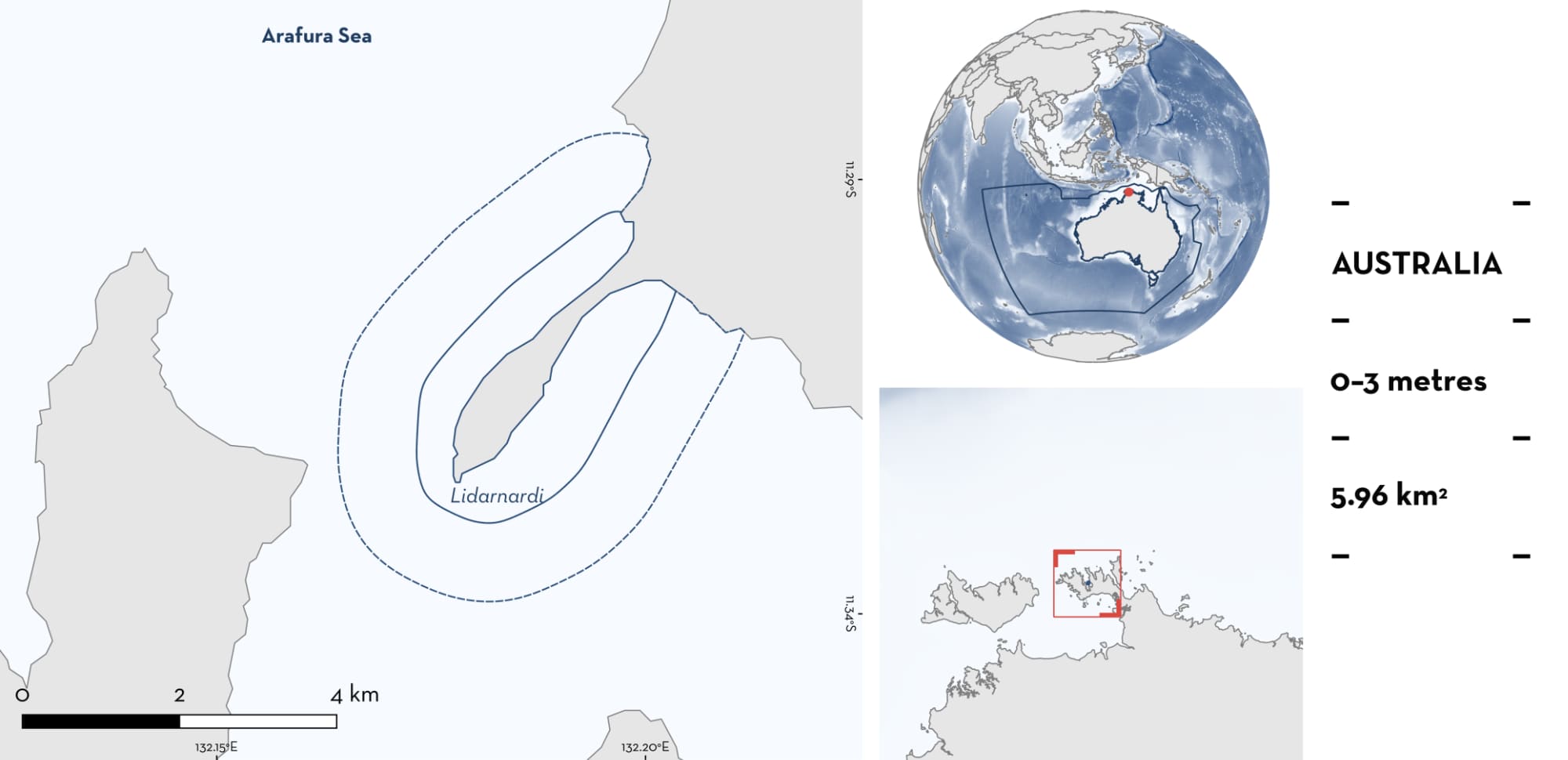
Lidarnardi is located in the Northern Territory, Australia. The area encompasses a narrow south-southwest pointing spit on the eastern side of Port Essington on the Cobourg Peninsula. Habitats comprise a gently sloping sandy beach, a series of shallow gutters, sandbars, silty-sand substrates, and fringing mangroves. This area overlaps with Garig Gunak Barlu National Park. Within the area there are: threatened species and reproductive areas (Green Sawfish Pristis zijsron).
Download factsheet
Lidarnardi
DESCRIPTION OF HABITAT
Lidarnardi is located in the Northern Territory, Australia. The area encompasses a narrow south-southwest pointing spit on the eastern side of Port Essington on the Cobourg Peninsula. Cobourg Peninsula sits in Arnhem Land between the Arafura Sea to the north and Van Diemen Gulf to the south. The area is comprised of two distinct sections (Lidarnardi East and Lidarnardi West) located on either side of the point (Davies et al. 2022). Lidarnardi East is a large, shallow, southeast-facing bay in the lee of a small sandbar. At high tide, the sparse fringing vegetation of mangroves is inundated. Lidarnardi West is a northwest-facing, gently sloping sandy beach with a series of shallow gutters. At high tide, there is still a strip of exposed sand between the water’s edge and the surrounding savannah woodland. The substrate on both sides comprises soft silty-sand sediments (Davies et al. 2022).
The Arafura Sea is a shallow tropical sea with ocean circulation driven by seasonal monsoonal winds. These comprise southeast trade winds during the dry season (May–September) and northwest monsoon winds during the wet season (December–March). The wet season is characterised by tropical storm activity and periodic cyclones. Seasonal upwelling during the southeast monsoon brings nutrient-rich waters from the Banda Sea onto the Arafura Shelf, supporting elevated primary productivity (Kämpf 2016). The area experiences semi-diurnal tides with a tidal range of 2.0–2.5 m (CPSMPB & PWS 2011). There is limited dry season discharge due to a lack of creeks on the Cobourg Peninsula and water turbidity is generally low (CPSMPB & PWS 2011).
The area overlaps with Garig Gunak Barlu National Park (CPSMPB & PWS 2011).
This Important Shark and Ray Area is benthic and is delineated from inshore and surface waters (0 m) to 3 m based on the bathymetry of the area.
CRITERION A
VULNERABILITY
One Qualifying Species considered threatened with extinction according to the IUCN Red List of Threatened Species regularly occurs in the area. This is the Critically Endangered Green Sawfish (Harry et al. 2022).
CRITERION C
SUB-CRITERION C1 – REPRODUCTIVE AREAS
Lidarnardi is an important reproductive area for one ray species.
Green Sawfish sightings from park rangers and local residents together with drone surveys highlight Lidarnardi as a hotspot for the species within the broader Garig Gunak Barlu National Park (Davies et al. 2022). Drone footage from a national park ranger showed an aggregation of at least nine small (estimated size ~100 cm total length; TL) Green Sawfish in the area in January 2018 (Davies et al. 2022). This local ecological knowledge and footage prompted formal drone surveys of the area with the aim of characterising this aggregation. In September 2019, drone scoping flights (to assess site and weather conditions) and survey transects (200 m length; 10 m height; 13.13 m transect width; ~2 m/s airspeed) were conducted (Davies et al. 2022). Green Sawfish were recorded quantitatively on the transect surveys and opportunistically on the scoping flights. For transect flights, Green Sawfish density was calculated, and size was estimated from still photos captured from the video footage with a submerged mock sawfish cut-out used to calibrate length measurements (although sizes are considered estimations only; Davies et al. 2022). Lidarnardi was surveyed on eight separate days with a total of seven scoping flights and 26 transect flights (Davies et al. 2022).
Green Sawfish (a total of 41 individuals) were recorded on seven out of eight survey days (88%), on eight of 26 transect flights (31%), and on five of seven scoping flights (71%). Across all transect flights, the mean number of individual Green Sawfish was 0.9 ± 1.9 (range: 0–8; total of 23 individuals). When Green Sawfish were recorded on transect flights (n = 8), the mean number of individuals was 3.2 ± 2.1 (range: 1–8). On transect flights with Green Sawfish present, density ranged from 3.8 animals per hectare to 30.5 animals per hectare. The estimated size of individual Green Sawfish (n = 23) was 57–167 cm total length (TL), with most in the size range 60–100 cm TL (Davies et al. 2022). Size-at-birth of the species likely averages 75–90 cm TL (although there are reports of sizes as small as 61 cm TL; Lear et al. 2023) and young-of-the-year (YOY) sizes are estimated at <117 cm TL based on growth curves (Lear et al. 2023). Green Sawfish at Lidarnardi are therefore early life-stages with most being neonate/YOY and the largest (167 cm TL) being ~2.5 years old, which is well under the size-at-maturity of 330–380 cm TL (Lear et al. 2023). This demonstrates the importance of this area for multiple early life-stages.
Download factsheet
SUBMIT A REQUEST
ISRA SPATIAL LAYER REQUEST
To make a request to download the ISRA Layer in either a GIS compatible Shapefile (.shp) or Google Earth compatible Keyhole Markup Language Zipped file (.kmz) please complete the following form. We will review your request and send the download details to you. We will endeavor to send you the requested files as soon as we can. However, please note that this is not an automated process, and before requests are responded to, they undergo internal review and authorization. As such, requests normally take 5–10 working days to process.
Should you have questions about the data or process, please do not hesitate to contact us.