ISRA FACTSHEETS
ISRA FACTSHEETS
AUSTRALIA AND SOUTHEAST INDIAN OCEAN
Lizard Island
Summary
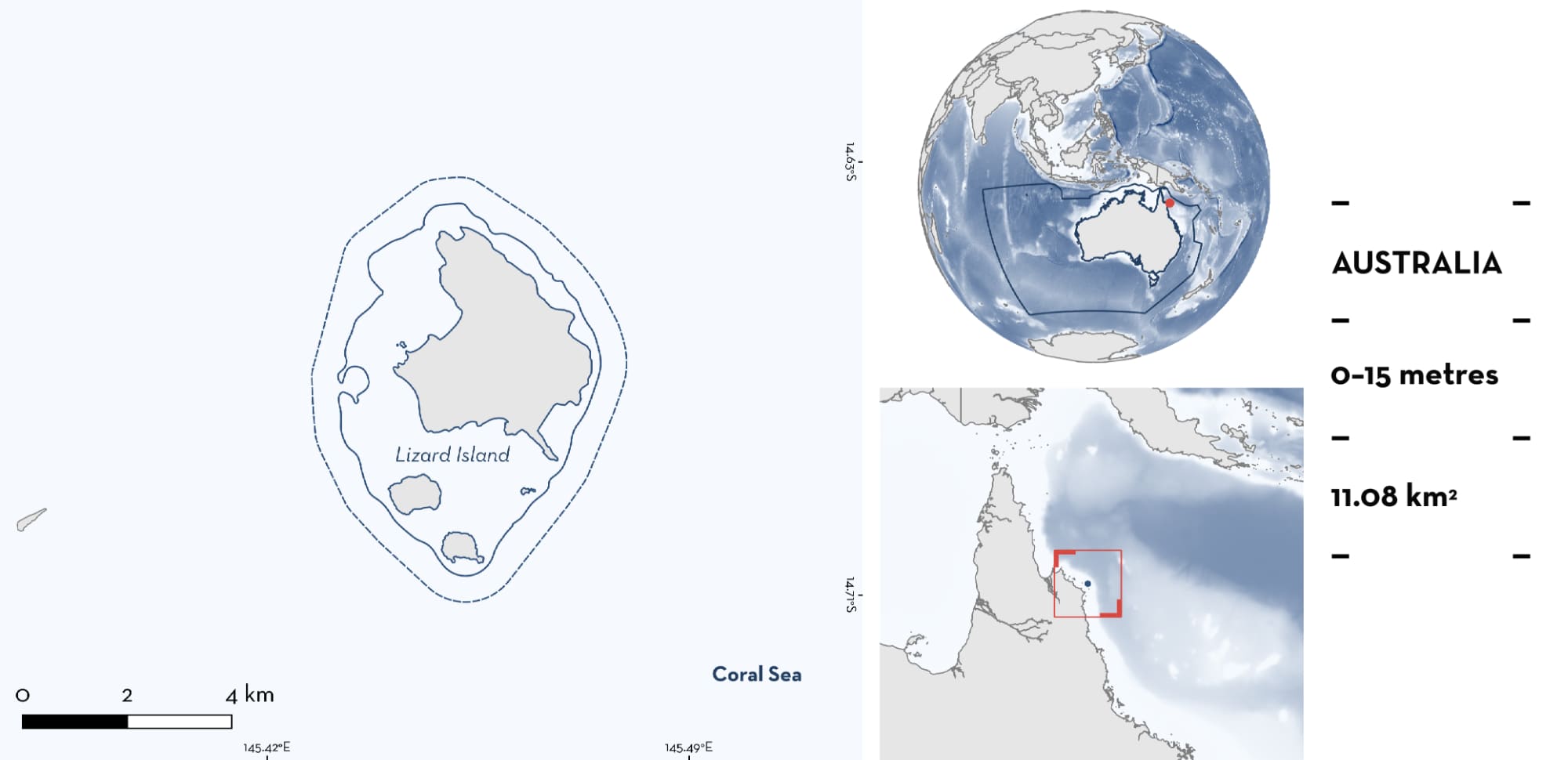
Lizard Island is located on the northern Great Barrier Reef, Queensland, Australia. The area encompasses granite Lizard Island and three smaller islands (Palfrey Island, South Island, and Bird Islet). It is characterised by outer reef slopes, fringing reefs, a lagoon, channels, mangrove patches, and seagrass beds. The area is influenced by prevailing southeast trade winds during the austral winter, while in summer months, monsoon weather makes the winds and currents more variable and increases cross-shelf flow. It overlaps with the Great Barrier Reef Marine Park. Within this area there are: threatened species and undefined aggregations (Blacktip Reef Shark Carcharhinus melanopterus).
Download factsheet
Lizard Island
DESCRIPTION OF HABITAT
Lizard Island is located on the northern Great Barrier Reef, Queensland, Australia. The area encompasses the main granite Lizard Island and three smaller islands (Palfrey Island, South Island, and Bird Islet). It is situated ~27 km offshore from the Australian mainland on the inner edge of the continental shelf with the continental slope (Coral Sea abyss) dropping to 2,000–3,000 m only ~20 km east of the island. The area is characterised by outer reef slopes, fringing reef that semi-encloses a 2–15 m deep lagoon, channels, mangrove patches, and seagrass beds (Philipps & Bellwood 2024).
This area is influenced by prevailing southeast trade winds during the austral winter (June–August), causing a prominent north to northwesterly flow between Lizard Island and the Ribbon Reefs within the Great Barrier Reef, with very little movement across the shelf (Frith et al. 1986). In summer (December–February), monsoon weather makes the winds and currents more variable and increases cross-shelf flow. Lizard Island’s steep terrain, rising to 359 m, shelters the lagoon from north and northwest winds during this season (Philipps & Bellwood 2024). Around the island group, tidal currents are the main drivers of water movement and generally flow across the shelf, while non-tidal currents are largely shaped by the wind, with wind strength closely influencing current speed (Frith et al. 1986).
Lizard Island overlaps with the Great Barrier Reef Marine Park – Marine National Park Zone (UNEP-WCMC & IUCN 2025).
This Important Shark and Ray Area is benthic and pelagic and is delineated from inshore and surface waters (0 m) to 15 m based on the bathymetry of the area.
CRITERION A
VULNERABILITY
One Qualifying Species considered threatened with extinction according to the IUCN Red List of Threatened Species regularly occurs in the area. This is the Vulnerable Blacktip Reef Shark (Simpfendorfer et al. 2020).
CRITERION C
SUB-CRITERION C5 – UNDEFINED AGGREGATIONS
Lizard Island is important for undefined aggregations of one shark species.
Historically, Blacktip Reef Sharks were fished in this area and surrounding waters by Traditional Owners annually between September and February. This was the season when their livers were filled with fish oil (Gordon 2012), possibly indicating seasonality in their feeding behaviour in the area.
Between 2012–2025, a total of 12 Blacktip Reef Shark aggregations of up to 15 individuals, inferred from direct observations, were recorded in this area and shared online (Australian Museum 2012; Australian Geographic 2016; Lizard Island Reef Research Foundation 2025; M Herrera pers. obs. 2025). Of these aggregations, eight involved Blacktip Reef Sharks feeding in the area and were comprised of juvenile individuals based on visual estimation of their size (<90 cm total length; TL) and their known size-of-maturity (90–112 cm TL; Ebert et al. 2021). Aggregating individuals were observed preying on schools of small fish along the shoreline, especially at sunset hours, as well as on giant clams, in 2012 (several small individuals, although numbers were not recorded), 2016 (n = 15 individuals), and between 2023–2025 (up to six observations with groups of 5–6 individuals). During two of these feeding aggregations, small Blacktip Reef Sharks exhibited near-stranding behaviour, propelling themselves onto the shoreline to capture prey fishes (Australian Museum 2012; Australian Geographic 2016). The other feeding aggregation involved six individuals feeding on the remnants of a giant clam being eaten by a Tawny Nurse Shark (Lizard Island Reef Research Foundation 2025). Blacktip Reef Sharks aggregate in larger numbers, more frequently, for feeding purposes. This is confirmed by observations of non-feeding aggregations of Blacktip Reef Sharks (n = 4), which were documented within the area in 2008, 2013, 2021, and 2022, ranging between 3–6 individuals. Additionally, between December 2023 and July 2025, aggregations of up to five juvenile Blacktip Reef Sharks were observed weekly patrolling along the shore within the area at sunrise and sunset hours (M Herrera pers. obs. 2025). Further information is required to understand the nature and function of these undefined aggregations.
Download factsheet
SUBMIT A REQUEST
ISRA SPATIAL LAYER REQUEST
To make a request to download the ISRA Layer in either a GIS compatible Shapefile (.shp) or Google Earth compatible Keyhole Markup Language Zipped file (.kmz) please complete the following form. We will review your request and send the download details to you. We will endeavor to send you the requested files as soon as we can. However, please note that this is not an automated process, and before requests are responded to, they undergo internal review and authorization. As such, requests normally take 5–10 working days to process.
Should you have questions about the data or process, please do not hesitate to contact us.