ISRA FACTSHEETS
ISRA FACTSHEETS
AUSTRALIA AND SOUTHEAST INDIAN OCEAN
Logan & Albert Rivers
Summary
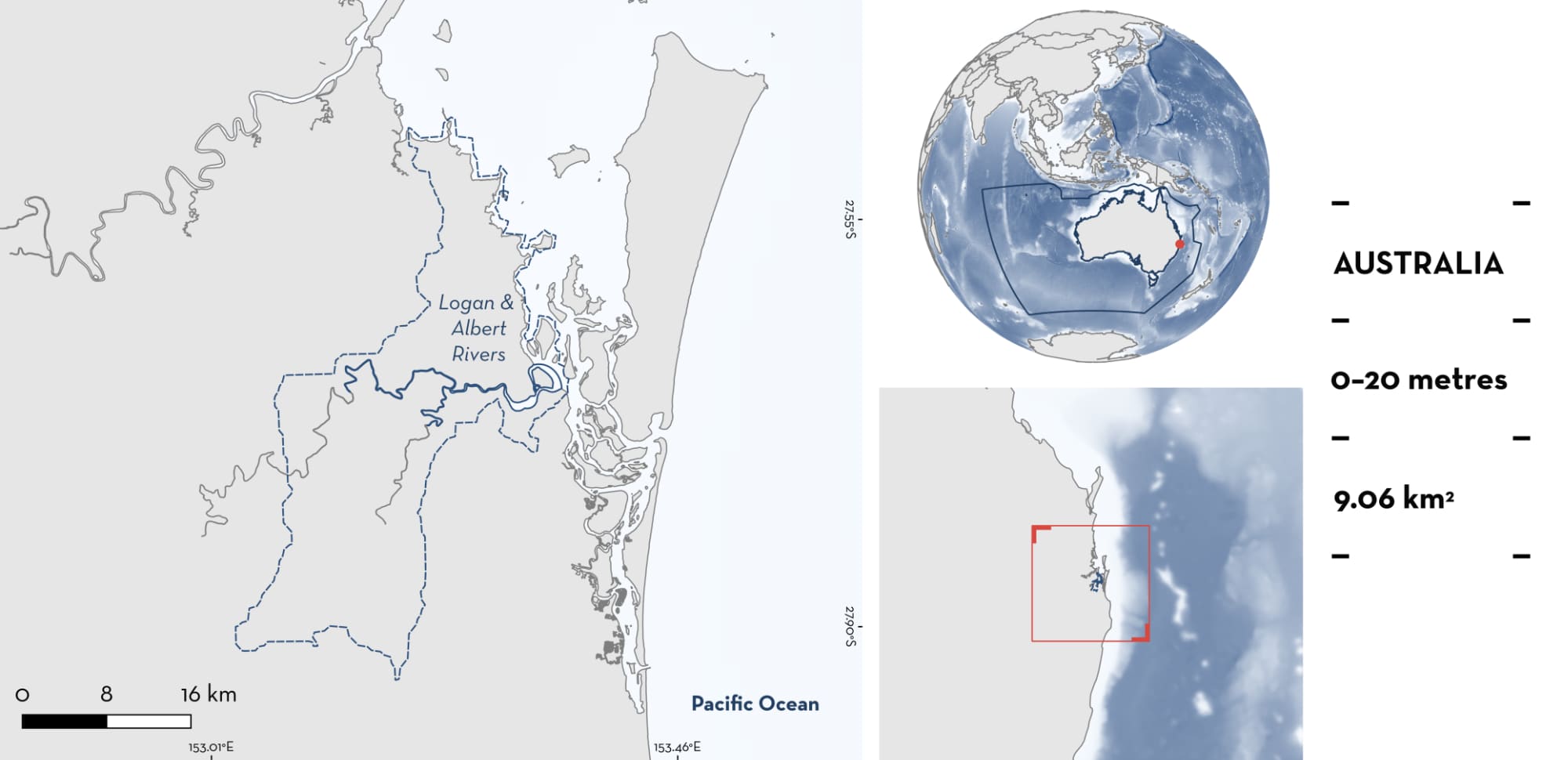
Logan & Albert Rivers is located in southeast Queensland, Australia. This riverine and estuarine area comprises the lower reaches of the Logan and Albert rivers, up to 35 and 23 km upstream from the shared river mouth, respectively. The habitat is characterised by mangroves and muddy substrate. The area is influenced by tides and by water flow that can increase ~15 times during flood events. The area marginally overlaps with a marine protected area, a Key Biodiversity Area, and a Ramsar Site. Within this area there are: threatened species and reproductive areas (Bull Shark Carcharhinus leucas).
Download factsheet
Logan & Albert Rivers
DESCRIPTION OF HABITAT
Logan & Albert Rivers is located in southeast Queensland, Australia. This area comprises the estuarine parts of the 191 km long Logan River and of the 102 km long Albert River. The two rivers merge 14 km upstream from the river mouth in southern Moreton Bay (Pillans et al. 2020). The habitat is characterised by mangroves, turbid water, and muddy substrate.
Tides influence the rivers up to 60 km upstream, resulting in a gradient of salinity levels ranging from freshwater to saltwater (Pillans et al. 2020). River flow, measured 88 km upstream in the Logan River, is ~10 m3 s-1 but can reach >150 m3 s-1 during flood events. Water temperature seasonally fluctuates between 16–28°C (Pillans et al. 2020).
This area marginally overlaps with Moreton Bay Marine Park (Queensland Government 2019), Moreton Bay and Pumicestone Passage Key Biodiversity Area (KBA 2025), and Moreton Bay Ramsar Site (Wetland of International Importance; Ramsar 2025).
This Important Shark and Ray Area is benthic and pelagic and is delineated from inshore and surface waters (0 m) to 20 m based on the bathymetry of the area.
CRITERION A
VULNERABILITY
One Qualifying Species considered threatened with extinction according to the IUCN Red List of Threatened Species regularly occurs in the area. This is the Vulnerable Bull Shark (Rigby et al. 2021).
CRITERION C
SUB-CRITERION C1 – REPRODUCTIVE AREAS
Logan & Albert Rivers is an important reproductive area for one shark species.
Neonate and young-of-the-year (YOY) Bull Sharks are regularly observed in this area (Pillans et al. 2020; N Lubitz unpubl. data 2025). A research survey captured small Bull Sharks ranging from 74–102 cm total length (TL) with rod-and-line at the junction of the Logan and Albert rivers between March 2012 and January 2014 (Pillans et al. 2020). Neonates and YOY were classified as animals with an umbilical scar and ranged 74–99 cm TL, while juveniles had no umbilical scars. The size-at-birth of the species is 56–81 cm TL (Ebert et al. 2021). A total of 36 neonate/YOY and one juvenile were tagged and tracked in a passive acoustic telemetry array with 17 receivers in the two rivers and 13 receivers in the adjacent southern Moreton Bay (Pillans et al. 2020). Over the 1,009 monitoring days, individuals were detected on an average of 205 days (range = 11–952 days). Detections ranged up to 52 km upstream in the Logan River (with additional receivers further upstream but recording no detections) and 30 km upstream in the Albert River. However, the bulk of the detections were made up to 35 km upstream in the Logan River and 23 km in the Albert River, in this area. Similarly, tagged Bull Sharks ventured into southern Moreton Bay, outside the area, but made few detections there. Neonates/YOY were detected in all months of the study. Movement within the river system was correlated to water flow and salinity levels, with sharks moving downstream in response to increasing flow and declining salinity, and upstream during low flow and increasing salinity. Tracked Bull Sharks remained within a narrow band of salinity levels (6–10 psu) throughout the tracking period despite a larger available range (0–32 psu) (Pillans et al. 2020). Additionally, research surveys captured seven neonates/YOY ranging 79–83 cm TL on a single day in May 2019, and one neonate of 80 cm TL in January 2025 in this area (N Lubitz et al. unpubl. data 2025). Further regular records from recreational fishers on social media confirm the continued presence of neonate/YOY Bull Sharks in this area. Although no pregnant females have been captured in the research surveys in this area, combined, the data show that Logan & Albert Rivers is an important area for the early life stages of Bull Sharks.
Download factsheet
SUBMIT A REQUEST
ISRA SPATIAL LAYER REQUEST
To make a request to download the ISRA Layer in either a GIS compatible Shapefile (.shp) or Google Earth compatible Keyhole Markup Language Zipped file (.kmz) please complete the following form. We will review your request and send the download details to you. We will endeavor to send you the requested files as soon as we can. However, please note that this is not an automated process, and before requests are responded to, they undergo internal review and authorization. As such, requests normally take 5–10 working days to process.
Should you have questions about the data or process, please do not hesitate to contact us.