
ISRA FACTSHEETS
ISRA FACTSHEETS
AUSTRALIA AND SOUTHEAST INDIAN OCEAN
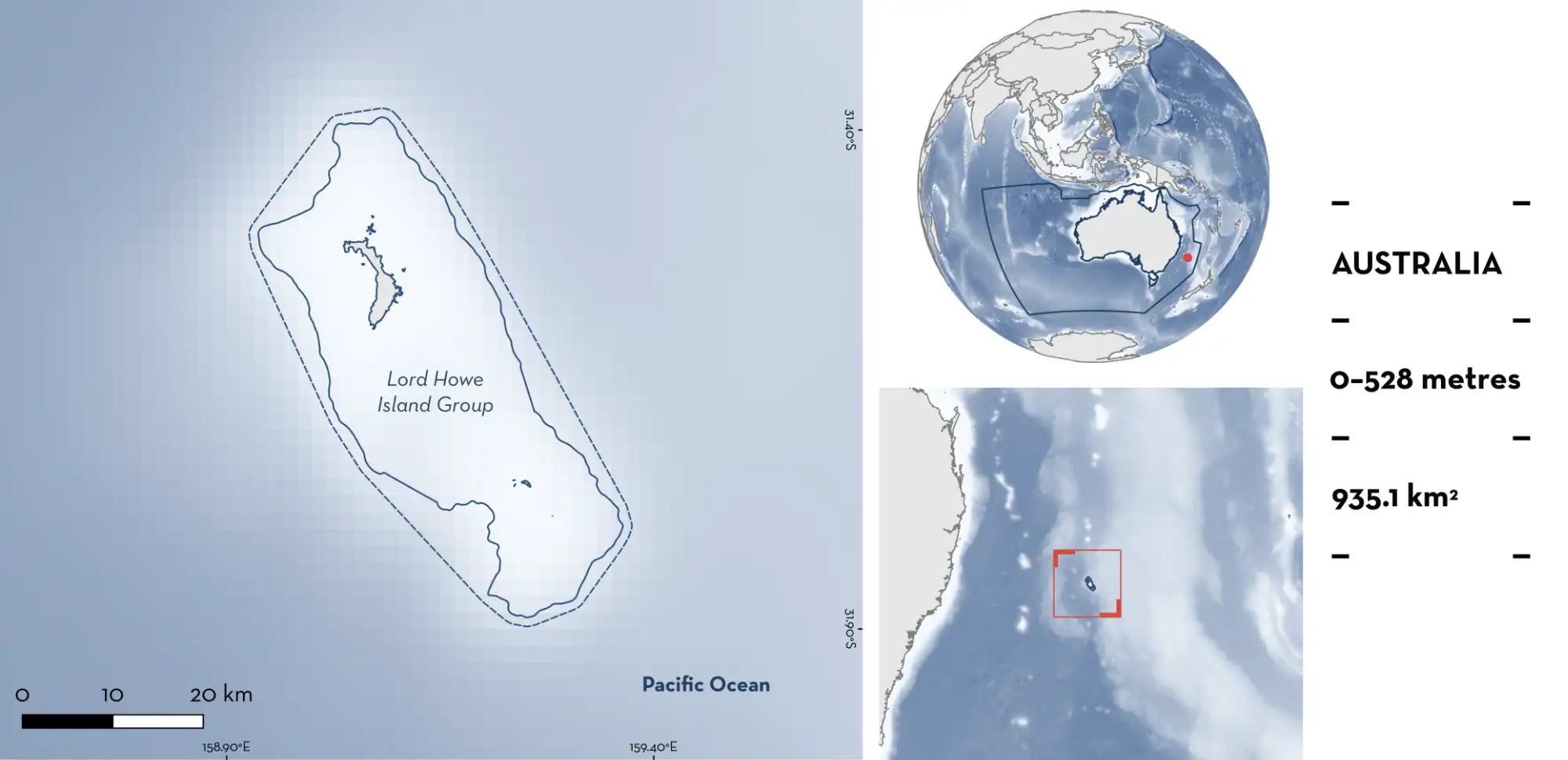
Lord Howe Island Group
Summary
Lord Howe Island Group is located in the southwest Pacific, ~600 km from mainland New South Wales, Australia. This remote area encompasses two seamounts: Lord Howe Island and Ball’s Pyramid. It is characterised by coral reefs, macroalgae reefs, volcanic pinnacles, and an oceanic ridge. The area is influenced by the Eastern Australian Current, and eddies caused by the Tasman Front. It overlaps with the Lord Howe Marine Park and the Lord Howe Island Marine Park. Within this area there are: reproductive areas and feeding areas (Galapagos Shark Carcharhinus galapagensis).
Download factsheet
Lord Howe Island Group
DESCRIPTION OF HABITAT
Lord Howe Island Group is located in the southwest Pacific, ~600 km off the coast of New South Wales, Australia. The area encompasses Lord Howe Island and Ball’s Pyramid: the two southernmost volcanic seamounts from a larger chain (formed from continental crust) (Environment Australia 2002). It is characterised by coral reefs (Harasti et al. 2022) and macroalgae reefs, alongside thick sediments and volcanic outcrops. This area is also characterised by submerged/bathymetric features such as canyons, volcanic cones, and pinnacles (Environment Australia 2002).
The area is influenced by extreme weather including occasional cyclonic activity (Environment Australia 2002). There is little diurnal or annual temperature variation, ranging between 14–18°C in the austral winter, and 17–25°C in summer. This variation is controlled at least partially by the Tasman Front, the boundary of the tropical (Coral Sea) and temperate (Tasman Sea) water masses, which moves in a north-south direction. The area is also influenced by eddies and the East Australian Current (Environment Australia 2002).
This area overlaps with the Lord Howe Marine Park (Parks Australia 2025) and the Lord Howe Island Marine Park (NSW DPIRD 2025).
This Important Shark and Ray Area is pelagic and is delineated from inshore and surface waters (0 m) to 528 m based on the global depth range of Qualifying Species.
CRITERION C
SUB-CRITERION C1 – REPRODUCTIVE AREAS
Lord Howe Island Group is an important reproductive area for one shark species.
Neonate, young-of-the-year (YOY), and juvenile Galapagos Sharks are regularly and predictably captured by local charter and recreational fishers at the Lord Howe Island Group (Figueira & Harianto 2022). Between 2004 and 2018, the number of Galapagos Sharks caught annually ranged from 583–1,835, representing ~25% of the annual catch, with mean catch-per-unit-effort ranging from 0.9 to 4.8 sharks per fishing trip (Figueira & Harianto 2022). The vast majority of Galapagos Sharks caught measured 90–150 cm in total length (TL), with fewer measuring <90 cm and >200 cm TL (Figueira & Harianto 2022), thus including neonates/YOY. Size-at-birth for the species is 57–80 cm TL and size-at-maturity is at 170–250 TL (Ebert et al. 2021).
During rod-and-line fishing research surveys for Galapagos Sharks undertaken in January 2018, January 2019, and January 2020, 64 sharks measuring 96–177 cm TL were captured (Mitchell et al. 2021, 2024). Of these, 11 neonate/YOY measuring <110 cm TL were recorded in 2018 (n = 1), 2019 (n = 8), and 2020 (n = 2). During research fishing surveys in January 2018 and November 2024, two neonate Galapagos Sharks measuring ~60 cm TL with visible umbilical scars were observed. In December 2025, two YOY Galapagos Sharks measuring 91 cm TL and 96 cm TL with visible umbilical scars were observed. Anecdotal reports from local fishers concur with similar observations during warmer months, when fishing activities peak.
Additionally, Baited Remote Underwater Video Station (BRUVS) surveys were conducted at 16 sites in the area in 2010, 2013, and 2017 (Rees 2013; Davis et al. 2017; Neilson et al. 2010). In 2017, Galapagos Sharks were observed at all sites, with a maximum number of individuals observed in one frame (MaxN) of 16 (Davis et al. 2017). Size ranged from 62–178 cm TL, with the majority measuring 70–129 cm TL (Davis et al. 2017), thus confirming the regular and predictable presence of neonate/YOY Galapagos Sharks. Two pregnant females (inferred based on distended abdomens) were observed in March 2020 near Ball’s Pyramid in this area (JD Mitchell pers. obs. 2025).
CRITERION C
SUB-CRITERION C2 – FEEDING AREAS
Lord Howe Island Group is an important feeding area for one shark species.
Galapagos Sharks regularly and predictably feed on large masses of fish which aggregate in a small area (referred to as ‘bait balls’) during summer months (JD Mitchell, V Camilieri-Asch, & J Gilligan pers. obs. 2021, 2023). This is the only area around Australia with regular and predictable observations of this behaviour. Between 2018–2025, seasonal (November–February) observations of fish aggregations (including Australasian Pilchard Sardinops neopilchardus, Sandy Sprat Hyperlophus vittus, Maray Etrumeus jacksoniensis, Southern Anchovy Engraulis australis, and Yellowtail Scad Trachurus muculloch) were recorded in this area. Researchers recorded these observations in January 2021 and December 2023, including aggregations of at least 50 Galapagos Sharks (JD Mitchell, V Camilieri-Asch, & J Gilligan pers. obs. 2021, 2023). These aggregations include juvenile and mature Galapagos Sharks, based on visual estimation of size, and animals are observed feeding. Although aggregations are also observed independent of bait balls, the presence of Galapagos Sharks (and a peak in aggregation record frequency) increases in correlation with the seasonality of bait balls.
Within this area, the shelf edge is particularly important for feeding behaviour as a result of the convergence of several ecological and oceanographic factors (Mitchell et al. 2024). Acoustically tagged Galapagos Sharks showed higher residency and smaller home ranges centred around these areas, which were 50–100 m deep (Mitchell et al. 2024). Similar preferred depth ranges have been observed for Galapagos Sharks at other island systems in different parts of the Pacific Ocean (Wetherbee et al. 1996; Meyer et al. 2009; Madigan et al. 2020). The shelf edges are influenced by upwelling processes, whereby nutrient-rich deep waters are transported to the surface, enhancing primary productivity and attracting abundant prey populations (Coelho et al. 2016; Genin & Dower 2007; White et al. 2007), as evidenced by elevated chlorophyll-a concentrations in this area (Bradford & Roberts 1978). Structural complexity of the seabed was also found to have a positive correlation with the number of detections of tagged Galapagos Sharks (Mitchell et al. 2024), likely because areas of complex seabed support a greater abundance of prey fish species, as has been documented for Yellowtail Kingfish in this area (Rees et al. 2018).
Seasonal variations further reinforce the importance of this species in the area; in spring and summer, favourable current patterns, elevated water temperatures, and increased productivity correspond with peak shark detections (Mitchell et al. 2024). Depth utilisation also exhibits seasonal variation, with sharks occurring in shallower waters during autumn and occupying deeper habitats in spring (Mitchell et al. 2021), likely reflecting shifts in prey distribution (Bessudo et al. 2011), productivity patterns, and thermoregulatory behaviour (Campana et al. 2011; Andrzejaczek et al. 2018; Madigan et al. 2020).
Download factsheet
SUBMIT A REQUEST
ISRA SPATIAL LAYER REQUEST
To make a request to download the ISRA Layer in either a GIS compatible Shapefile (.shp) or Google Earth compatible Keyhole Markup Language Zipped file (.kmz) please complete the following form. We will review your request and send the download details to you. We will endeavor to send you the requested files as soon as we can. However, please note that this is not an automated process, and before requests are responded to, they undergo internal review and authorization. As such, requests normally take 5–10 working days to process.
Should you have questions about the data or process, please do not hesitate to contact us.

