ISRA FACTSHEETS
ISRA FACTSHEETS
AUSTRALIA AND SOUTHEAST INDIAN OCEAN
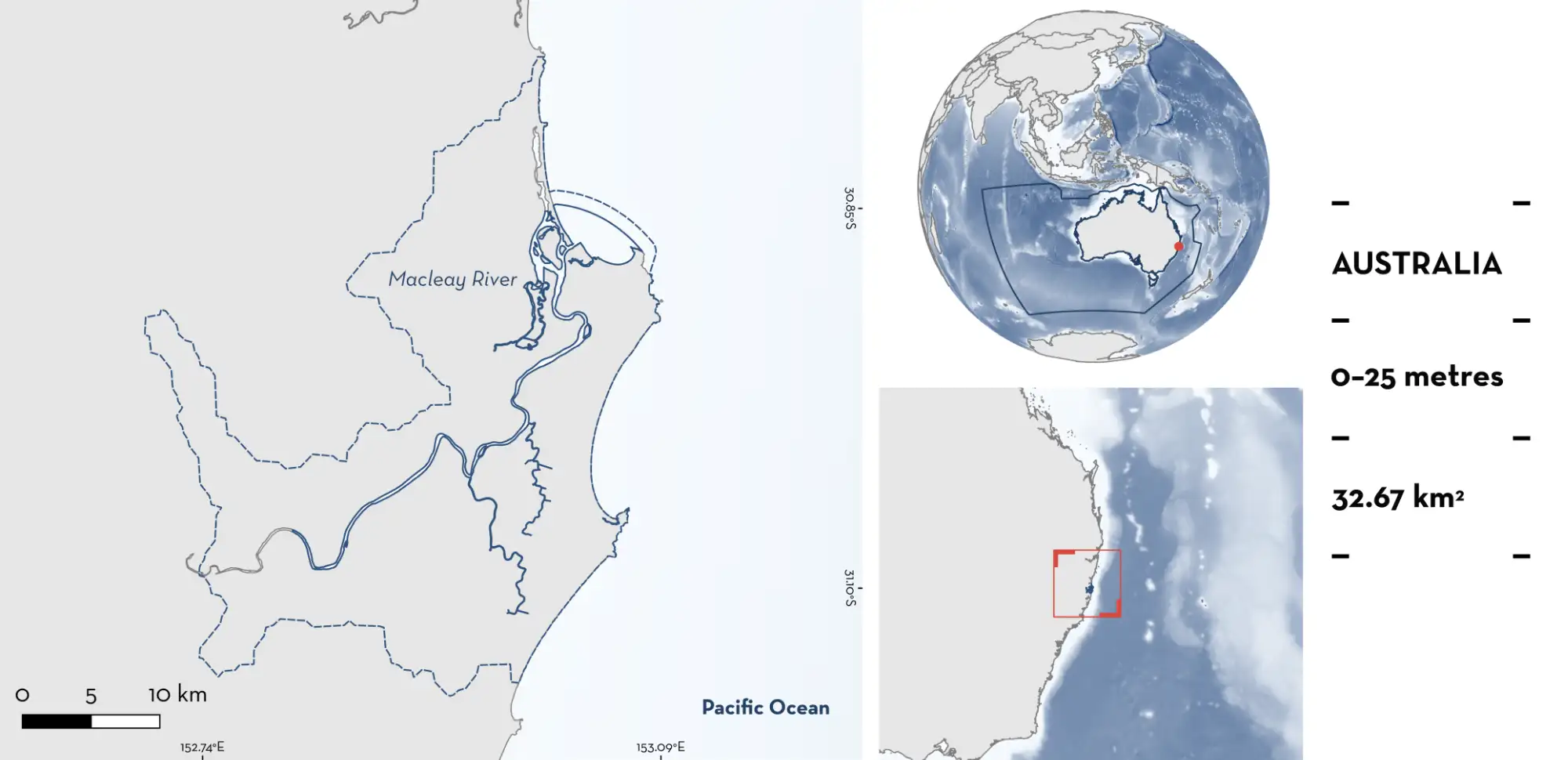
Macleay River
Summary
Macleay River is located on the mid-north coast of New South Wales, Australia. The area comprises the lower reaches of the Macleay River, from the town of Kempsey to the river mouth, as well as coastal waters of South West Rocks. The habitat is characterised by silty sediment, mangroves, and agricultural land adjoining the river, as well as sandy and rocky substrates in the coastal section. It is influenced by freshwater and sediment input from the river, by tidal saltwater intrusions, and by the East Australian Current. Within this area there are: threatened species and reproductive areas (Bull Shark Carcharhinus leucas).
Download factsheet
Macleay River
DESCRIPTION OF HABITAT
Macleay River is located on the mid-north coast of New South Wales, Australia. The area comprises the lower reaches of the Macleay River, from the town of Kempsey ~40 km upstream to the river mouth at South West Rocks, as well as coastal waters around South West Rocks. The Macleay River is ~400 km long and drains a catchment of ~11,500 km2 (Ashley et al. 2007). The river has a large variability in flow, with the potential for flooding at any time of year. Within the area, the river lies on the floodplain and has several meandering tidal streams, islands, and tributaries (Ashley et al. 2007). The habitat is characterised by silty sediment, mangroves, and agricultural land adjoining the riverbank, as well as sandy and rocky substrates in coastal waters.
The area is influenced by tides leading to a gradient of salinities in the river, and by freshwater and sediment input from the river. The tidal limit is further upstream, outside the boundaries of this area. The coastal part of the area is influenced by the East Australian Current that carries warm water southward along Australia’s east coast (Ridgeway & Hill 2009). The East Australian Current is a dynamic western boundary current, with mesoscale eddies influencing current strength and direction. The flow is seasonally stronger in the austral summer, and the separation location, where the current turns eastward into the Tasman Sea, also moves seasonally (Ridgeway & Hill 2009).
This Important Shark and Ray Area is benthic and pelagic and is delineated from inshore and surface waters (0 m) to 25 m based on the bathymetry of the area.
CRITERION A
VULNERABILITY
One Qualifying Species considered threatened with extinction according to the IUCN Red List of Threatened Species regularly occurs in the area. This is the Vulnerable Bull Shark (Rigby et al. 2021).
CRITERION C
SUB-CRITERION C1 – REPRODUCTIVE AREAS
Macleay River is an important reproductive area for one shark species.
Pregnant, neonate, and young-of-the-year (YOY) Bull Sharks are regularly observed in this area by recreational fishers. One recreational fisher recorded 47 Bull Shark captures within this area between 2016–2026. The size of 38 individuals was recorded, and these ranged in size from 126–323 cm total length (TL). Of the 28 mature females (>180 cm TL), 12 were possibly pregnant (43%), with a visibly distended abdomen, and three were believed to be in post-partum stage. Pregnant Bull Sharks were only captured in November and December. The size-at-maturity for females is 180–230 cm TL (Ebert et al. 2021).
Additionally, recreational fishers regularly capture neonate and YOY Bull Sharks further upstream within this area. For example, a media report shows captures on most nights between December 2016–February 2017 of Bull Sharks <100 cm TL. The size-at-birth for the species is 56–81 cm TL and YOY can be up to 99 cm TL (Pillans et al. 2020; Ebert et al. 2021). In addition to neonates and YOY, juveniles of the species are also still largely restricted to river systems (Werry et al. 2011; Niella et al. 2022). Combined, these data demonstrate that Macleay River is important for pupping and for the early life-stage Bull Sharks. The coastal area near the river mouth at South West Rocks is also where most Bull Shark detections were recorded in a passive acoustic telemetry study along the entire New South Wales coast (Smoothey et al. 2023). Particularly large females were detected here, further highlighting this as an important reproductive area.
Although Macleay River is located only ~25 km from Nambucca River to the north, and ~130 km from Manning River to the south, both of which also host important reproductive habitat for Bull Sharks, these river systems are individually important. Bull Sharks in Australia display natal philopatry, with females returning to particular river systems to pup (Tillett et al. 2012; Lubitz 2023). For example, half-sibling pairs were found within a river up to seven cohorts apart, highlighting the long-term natal philopatry of females (Lubitz 2023). Therefore, individual rivers in this region represent discrete portions of habitat that are important to Bull Sharks.
Download factsheet
SUBMIT A REQUEST
ISRA SPATIAL LAYER REQUEST
To make a request to download the ISRA Layer in either a GIS compatible Shapefile (.shp) or Google Earth compatible Keyhole Markup Language Zipped file (.kmz) please complete the following form. We will review your request and send the download details to you. We will endeavor to send you the requested files as soon as we can. However, please note that this is not an automated process, and before requests are responded to, they undergo internal review and authorization. As such, requests normally take 5–10 working days to process.
Should you have questions about the data or process, please do not hesitate to contact us.