ISRA FACTSHEETS
ISRA FACTSHEETS
AUSTRALIA AND SOUTHEAST INDIAN OCEAN
Macquarie Harbour
Summary
Macquarie Harbour is located on the west coast of Tasmania, Australia. The area is characterised by silt substrates. It is influenced by saltwater input from the sea through the entrance of the harbour, and by freshwater input from two major rivers. The water column is distinctly stratified, with a tannin-rich freshwater surface layer, a brackish mid-layer, and a denser saline bottom layer. The area overlaps with two Key Biodiversity Areas. Within this area there are: threatened species; range-restricted species; reproductive areas; and distinctive attributes (Maugean Skate Zearaja maugeana).
Download factsheet
Macquarie Harbour
DESCRIPTION OF HABITAT
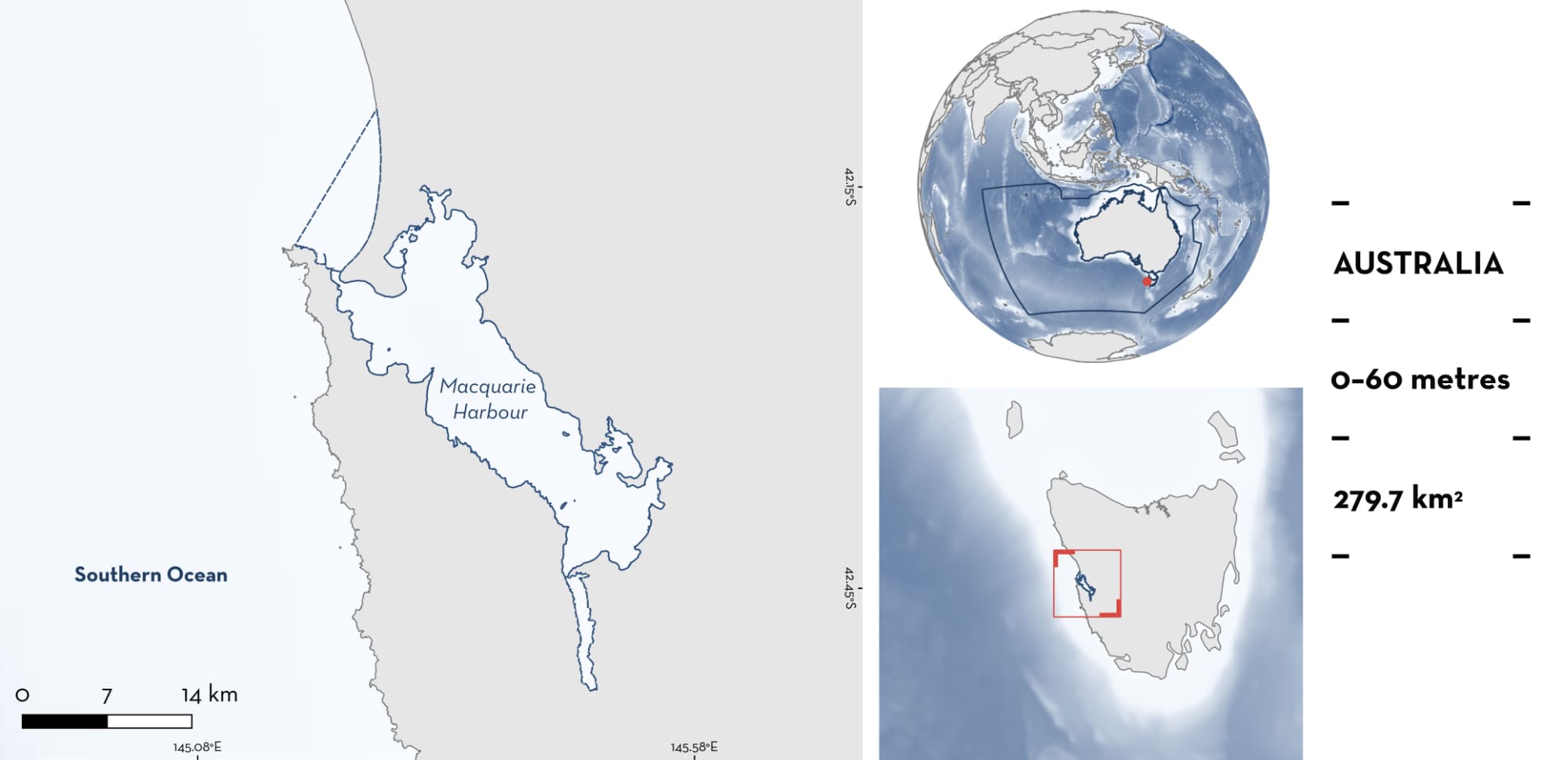
Macquarie Harbour is located on the west coast of Tasmania, Australia. It is an estuarine system with mean depths of 5–20 m, and a deeper central basin that reaches 60 m. The area is characterised by silt substrates (Teasdale et al. 2003). It has a narrow entrance to the Southern Ocean at the northwest end, known as ‘Hell’s Gates’, which restricts tidal flushing and contributes to the harbour’s long freshwater residence time, estimated at ~70 days (Teasdale et al. 2003).
The area is influenced by freshwater inflow from two major rivers: the Gordon River to the south, which is the primary freshwater source, and the King River to the northeast, which introduces legacy mining contaminants from the historical Mount Lyell mine. The water column is distinctly stratified, with a tannin-rich freshwater surface layer, a brackish mid-layer, and a denser saline bottom layer. This bottom layer is periodically refreshed by flood tides, but because the oceanic water passes over a shallow bar at the entrance, it becomes diluted and is not fully marine (Teasdale et al. 2003). The water parameters of this area vary seasonally, including temperature (12–16oC), salinity (18–30 ppt), and dissolved oxygen concentration (20–50%) (Bell et al. 2016).
This area overlaps with the Macquarie Harbour Key Biodiversity Area (KBA) and the North-west Tasmanian Coast KBA (KBA 2025a, 2025b).
This Important Shark and Ray Area is benthic and is delineated from inshore and surface waters (0 m) to 60 m based on the bathymetry of the area.
CRITERION A
VULNERABILITY
One Qualifying Species considered threatened with extinction according to the IUCN Red List of Threatened Species regularly occurs in the area. This is the Endangered Maugean Skate (Grant et al. 2025).
CRITERION B
RANGE RESTRICTED
This area holds the regular presence of Maugean Skate as a resident range-restricted species. Contemporary records of Maugean Skates are only known from this area where the species spends its entire life cycle. From 2,583 scientific gillnet deployments between 2012–2024, 655 Maugean Skates (female = 320, male = 331, sex not recorded = 15) were observed in this area in 11 years, with no apparent seasonality (Moreno et al. 2025; Institute for Marine and Antarctic Studies [IMAS] unpubl. data 2025). Animals were recorded in 2012 (n = 113), 2013 (n = 68), 2014 (n = 163), 2015 (n = 10), 2017 (n = 9), 2018 (n = 46), 2019 (n = 17), 2021 (n = 45), 2022 (n = 25), 2023 (n = 57), and 2024 (n = 102). The only other location where the species has been observed is Bathurst Harbour (~280 km south of Macquarie Harbour; n = 4 individuals), where the last record was from 1992 (Moreno et al. 2022). Maugean Skates do not move out of Macquarie Harbour and this limited movement has been confirmed through acoustic tracking data, whereby 58 tagged Maugean Skates remained in this area (Bell et al. 2016). Specifically, there was no movement out of the harbour entrance, and none were detected at the mouth of the Gordon River, thereby confirming that they are not using the river system (Bell et al. 2016). Maugean Skate are restricted to the Southeast Australian Shelf Large Marine Ecosystem.
CRITERION C
SUB-CRITERION C1 – REPRODUCTIVE AREAS
Macquarie Harbour is an important reproductive area for one ray species.
Maugean Skates spend their entire lifecycle in this area. Between February 2017 and July 2019, 110 Maugean Skate egg cases were recorded via trawl surveys (275 deployments) and dive surveys. Of these, 102 were empty egg cases, including ~40 with evidence of successful hatching. Three egg cases were found with live embryos inside during surveys in 2017 (n = 1), 2018 (n = 1), and 2019 (n = 1). In addition, one gravid female caught in May 2019 released four egg cases (Moreno et al. 2020). In 2023, 180 egg cases were observed by divers within the area. Of these, 26 were viable and hatched successfully based on the nature of the opening of the egg case upon direct visual observation (IMAS unpubl. data 2025). Clusters of egg case records come from Table Head/Liberty Point and Swan Basin within this area (Moreno et al. 2020). From scientific gillnet surveys undertaken between 2012–2024, two young-of-the-year (YOY) Maugean Skates measuring <40 cm total length (TL) were recorded in March and July 2025. In addition, four juveniles measuring 42.6–58.0 cm TL were observed. These immature Maugean Skates comprised 20.7% of the total catch from the March–July 2025 survey (n = 29). The size-at-birth of the species is 13.5 cm TL (Moreno et al. 2020), YOY individuals measure <40 cm TL (Bell et al. 2016), and juveniles measure <60 cm TL (Moreno et al. 2025). There are few observations of early life-stages because the dominant fishing gear (which has a large mesh size) has a low catchability of smaller skates. In addition, 136 mature males with calcified claspers (indicative of sexual maturity) were observed in these surveys. Since the species is found only in Macquarie Harbour, this implies that these individuals are breeding here. These were recorded in 2012 (n = 24), 2013 (n = 13), 2014 (n = 56), 2015 (n = 2), 2021 (n = 19), 2022 (n = 4), and 2023 (n = 18). Finally, mature females with large follicles are regularly captured in the area, which is also indicative of reproductive behaviour (Moreno et al. 2025). Maugean Skate have the ability to reproduce year-round (Awruch et al. 2021), which is reflected in the observations made from this area.
CRITERION D
SUB-CRITERION D1 – DISTINCTIVENESS
Macquarie Harbour is a distinctive area for one ray species.
Maugean Skates are considered the only skate species in the world restricted exclusively to estuarine habitats (Treloar et al. 2016). The species does not leave the harbour entrance, nor enter the adjacent Gordon River (Bell et al. 2016). It is considered a Gondwanan relict – the only living representative of a lineage that originated on the ancient southern supercontinent of Gondwana before it broke up into Australia, Tasmania, and New Zealand. This is the only location in the world with contemporary records of this species (Moreno et al. 2022).
Download factsheet
SUBMIT A REQUEST
ISRA SPATIAL LAYER REQUEST
To make a request to download the ISRA Layer in either a GIS compatible Shapefile (.shp) or Google Earth compatible Keyhole Markup Language Zipped file (.kmz) please complete the following form. We will review your request and send the download details to you. We will endeavor to send you the requested files as soon as we can. However, please note that this is not an automated process, and before requests are responded to, they undergo internal review and authorization. As such, requests normally take 5–10 working days to process.
Should you have questions about the data or process, please do not hesitate to contact us.