ISRA FACTSHEETS
ISRA FACTSHEETS
AUSTRALIA AND SOUTHEAST INDIAN OCEAN
Marion Reef
Summary
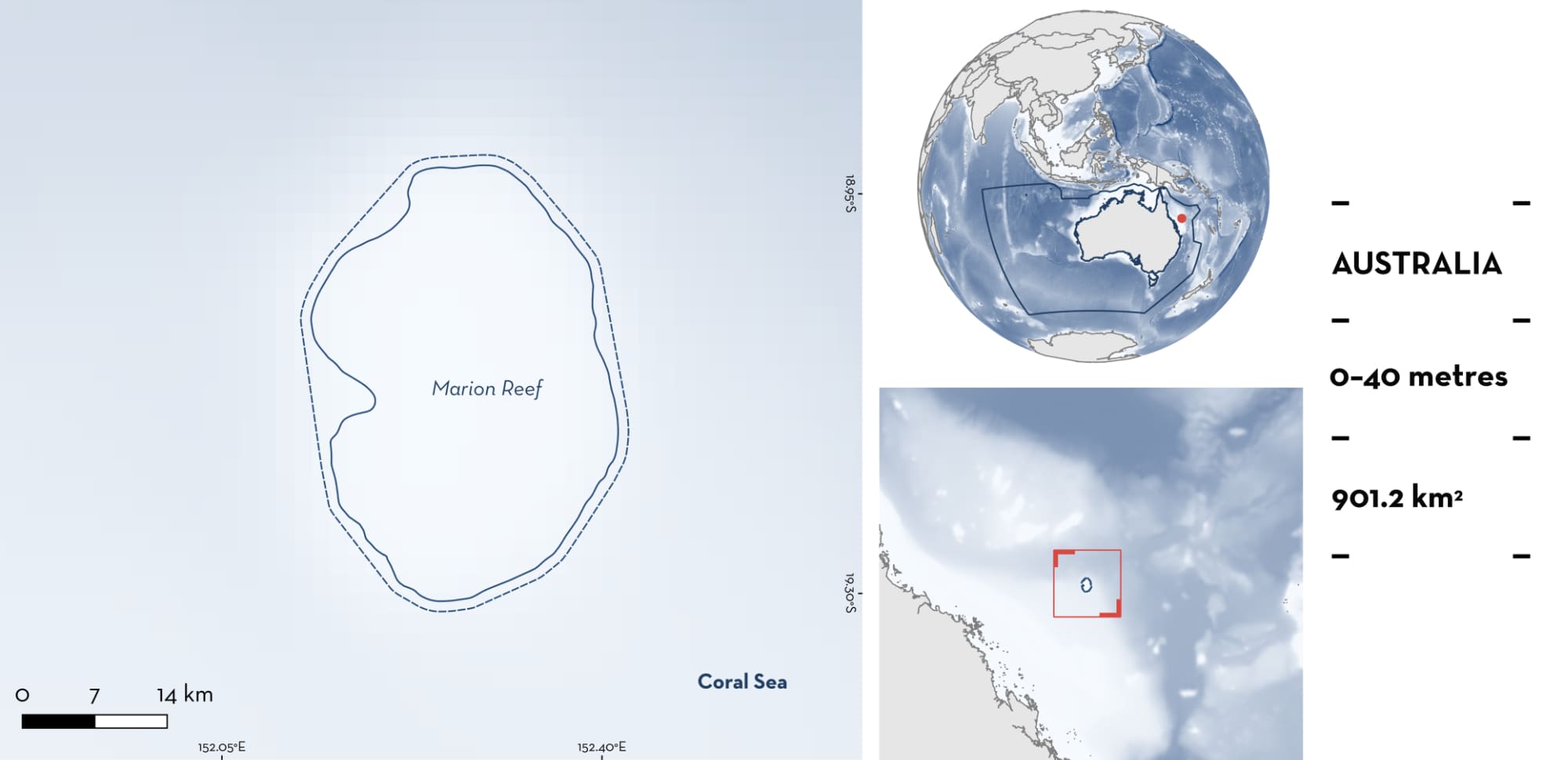
Marion Reef is located in the Coral Sea, off Queensland, Australia. It encompasses the deep reef lagoon of a coral atoll and a series of bommies. The area is characterised by a mix of hard and soft corals, macroalgae, and soft sediment. It is influenced by the westward-flowing South Equatorial Current and slow-moving eddies that drive localised upwelling. The area overlaps with the Coral Sea Marine Park. Within this area there are: threatened species and undefined aggregations (Grey Reef Shark Carcharhinus amblyrhynchos).
Download factsheet
Marion Reef
DESCRIPTION OF HABITAT
Marion Reef is located in the Coral Sea, off Queensland, Australia. It is a remote, circular coral atoll located about 400 km east of the Whitsunday coast, spanning roughly 40 km in length and 25 km in width. It encompasses the deep reef lagoon surrounded by a ring of reef and a series of coral bommies rising from 40–10 m depth. The area is characterised by a mix of hard and soft corals, macroalgae, and soft sediment. Coral bommies vary considerably in size, ranging from small patches <2 m in diameter to large structures with circumferences of 100–200 m (Galbraith et al. 2022).
The area is influenced by the westward-flowing South Equatorial Current. Its position on the northeastern corner of the Marion Plateau, a broad submerged carbonate platform, promotes the formation of slow-moving eddies that drive localised upwelling of cooler, nutrient-rich deep water onto the reef margin (Choukroun 2010).
Marion Reef overlaps with the Coral Sea Marine Park – National Park Zone (Parks Australia 2025).
This Important Shark and Ray Area is benthic and pelagic and is delineated from 0–40 m based on the bathymetry of the area.
CRITERION A
VULNERABILITY
One Qualifying Species considered threatened with extinction according to the IUCN Red List of Threatened Species regularly occurs in the area. This is the Endangered Grey Reef Shark (Simpfendorfer et al. 2020).
CRITERION C
SUB-CRITERION C5 – UNDEFINED AGGREGATIONS
Marion Reef is an important aggregation area for one shark species.
Grey Reef Sharks have been observed aggregating in the area in the reef lagoon around coral bommies. Between 1982–2022, aggregations (n = 5) were opportunistically recorded by scientists, recreational divers, and fishers in the area (The New York Times 1982; YouTube 2016; Cruising the Edge 2017; Symphony in Sea 2021; Galbraith et al. 2022). These aggregations comprised 6–30 individuals larger than 100 cm total length (TL), based on visual size estimations, and included juveniles and adults. Size-at-maturity ranges between 120–145 cm TL (Ebert et al. 2021). Travel blogs from recreational divers in 1982, 2017, and 2021 reported consistent aggregations/assemblages of 6–30 sharks, mainly large Grey Reef Sharks, with some Silvertip Sharks, observed during every dive in the area (The New York Times 1982; Cruising the Edge 2017; Symphony in Sea 2021). These sharks were described as forming dense groups or engaging in social behaviour (Cruising the Edge 2017). Additionally, in 2022, during a scientific exploratory Remotely Operated Vehicle (ROV) dive conducted in the area, an aggregation of between 20–30 Grey Reef Sharks was recorded at 30 m around the slope of a coral bommie within the area (Galbraith et al. 2022).
Grey Reef Sharks have shown high residency and site fidelity to similar reefs in the Coral Sea and the Great Barrier Reef, highlighting the individual importance of the reefs (Espinoza et al. 2015). Due to the remoteness of the area, observations are opportunistic, but the large numbers of individuals and predictability of aggregations reported across different years highlight the importance of this area. Further information is required to understand the nature and function of these aggregations.
Download factsheet
SUBMIT A REQUEST
ISRA SPATIAL LAYER REQUEST
To make a request to download the ISRA Layer in either a GIS compatible Shapefile (.shp) or Google Earth compatible Keyhole Markup Language Zipped file (.kmz) please complete the following form. We will review your request and send the download details to you. We will endeavor to send you the requested files as soon as we can. However, please note that this is not an automated process, and before requests are responded to, they undergo internal review and authorization. As such, requests normally take 5–10 working days to process.
Should you have questions about the data or process, please do not hesitate to contact us.