ISRA FACTSHEETS
ISRA FACTSHEETS
AUSTRALIA AND SOUTHEAST INDIAN OCEAN
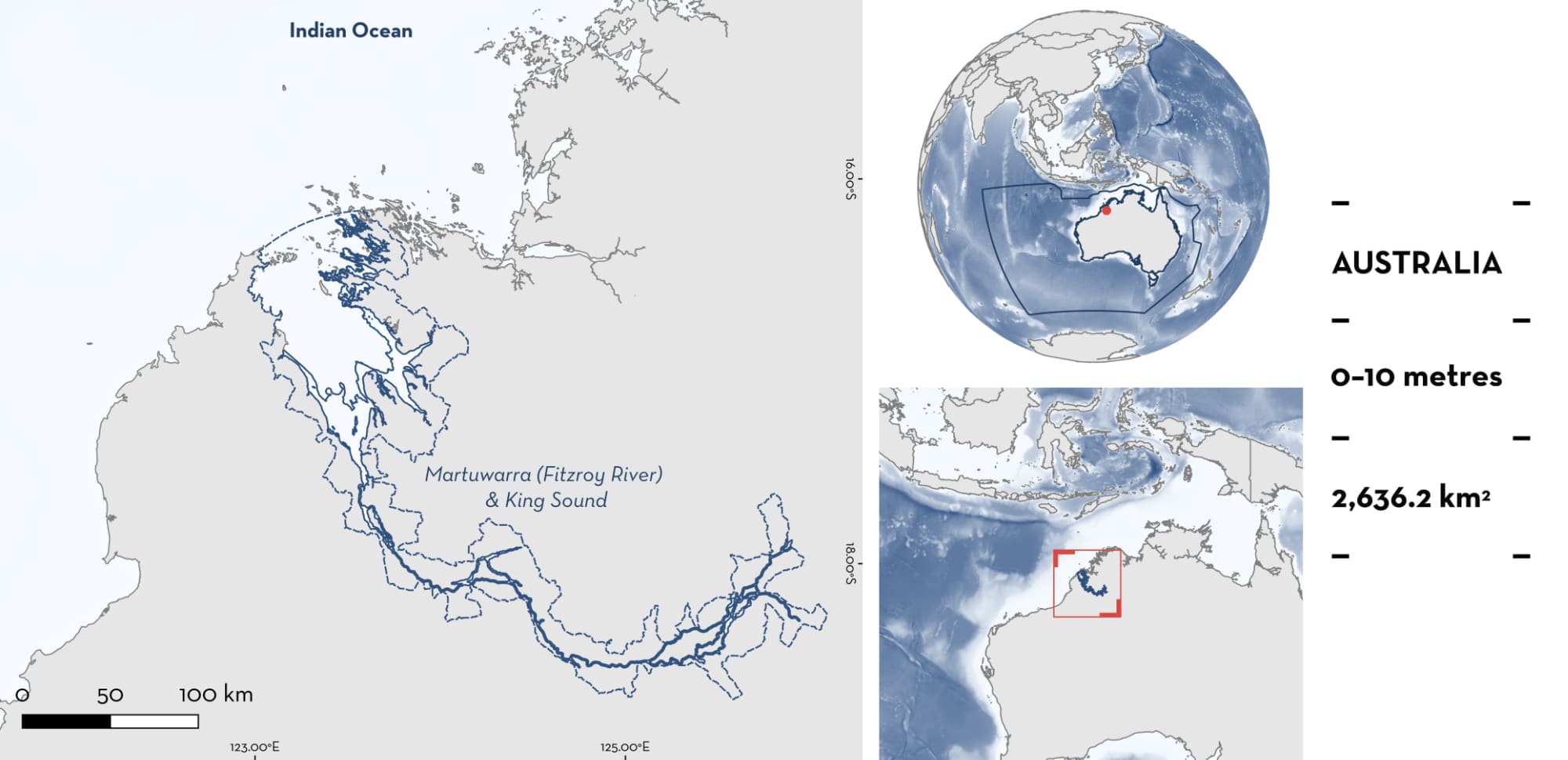
Martuwarra (Fitzroy River) & King Sound
Summary
Martuwarra (Fitzroy River) & King Sound is located in the Kimberley region, Western Australia, Australia. This area encompasses the eastern margin of King Sound, the Fitzroy River estuary, and the Fitzroy River. This area is a highly dynamic system that operates under a monsoonal climate with extreme wet and dry seasons and substantial inter-annual variability in freshwater discharge. It also experiences some of the world’s largest tidal ranges. Within this area there are: threatened species (e.g., Dwarf Sawfish Pristis clavata); reproductive areas (e.g., Bull Shark Carcharhinus leucas); and resting areas (Largetooth Sawfish Pristis pristis).
Download factsheet
Martuwarra (Fitzroy River) & King Sound
DESCRIPTION OF HABITAT
Martuwarra (Fitzroy River) & King Sound is located in the Kimberley region, Western Australia, Australia. It is situated in Dambimangari, Warrwa, Bardi, Djawi, Nimanburr, Nyikina, Bunuba, Gooniyandi, and Walmajarri Country. This area encompasses the eastern margin of King Sound, the Fitzroy River estuary (e.g., Telegraph Pool and Snag Pool), and the Fitzroy River upstream up to Geikie Gorge, including the dry season freshwater pools (e.g., Camballin Pool and Myroodah Pool). This area also includes estuaries of the May, Meda, Robinson, and Fraser rivers.
The Fitzroy River is a highly dynamic river system and estuary. During the wet season (December–May), monsoonal rains fill the catchment, fully connecting the river. In contrast, during the dry season (June–November) flows decline and eventually cease, leaving a series of permanent pools sustained by local aquifers (CSIRO 2018). When flowing during the wet season, water levels can exceed dry season levels by more than 10 m, inundating much of the surrounding floodplain. In the dry season, water levels fall within freshwater reaches, and the river becomes a chain of pools connected only by shallow channels and runs (Whitty et al. 2009, 2017; CSIRO 2018; Lear et al. 2019). Like many dryland rivers, the Fitzroy also exhibits considerable interannual variability in discharge, with wet season flows varying more than 25-fold over the past two decades (Lear et al. 2019). Consequently, the extent and quality of wet and dry season habitats fluctuate substantially between years, depending on rainfall and river flow (Lear et al. 2021).
The Fitzroy River estuary extends from the river mouth to Langi Crossing, ~16 km upstream. Together with King Sound, it experiences some of the world’s largest tidal ranges, with periodic tides exceeding 11 m (Whitty et al. 2009; Brocx & Semeniuk 2012; Morgan et al. 2021). These extreme tidal dynamics generate strong currents, extensive intertidal flats, and highly turbid waters.
This Important Shark and Ray Area is benthic and pelagic and is delineated from inshore and surface waters (0 m) to 10 m based on the depth range of Qualifying Species in the area.
CRITERION A
VULNERABILITY
Three Qualifying Species considered threatened with extinction according to the IUCN Red List of Threatened Species regularly occur in the area. These are the Critically Endangered Dwarf Sawfish (Grant et al. 2022) and Largetooth Sawfish (Espinoza et al. 2022), and the Vulnerable Bull Shark (Rigby et al. 2021).
CRITERION C
SUB-CRITERION C1 – REPRODUCTIVE AREAS
Martuwarra (Fitzroy River) & King Sound is an important reproductive area for one shark and two ray species.
Between 2002–2023, fishery-independent gillnet surveys were conducted in this area recording neonates, young-of-the-year (YOY), and older juveniles of Bull Shark, Dwarf Sawfish, and Largetooth Sawfish (Morgan et al. 2004; Thorburn et al. 2004, 2007; Whitty et al. 2009; Whitty 2011; Gleiss et al. 2015; Lear et al. 2019, 2021).
Between 2002–2023, gillnet surveys (100–150 mm mesh, 20–60 m length, soaked for 1–4 hours) captured a total of 276 Bull Sharks in 2002 (n = 3 individuals), 2003 (n = 18), 2007–2014 (n = 81; 68–139 cm total length; TL), and 2015–2023 (n = 174; 65–158 cm TL) (Morgan et al. 2004; Thorburn et al. 2004, 2008; Laolada 2015; KO Lear et al. unpubl. data 2025). Between 2007–2023, of 210 captures where individuals were measured, 87 (41%) were estimated to be neonate or YOY as their body size was <90 cm TL. These neonates and YOY were captured in 16 of the 17 years of surveys, except for 2020, where four juveniles (1+ year) were captured (KO Lear et al. unpubl. data 2025). Bull Sharks size-at-birth is at 56–81 cm TL (Rigby et al. 2021) indicating that these were all early life-stages.
In these same surveys, between 2002–2016, 118 juvenile Dwarf Sawfish (74–254 cm TL) including 11 YOY were captured (Morgan et al. 2021), and between 2017–2023, 16 juveniles, including two YOY, were recorded (A Harry unpubl. data 2017–2023). YOY Dwarf Sawfish were defined as individuals measuring <111 cm TL with a size-at-birth estimated as 65 cm TL, and males size-at-maturity of 260 cm TL (Peverell 2010; Last et al. 2016; White et al. 2017). The catch-per-unit-effort (CPUE) during the targeted September 2015 survey ranged between 0–10.5 Dwarf Sawfish per 20-m net per h (mean = 1.60 ± 1.89 sawfish per 20-m net per h) in Snag Pool (Fitzroy River estuary), and in August 2015, between 0.5 and 3.64 Dwarf Sawfish per 20-m net per h (mean = 1.82 ± 0.94 sawfish per 20-m net per h) in Telegraph Pool (Fitzroy River estuary) (Morgan et al. 2021). The few targeted surveys for Dwarf Sawfish that have been conducted in other areas across Western Australia, as well as non-targeted sampling in Gulf of Carpentaria (Queensland), have had much lower catch rates (0.2–4.9 Dwarf Sawfish per 500-m net per day; Peverell 2005). Between 2017–2023, gillnet surveys demonstrated higher catch rates (i.e., number of individuals per unit effort [hours]) of Dwarf Sawfish in this area compared to surrounding regions (1.5x higher than the second-highest rate and 20.9x higher than the lowest; A Harry unpubl. data 2017–2023).
In 2015–2016, nine acoustic receivers were deployed along the lower Fitzroy River, its estuary, and the southern and eastern areas of King Sound, where 17 juvenile Dwarf Sawfish (133–190 cm TL; age 1+) were tracked. Individuals predominately occupied two estuarine pools, Telegraph Pool and Snag Pool, on the Fitzroy River estuary during the dry season (May–December). Dwarf Sawfish first moved into Snag Pool as river flow starts to dissipate in the early–mid dry season (May–July), before moving upstream to Telegraph Pool. Snag Pool also showed a second peak in probability of residency in December at the end of the dry season in 2015 and 2016, when sawfish transited through Snag Pool on their way out of the estuary as the wet season river flows began. Between August–September 2015, six individuals (35%) resided in Snag Pool, and from October–November 2015, up to 12 individuals (70%) resided in Telegraph Pool. A similar pattern was observed in 2016. In the wet and early dry seasons (December–July) or in years with substantial rainfall/freshwater discharge, individuals transition to areas in southern King Sound, in this area (Morgan et al. 2021).
Sawfish rostra were collected or donated from various sources across Western Australia (Morgan et al. 2011). Of the 141 Dwarf Sawfish rostra obtained, 94% originated from this area. Five of these rostra had a total rostral length <21 cm, corresponding to a body size of <100 cm TL, so were from YOY (Morgan et al. 2011). Combined, these studies showed an extended and repeated use within the estuary by acoustically tracked juvenile Dwarf Sawfish (Morgan et al. 2021), as well as the long-term use of the area shown by the historical catch data and rostra records (Morgan et al. 2011, 2021).
This area might be one of the most important remaining habitats for Dwarf Sawfish. Due to localised extinctions, this species’ distribution has contracted primarily to Australia (Yan et al. 2021; Constance et al. 2024). Along its known geographic range, only one Important Shark and Ray Area has been identified in Papua New Guinea (Jabado et al. 2024). In Australia, published information highlights that this species has only been studied in two locations: this area (Morgan et al. 2004; Thorburn et al. 2004, 2007; Whitty 2011; Morgan et al. 2021) and the Gulf of Carpentaria (Peverell 2005, 2010). Based on data collated from commercial fisheries operating in the Gulf of Carpentaria in 2000–2002, 24 individuals (80–306 cm TL) were captured, with body size frequencies peaking at 70–120 cm TL (Peverell 2005, 2010). This showcases that only YOY, juveniles, and adult males were recorded. Across Australia, neonates or embryos have never been documented (Constance et al. 2024), and only four adult females have been recorded from across northwest Australia (~160–500 km from this area) (Windstein et al. 2025).
Between 2002–2018, gillnet surveys (100–150 mm mesh, 20–60 m length, typically soaked for 1–2 hours) were conducted annually during the dry season in this area (Morgan et al. 2004, 2011; Thorburn et al. 2007; Whitty et al. 2009, 2017; Lear et al. 2019, 2021). Body size and sex were recorded, and individual Largetooth Sawfish were numbered with rototags attached to the first dorsal fins to assess recaptures of individuals within and between years (Morgan et al. 2004; Thorburn et al. 2007; Whitty et al. 2014; Lear et al. 2019). Over 500 individual Largetooth Sawfish were captured in this area in over 5,600 20-m net hours, including >340 YOY individuals (Lear et al. 2019). Individuals were caught up to 8 times over a period of 0–5 years, resulting in a total of 932 Largetooth Sawfish encounters. Individuals ranged in size from 76.3–277.0 cm TL, with a sex ratio of 1:0.96 (female: male). YOY Largetooth Sawfish were defined as individuals measuring <130 cm TL (Thorburn et al. 2007; Morgan et al. 2011; Peverell 2010). YOY were caught in most years sampled (Morgan et al. 2004; Thorburn et al. 2007; Lear et al. 2019), and were especially abundant, as recorded by CPUE, in freshwater pools of the Fitzroy River in years with large wet season floods (Lear et al. 2019).
These studies show that the Largetooth Sawfish are pupped in the macrotidal estuary of King Sound during the wet season, and migrate into the Fitzroy River estuary and then into the non-tidal, freshwater reaches of the river which they use as a nursery for 4–6 years (Morgan et al. 2011; Thorburn et al. 2007; Whitty et al. 2009; Whitty 2011; Lear et al. 2019). Once they reach a size between 220–260 cm TL, they return to marine environments to mature. No adult females have been captured in this area. Additionally, sawfish rostra were collected or donated from various sources across Western Australia (Morgan et al. 2011). Of the 74 Largetooth Sawfish rostra obtained, 81% originated from this area.
CRITERION C
SUB-CRITERION C3 – RESTING AREAS
Martuwarra (Fitzroy River) & King Sound is an important resting area for one ray species.
Various tagging studies have investigated behaviour of juvenile Largetooth Sawfish within freshwater and estuarine nursery habitats within this area. Between 2008–2015, 32 neonates, YOY, and larger juveniles (<251 cm TL) were monitored in freshwater pools through acoustic telemetry (Whitty et al. 2017). Individuals tended to rest in deeper runs and pools in proximity to large woody debris during the day, becoming more active at night and twilight when inhabiting shallow water such as glides, pool edges, and shallow runs (Whitty et al. 2017). During the dry season of 2011, animal-attached accelerometers were used on 16 juvenile Largetooth Sawfish occupying this area to examine the activity and depth selection in response to seasonal changes in thermal stratification (Gleiss et al. 2017). Individuals in the late dry season utilised deeper and cooler sections of the river during periods of extensive rest which is consistent with behavioural thermoregulation to reduce energy expenditure. Energetic studies in this area have confirmed that this strategy is likely related to energy conservation, as sawfishes appear highly energy-limited in the late dry season when food resources are scarcer and temperatures are higher (Lear et al. 2020), especially in years where there was lower wet season rainfall and water flow (Lear et al. 2021).
Download factsheet
SUBMIT A REQUEST
ISRA SPATIAL LAYER REQUEST
To make a request to download the ISRA Layer in either a GIS compatible Shapefile (.shp) or Google Earth compatible Keyhole Markup Language Zipped file (.kmz) please complete the following form. We will review your request and send the download details to you. We will endeavor to send you the requested files as soon as we can. However, please note that this is not an automated process, and before requests are responded to, they undergo internal review and authorization. As such, requests normally take 5–10 working days to process.
Should you have questions about the data or process, please do not hesitate to contact us.