ISRA FACTSHEETS
ISRA FACTSHEETS
AUSTRALIA AND SOUTHEAST INDIAN OCEAN
Mary River
Summary
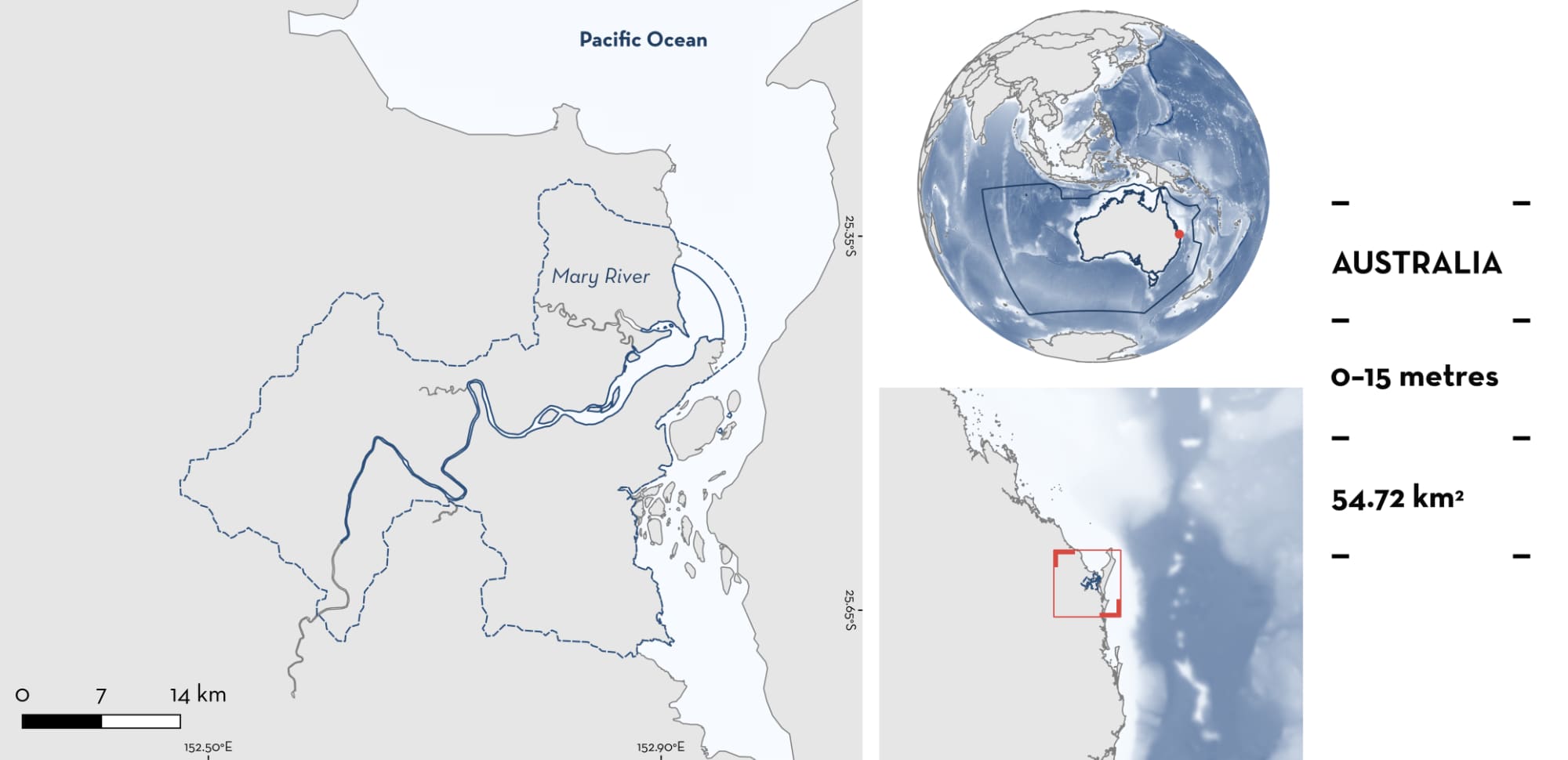
Mary River is located in southeast Queensland, Australia. The area comprises the lower reaches and estuary of the Mary River, from the barrage upstream of Maryborough to the river mouth near the town of Hervey Bay. The habitat is characterised by mangroves, turbid water, and riverbanks adjoining urban and agricultural land. It is influenced by freshwater and sediment input from the river, by tidal saltwater intrusion, and by a subtropical climate with higher river flow during the austral summer. This area overlaps with the Great Sandy Strait Ramsar Site and the Great Sandy Strait Key Biodiversity Area. Within this area there are: threatened species and reproductive areas (Bull Shark Carcharhinus leucas).
Download factsheet
Mary River
DESCRIPTION OF HABITAT
Mary River is located in southeast Queensland, Australia. The area comprises the lower reaches and estuary of the Mary River from the barrage upstream of Maryborough to the river mouth near the town of Hervey Bay. The 305 km long river has a catchment area of 9,595 km2 and empties into the Great Sandy Strait between the mainland and K’gari (Simpson & Mapleston 2002). The habitat is characterised by mangroves, turbid water, and urban and agricultural land adjoining the riverbank.
The area is influenced by a subtropical climate with the highest rainfall during the austral summer months (Simpson & Mapleston 2002). It is also influenced by freshwater and sediment input from the river, and by tidal saltwater intrusions. The tidal influence reaches the upstream boundary at the barrage, resulting in a gradient of salinity levels within this area.
This area overlaps with the Great Sandy Strait Ramsar Site (Wetland of International Importance; Ramsar 2025) and the Great Sandy Strait Key Biodiversity Area (KBA 2025).
This Important Shark and Ray Area is benthic and pelagic and is delineated from inshore and surface waters (0 m) to 15 m based on the bathymetry of the area.
CRITERION A
VULNERABILITY
One Qualifying Species considered threatened with extinction according to the IUCN Red List of Threatened Species regularly occurs in the area. This is the Vulnerable Bull Shark (Rigby et al. 2021).
CRITERION C
SUB-CRITERION C1 – REPRODUCTIVE AREAS
Mary River is an important reproductive area for one shark species.
Neonate and young-of-the-year (YOY) Bull Sharks are regularly observed in this area (Lubitz 2023; N Lubitz unpubl. data 2025). A research study captured and released 23 Bull Sharks in this area using rod-and-line during three survey days in May 2019, March 2020, and January 2025. Multiple individuals (n = 2, 5, and 16) were captured on each survey day, demonstrating their high abundance despite low survey effort. Total length (TL) was measured and used to determine the life-stage.
The 23 Bull Sharks examined ranged in size from 70–91 cm total length (TL) (N Lubitz unpubl. data 2025). All individuals were either neonates or YOY, with 10 neonates (43%) ranging 70–81 cm TL and 13 YOY (57%) ranging 83–91 cm TL. The size-at-birth for the species is 56–81 cm TL and YOY can be up to 99 cm TL (Pillans et al. 2020; Ebert et al. 2021). Small Bull Sharks in eastern Australia remain in river and estuary habitats for up to five years (Werry et al. 2011). Additionally, small Bull Sharks have been reported in flooded areas of land within this area during the 2022 flood (Gausmann 2024). The species is also regularly captured by recreational fishers operating in this area, particularly in the summer. Social media records show that they are abundant, with up to 14 individuals estimated to be 60 cm TL captured within 2 h of fishing. Combined, this information shows that Mary River is an important area for the early life-stage Bull Sharks. Although Mary River is located only ~120 km from the northern most Sunshine Coast rivers, which also hosts important habitat for young Bull Sharks, these river systems are individually important. Bull Sharks in Australia display natal philopatry, with females returning to particular river systems to pup (Tillett et al. 2012; Lubitz 2023). For example, half-sibling pairs were found within a river on Australia’s east coast up to seven cohorts apart, highlighting the long-term natal philopatry of females (Lubitz 2023). Therefore, individual rivers in this region represent discrete portions of habitat that are important to Bull Sharks.
Download factsheet
SUBMIT A REQUEST
ISRA SPATIAL LAYER REQUEST
To make a request to download the ISRA Layer in either a GIS compatible Shapefile (.shp) or Google Earth compatible Keyhole Markup Language Zipped file (.kmz) please complete the following form. We will review your request and send the download details to you. We will endeavor to send you the requested files as soon as we can. However, please note that this is not an automated process, and before requests are responded to, they undergo internal review and authorization. As such, requests normally take 5–10 working days to process.
Should you have questions about the data or process, please do not hesitate to contact us.