
ISRA FACTSHEETS
ISRA FACTSHEETS
EUROPEAN ATLANTIC
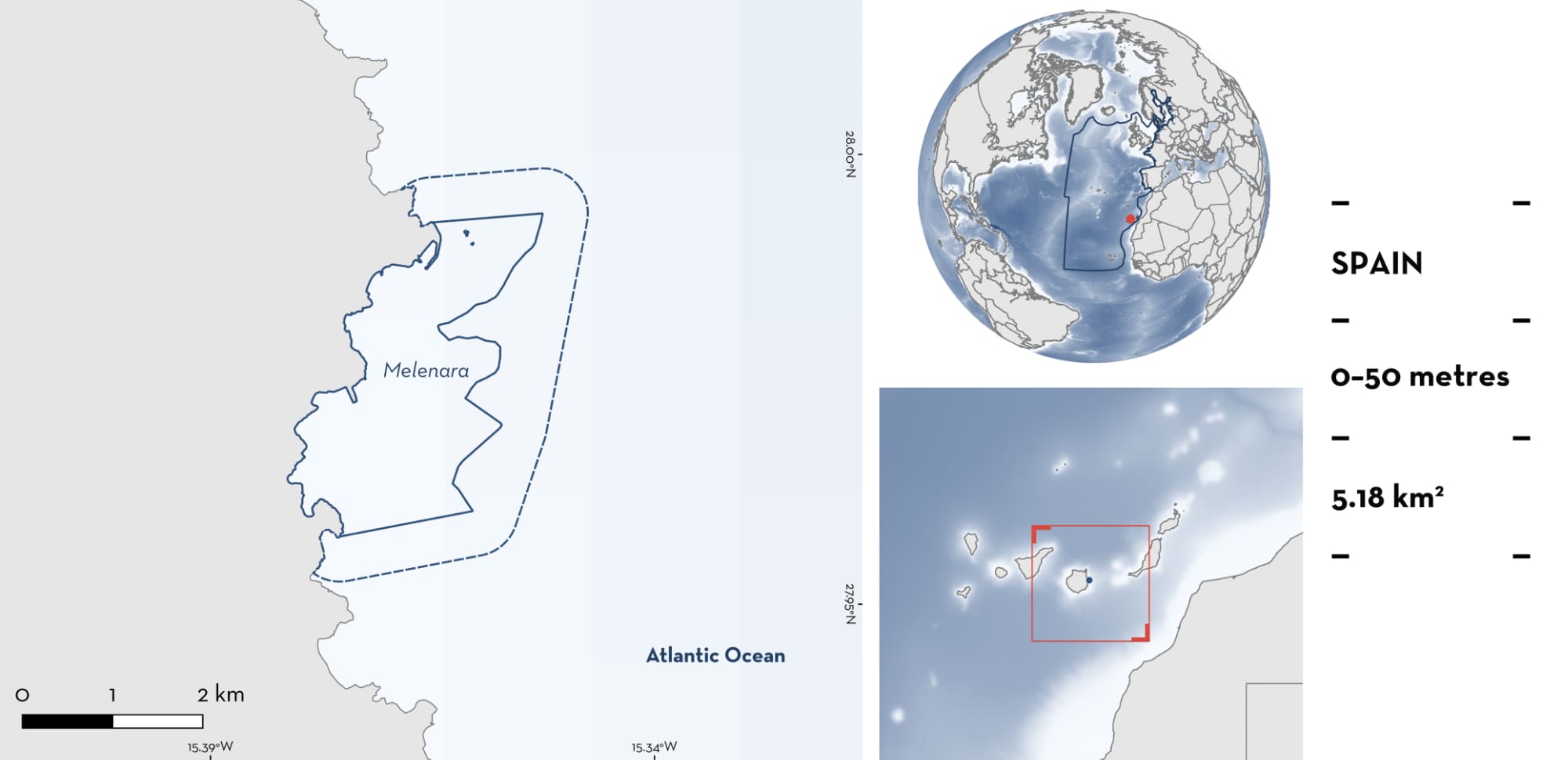
Melenara
Summary
Melenara is located on the coast of Gran Canaria Island, Canary Islands, Spain. It is situated on the eastern platform of the island where a gentle slope progressively deepens toward the edge of the platform. The area is characterised by rocky reefs, basaltic platforms, and sandy plains with volcanic features. The area overlaps with the Oceanic Islands and Seamounts of the Canary Region Ecologically or Biologically Significant Marine Area. Within this area there are: threatened species and undefined aggregations (Spiny Butterfly Ray Gymnura altavela).
Download factsheet
Melenara
DESCRIPTION OF HABITAT
Melenara is located on the coast of Gran Canaria Island, Canary Islands, Spain. It is situated on the eastern platform of the island where a gentle slope progressively deepens toward the edge of the platform. The area is characterised by rocky reefs, basaltic platforms, and sandy plains with volcanic features such as overhangs, ledges, and cavities increasing the structural complexity of the area (Rays of Paradise pers. obs. 2025).
The area is influenced by the Canary Current and the seasonal coastal upwelling system off northwest Africa, which brings cold, nutrient-rich waters enhancing primary productivity especially from the boreal spring to autumn (Gómez-Letona et al. 2017; Espino-Ruano et al. 2023). The area is also subject to the periodic influence of internal waves and localised coastal currents, which contribute to sediment redistribution and prey availability (Gómez-Letona et al. 2017).
This area overlaps with the Oceanic Islands and Seamounts of the Canary Region Ecologically or Biologically Significant Marine Area (EBSA; CBD 2025).
This Important Shark and Ray Area is benthic and is delineated from inshore and surface waters (0 m) to 50 m based on the bathymetry of the area.
CRITERION A
VULNERABILITY
One Qualifying Species considered threatened with extinction according to the IUCN Red List of Threatened Species regularly occurs in the area. This is the Endangered Spiny Butterfly Ray (Dulvy et al. 2021).
CRITERION C
SUB-CRITERION C5 – UNDEFINED AGGREGATIONS
Melenara is an important area for undefined aggregations of one ray species.
Spiny Butterfly Ray aggregations are regularly observed in this area between June–November (Espino-Ruano et al. 2023; Rays of Paradise unpubl. data 2025). Between May 2017–December 2019, monthly scientific surveys (n = 30) were conducted using random 50 m transects. Two snorkelers surveyed each transect along the beach at depths of 0–5 m for three minutes (Rays of Paradise unpubl. data 2025). Spiny Butterfly Rays observed in the area were recorded, sexed, and measured for total length (TL; from the tip of the snout to the end of the tail) and disc width (DW) (Espino-Ruano et al. 2023). Measurements were estimated by approaching the resting rays with a tape measure while they were on the seafloor (Espino-Ruano et al. 2023).
Nineteen sightings comprising a total of 422 Spiny Butterfly Rays were recorded in the area. Of these, 14 sightings (73.7%) were aggregations, comprising between 3–82 individuals (mean = 12; Rays of Paradise unpubl. data 2025). Aggregations were recorded in 2017 (number of aggregations = 4), 2018 (n = 5), and 2019 (n = 5) (Espino-Ruano et al. 2023; Rays of Paradise unpubl. data 2025). All individuals were adults ranging in size between 60–175 cm TL and were skewed towards females (77%) (Espino-Ruano et al. 2023; Rays of Paradise unpubl. data 2025). Aggregations followed a seasonal pattern following the rise of sea surface temperature occurring from June–November and peaking in September when water reached 22–24°C (Espino-Ruano et al. 2023). Seasonal site fidelity to aggregation areas was documented for this species between 2020–2024 through passive acoustic telemetry at other sites within Gran Canary Island (Rays of Paradise unpubl. data 2025). It is hypothesised that during the remainder of the year, individuals likely migrate to deeper waters or other unknown locations (Espino-Ruano et al. 2023; Rays of Paradise unpubl. data 2025). Melenara hosts the largest observed aggregation of the species along the east coast of Gran Canaria Island. Further information is required to understand the nature and function of these aggregations.
Download factsheet
SUBMIT A REQUEST
ISRA SPATIAL LAYER REQUEST
To make a request to download the ISRA Layer in either a GIS compatible Shapefile (.shp) or Google Earth compatible Keyhole Markup Language Zipped file (.kmz) please complete the following form. We will review your request and send the download details to you. We will endeavor to send you the requested files as soon as we can. However, please note that this is not an automated process, and before requests are responded to, they undergo internal review and authorization. As such, requests normally take 5–10 working days to process.
Should you have questions about the data or process, please do not hesitate to contact us.

