
ISRA FACTSHEETS
ISRA FACTSHEETS
AUSTRALIA AND SOUTHEAST INDIAN OCEAN
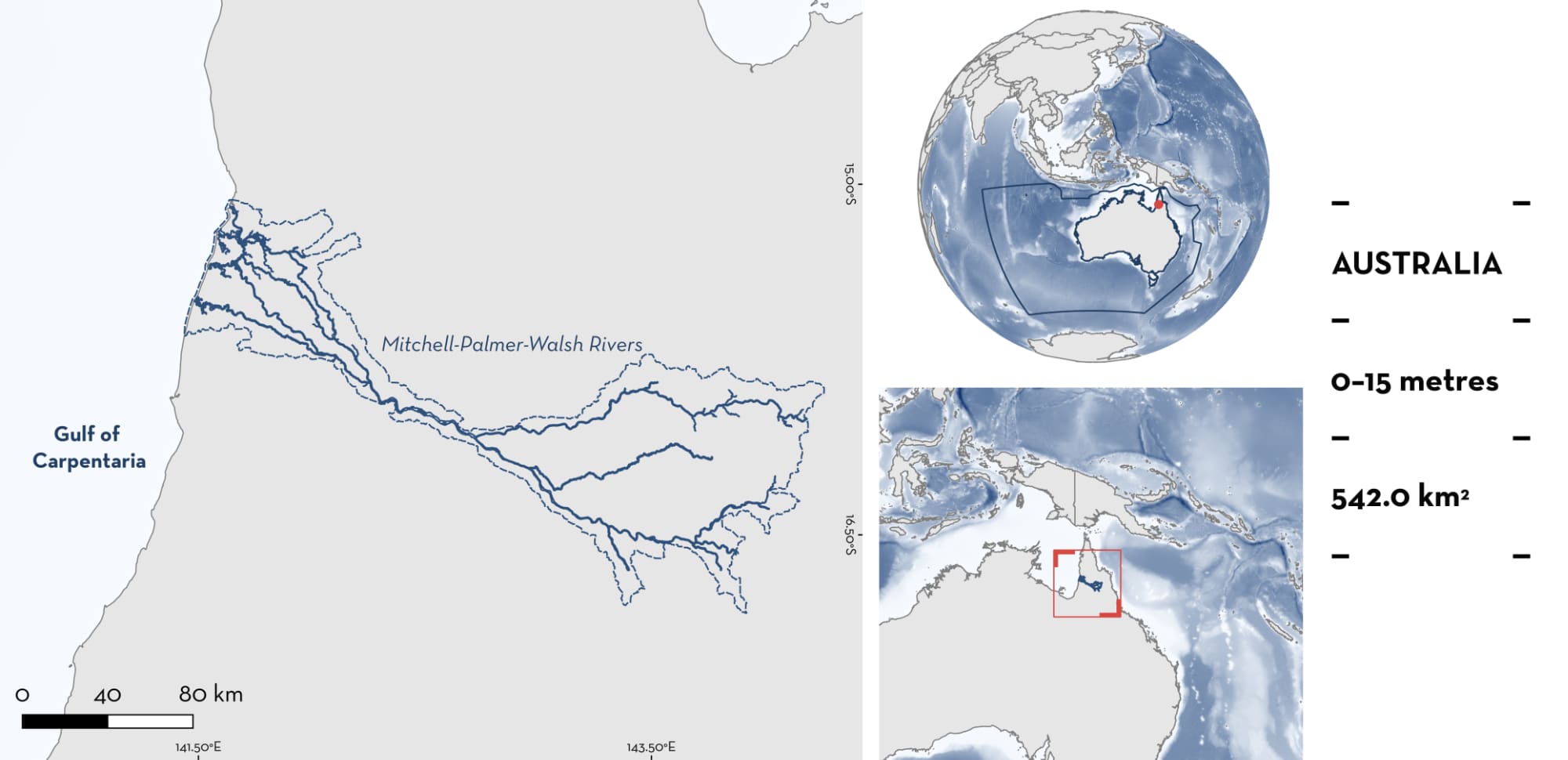
Mitchell-Palmer-Walsh Rivers
Summary
Mitchell-Palmer-Walsh Rivers is located in Far North Queensland, Queensland, Australia. The area includes the Mitchell River, Lynd River, Walsh River, Rosser Creek, and Palmer River. It is characterised by expansive floodplain wetlands, alluvial plains, estuaries, mangroves, and salt flats. The area is influenced by a tropical sub-humid to humid climate. The area overlaps with the Gulf Plains Key Biodiversity Area. Within the area there are: threatened species (e.g., Largetooth Sawfish Pristis pristis); and reproductive areas (e.g., Freshwater Whipray Urogymnus dalyensis).
Download factsheet
Mitchell-Palmer-Walsh Rivers
DESCRIPTION OF HABITAT
Mitchell-Palmer-Walsh Rivers is located in Far North Queensland, Queensland, Australia. The Mitchell-Palmer-Walsh Rivers is located on the country of the Kokoberra, Yir Yoront, Kunjen, Olkola, Wakaman, Bar Barrum, Djungan, Tableland Yidinji, Mbabaram, Western Yalanji, and Koko Muluridji First Peoples. It is a major river system, extending for about 650 km from the eastern flank of Cape York Peninsula to the Gulf of Carpentaria, with a catchment area of approximately 72,000 km2 (Rustomji 2010; Hunt et al. 2012). The area includes the Mitchell River, Lynd River, Walsh River, Rosser Creek, and Palmer River. The Mitchell River is perennial, while its tributaries (the Alice, Lynd, Palmer, and Walsh rivers) flow intermittently (Hunt et al. 2012). The river flows through rainforest and wet sclerophyll forest in the highlands, transitions into savannah woodlands and open woodlands in the central uplands, and finally spreads across expansive floodplain wetlands, alluvial plains, estuaries, mangroves, and salt flats near its mouth. The Mitchell River tributaries form a fluvial megafan (carved deeply into alluvial plains) with maximum incision occurring about 400 km upstream before gradually flattening toward the coast (Brooks et al. 2009).
The area is influenced by a tropical sub-humid to humid climate, with the wet season from November to April encompassing nearly all annual rainfall. Rainfall averages 1,200 mm/yr near the Gulf of Carpentaria, decreasing to below 800 mm/yr in inland southern and western areas (Rustomji 2010). Temperatures remain high year-round, ranging from 17–23°C in the dry season to 32–37°C in the wet season (Crowley & Garnett 2000).
This area overlaps with the Gulf Plains Key Biodiversity Area (KBA 2025).
This Important Shark and Ray Area is benthic and pelagic and is delineated from inshore and surface waters (0 m) to 15 m depth based on the bathymetry in the area.
CRITERION A
VULNERABILITY
Two Qualifying Species considered threatened with extinction according to the IUCN Red List of Threatened Species regularly occur in the area. These are the Critically Endangered Largetooth Sawfish (Espinoza et al. 2022) and the Vulnerable Bull Shark (Rigby et al. 2021).
CRITERION C
SUB-CRITERION C1 – REPRODUCTIVE AREAS
Mitchell-Palmer-Walsh Rivers is an important reproductive area for one shark and two ray species.
Between 2016–2018 and 2020–2023, annual sampling trips for sawfishes in the Mitchell River Basin (Mitchell River and its associated tributaries Surprise Creek, Walsh River, and Palmer River) were conducted during the dry season, in June (2016, 2021), July–August (2017, 2018, 2020, 2021), and September (2022, 2023) (SARA 2025; BE Wueringer unpubl. data 2025). Gillnets were set for up to five days per field trip, with 1–2 sets per day. In total, 74 nets (25 m or 50 m) were deployed for 126 hrs, with a mean soak time of 2.80 ± 1.54 hrs (BE Wueringer unpubl. data 2025). Drum lines were used in the downstream tidal reaches, with 45 lines deployed for 276.8 hrs and a mean soak time of 3.74 ± 1.53 hrs. Both tidal and non-tidal waters were also sampled using 210 handlines, with a mean soak time of 2.70 ± 1.79 hrs and a total effort of 564.6 hrs. All specimens captured were measured (total length; TL) and sexed. Additionally, between 2016–2025 citizen science reports from local and visiting recreational fishers, and the Kowanyama Land and Sea Rangers, including photos, capture details, species identification, and TL (either reported directly or estimated using rostrum morphometrics), were collected during the wet season (Biskis et al. 2025; SARA 2025). Further, a collection of sawfish rostra from this area was donated and analysed to determine species and size of animals (Wueringer et al. 2023).
Between 2016–2022, 35 Bull Sharks ranging in size between 70–150 cm TL (average = 91 cm TL) were captured during field surveys in the area from ~14 km from the river mouth to more than ~65 km upstream (BE Wueringer unpubl. data 2025). Of these, 29 (83%) were neonates and young-of-the-year (YOY) ranging in size between 70–99 cm TL (BE Wueringer unpubl. data 2025). Size-at-birth of the species is 56–81 cm TL (Ebert et al. 2021) and YOY showing umbilical scars of up to 99 cm TL have been captured in the region (Pillans et al. 2020). Neonates and YOY were captured between June–September in 2016 (n = 2), 2018 (n = 8), 2020 (n = 11), 2021 (n = 6), and 2022 (n = 2; BE Wueringer unpubl. data 2025). The remaining individuals (n = 6) were juvenile (102–150 cm TL) and were captured in 2016, 2017, 2020, and 2021 (BE Wueringer unpubl. data 2025). While pregnant females have not been documented through this sampling effort, the occurrence of neonates, YOY, and juveniles highlights that this area is important for early life-stage Bull Sharks.
Between 2014–2021, a total of 29 Largetooth Sawfish were captured or observed in the area from the river mouth to more than ~65 km upstream (Wueringer et al. 2023; BE Wueringer unpubl. data 2025). Of the 24 records where TL was available, 10 (41.7%) were neonate and YOY Largetooth Sawfish, ranging in size between 60.9–115.0 cm TL (BE Wueringer unpubl. data 2025). They were captured during field surveys (n = 3) in 2017–2018 (June–July) and submitted through citizen science records (n = 7) in 2016, 2019, 2021, and 2024, and were recorded in downstream areas during August–September and in upstream areas year-round (March–June, November; BE Wueringer & VN Biskis unpubl. data 2025; SARA 2025). Size-at-birth of the species is 72–91 cm TL and YOY sizes are estimated at <130 cm TL based on growth curves (Peverell 2009). The area is also important for juvenile Largetooth Sawfish with 14 individuals ranging in size between 180–265 cm TL either captured in field surveys (n = 2), citizen science submissions (n = 3), or identified from donated rostra (n = 9) (Wueringer et al. 2023; Biskis et al. 2025; BE Wueringer & VN Biskis unpubl. data 2025). Since Largetooth Sawfish leave rivers only upon reaching sexual maturity (Peverell 2009), the presence of YOY and juveniles in the Mitchell-Palmer-Walsh Rivers indicates that this area is an important reproductive area for the species. This area, together with the Norman River, holds the largest contemporary records of YOY Largetooth Sawfish on the east coast of the Gulf of Carpentaria, based on these monitoring efforts surveying a total of at least four river basins (BE Wueringer unpubl. data 2025).
Between 2016–2022, Freshwater Whiprays were captured during six of the seven surveys in the Mitchell River Basin. Thirty-eight animals ranging in size between 59–138 cm disc width (DW) (average = 90.9 cm DW) were captured from ~13 km from the river mouth to more than ~17 km upstream (BE Wueringer unpubl. data 2025). Of these, 13 (34.2%) were immature ranging in size between 59–86 cm DW (mean = 75.1) and were captured during all survey months (June–September; BE Wueringer unpubl. data 2025). Size-at-birth of the species is unknown, but size-at-maturity is estimated at 87 cm DW (Constance et al. 2024). Of these, six individuals were between 59–73 cm DW, while seven were 80–86 cm DW. This species appears to be highly resident, especially females, in other river systems within the Gulf of Carpentaria (Campbell et al. 2012), and in the area, two tagged Freshwater Whiprays were recaptured at the same location up to four years apart (BE Wueringer unpubl. data 2025). The Mitchell-Palmer-Walsh Rivers yielded higher captures of immature individuals of this species than adjacent rivers on the west coast of Cape York where similar surveys were conducted (BE Wueringer unpubl. data 2025). Considering the restricted movements of the species, the number of immature individuals recorded, and limited sampling opportunities due to the remoteness of the location, the area represents an important reproductive habitat for the species.
Download factsheet
SUBMIT A REQUEST
ISRA SPATIAL LAYER REQUEST
To make a request to download the ISRA Layer in either a GIS compatible Shapefile (.shp) or Google Earth compatible Keyhole Markup Language Zipped file (.kmz) please complete the following form. We will review your request and send the download details to you. We will endeavor to send you the requested files as soon as we can. However, please note that this is not an automated process, and before requests are responded to, they undergo internal review and authorization. As such, requests normally take 5–10 working days to process.
Should you have questions about the data or process, please do not hesitate to contact us.

