
ISRA FACTSHEETS
ISRA FACTSHEETS
EUROPEAN ATLANTIC
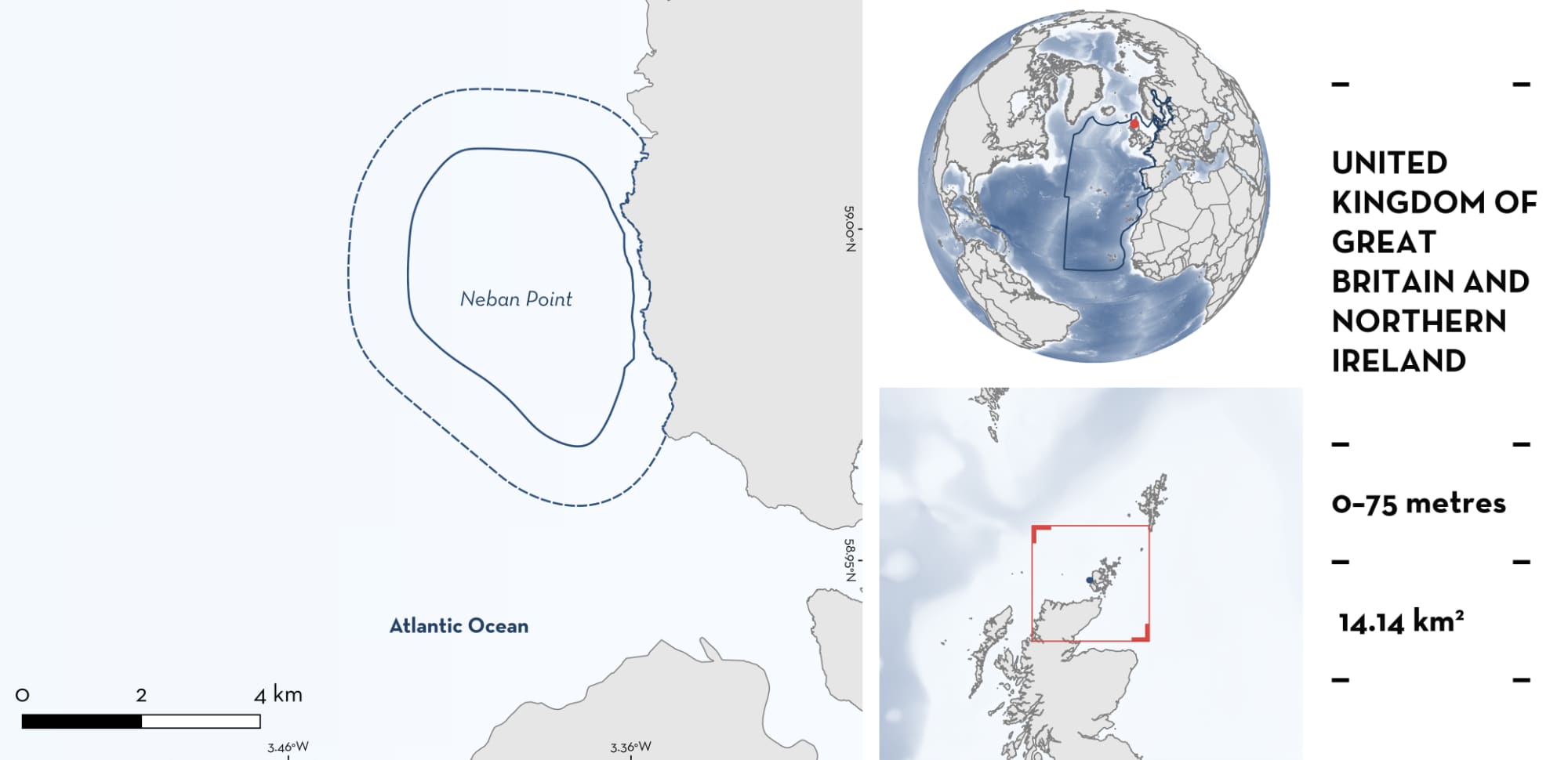
Neban Point
Summary
Neban Point is located in the Orkney Islands of Scotland, United Kingdom of Great Britain and Northern Ireland. This coastal area lies ~40 km north of the mainland of Scotland, on the Atlantic-facing west coast of Orkney mainland. It is influenced by wave action, strong tidal currents, and upwelling. The habitat is characterised by rocky reefs, boulders, and coarse sediment. Within this area there are: threatened species and undefined aggregations (Flapper Skate Dipturus intermedius).
Download factsheet
Neban Point
DESCRIPTION OF HABITAT
Neban Point is located in the Orkney Islands of Scotland, United Kingdom of Great Britain and Northern Ireland. It is situated ~40 km from mainland Scotland, on the Atlantic-facing west coast of Orkney mainland. The Orkney Archipelago comprises over 70 islands, separated by bays and dynamic tidal channels (Neill et al. 2014). The coastline of Neban Point is dominated by sea cliffs and coastal stacks. The inshore habitat features rocky reefs that transition into a narrow band of boulder reef running parallel to the coastline. Beyond 50 m depth, the seabed shifts to coarse, rippled sediments. A secondary boulder reef is present in ~70 m depth, marking the boundary of the area.
Orkney’s prevailing wind direction is southwesterly, and the region is strongly influenced by upwelling and powerful tidal currents, which exceed 3 m s-1 in many locations (Neill et al. 2014). Neban Point is highly exposed to wave action, particularly during the boreal winter, facing the full force of the northeast Atlantic Ocean. The strong tidal stream of Hoy Sound lies just to the south, generating a variety of back eddies and localised tidal flows in the vicinity.
This Important Shark and Ray Area is benthic and is delineated from inshore and surface waters (0 m) to 75 m based on the bathymetry of the area.
CRITERION A
VULNERABILITY
One Qualifying Species considered threatened with extinction according to the IUCN Red List of Threatened Species regularly occurs in the area. This is the Critically Endangered Flapper Skate (Ellis et al. 2024).
CRITERION C
SUB-CRITERION C5 – UNDEFINED AGGREGATIONS
Neban Point is an important area for undefined aggregations of one ray species.
Based on Baited Remote Underwater Video Station (BRUVS) surveys, Flapper Skates are observed year-round in this area (Orkney Skate Trust unpubl. data 2025). BRUVS surveys covered all coastal areas of the Orkney Archipelago, including Scapa Flow, Atlantic west coast, Atlantic north coast, the Northen Isles, east Orkney (North Sea), as well as within this area (Orkney Skate Trust unpubl. data 2025). These surveys made 274 deployments in this region between 2019–2025 throughout all seasons, lasting 60–300 minutes (average = 90 min). A total of 29 deployments were made within Neban Point. The maximum number of individuals within any one frame per deployment (MaxN) was recorded. Fourteen aggregations were recorded in total in the wider Orkney Archipelago region, defined as three or more individuals on a frame in a BRUVS survey which equates to 5% of all deployments and 23% of deployments with the species recorded (n = 60). Ten of fourteen aggregations were recorded within the area, highlighting that Neban Point is the hotspot of Flapper Skate aggregations in the Orkney Archipelago. Inside the area, MaxN ranged between 3–11 individuals (mean = 4.4 individuals) and aggregations were recorded on one third of deployments (10 of 29). A total of 114 Flapper Skates were recorded in the Orkney Archipelago during the BRUVS surveys (sum of MaxN values), of which 59 were observed within the area, representing 52% of records and highlighting the importance of this area for the species (Orkney Skate Trust unpubl. data 2025).
Orkney Skate Trust tag-and-release angling data have further shown aggregations of Flapper Skates in the area (Orkney Skate Trust unpubl. data 2025). The highest number of Flapper Skates were tagged through the night of 11th July 2018 off the Marwick coast, in this area, where a single angler tagged 20 individuals over a seven-hour fishing period. On a further six occasions, between 3–8 individuals were tagged per fishing session in this area between 2011–2023. In total, 141 Flapper Skates were tagged in the Orkney region, of which 32 individuals were from within this area (23%). Most aggregations were concentrated within this area. Almost all individuals were adults (96%) and there were more females (61%) than males (Orkney Skate Trust unpubl. data 2025). Additionally, Flapper Skate egg cases are found in high abundance after storm events on the beaches near this area, indicating that this may be an important reproductive area. Skates are known to aggregate, with temporal changes in aggregations related to sex and life-stage segregations (Swain & Benoît 2006; Frisk 2010; Hoff 2010). Further information is needed to understand the nature and function of the aggregations in this area.
Download factsheet
SUBMIT A REQUEST
ISRA SPATIAL LAYER REQUEST
To make a request to download the ISRA Layer in either a GIS compatible Shapefile (.shp) or Google Earth compatible Keyhole Markup Language Zipped file (.kmz) please complete the following form. We will review your request and send the download details to you. We will endeavor to send you the requested files as soon as we can. However, please note that this is not an automated process, and before requests are responded to, they undergo internal review and authorization. As such, requests normally take 5–10 working days to process.
Should you have questions about the data or process, please do not hesitate to contact us.

