ISRA FACTSHEETS
ISRA FACTSHEETS
AUSTRALIA AND SOUTHEAST INDIAN OCEAN
Neptune Islands
Summary
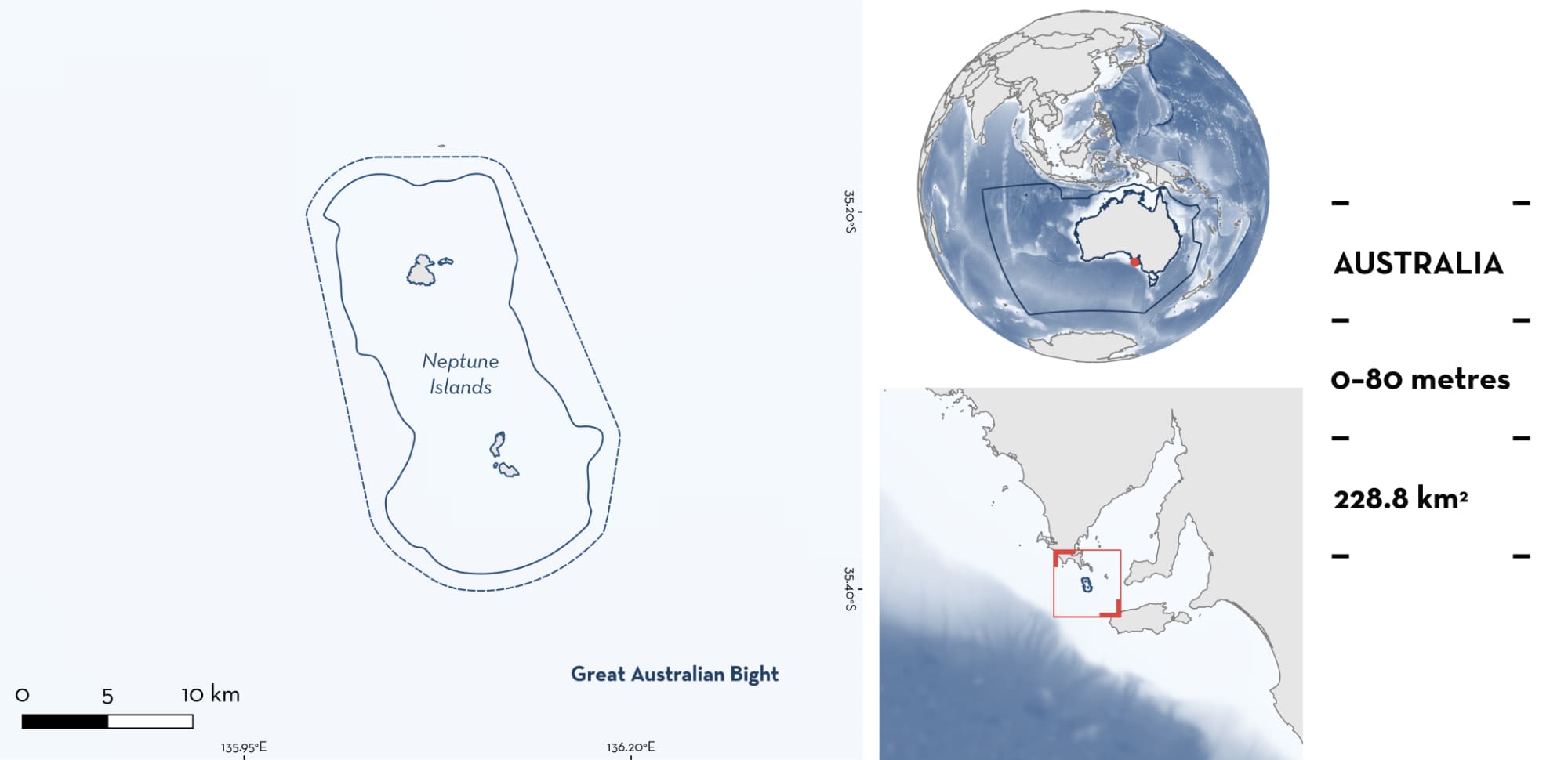
Neptune Islands is located south of the Eyre Peninsula in South Australia, Australia. The area is composed of two groups of islands, the North and South Neptune Islands. The habitat is characterised by seagrass patches, sandflats, shallow intertidal reef flats, and deep adjacent reefs. It is influenced by seasonal upwellings of cold nutrient-rich water that occur in the area during the austral summer. The area overlaps with two protected areas. Within this area there are: threatened species and feeding areas (White Shark Carcharodon carcharias).
Download factsheet
Neptune Islands
DESCRIPTION OF HABITAT
Neptune Islands is located in the Great Australian Bight off the Eyre Peninsula, South Australia, Australia. The area is situated ~70 km south of Port Lincoln and is composed of two groups of islands, the North and South Neptune Islands. The two groups of islands are separated by approximately 9 km. The area is characterised by seagrass patches, sandflats, shallow intertidal reef flats, and deep adjacent reefs.
The oceanography of the region is influenced by the Leeuwin and Flinders currents, which flow through the Great Australian Bight. The warm Leeuwin Current flows from the west during austral winter, while the Flinders Current brings cooler water from the southeast and enhances upwelling also during the winter (Richardson et al. 2019). Furthermore, seasonal upwellings of cold nutrient-rich water occur in the area during the summer (Richardson et al. 2020).
The area overlaps with the Neptune Islands (Ron and Valerie Taylor) Marine Park and the Neptune Islands Conservation Park (NPWS SA 2025).
This Important Shark and Ray Area is benthic and pelagic and is delineated from inshore and surface waters (0 m) to 80 m based on the bathymetry of the area.
CRITERION A
VULNERABILITY
One Qualifying Species considered threatened with extinction according to the IUCN Red List of Threatened Species regularly occurs in the area. This is the Vulnerable White Shark (Rigby et al. 2022).
CRITERION C
SUB-CRITERION C2 – FEEDING AREAS
Neptune Islands is an important feeding area for one shark species.
White Sharks seasonally feed on aggregations of Long-nosed Fur Seals Arctocephalus forsteri in the area (Watanabe et al. 2019; C Huveneers unpubl. data 2025; A Fox pers. comm 2025). Annual monitoring with acoustic telemetry since 2013 (Huveneers et al. 2013; Niella et al. 2023, 2024; S Madrigal-Mora unpubl. data 2025) and observations by cage-diving operators recorded since 1999 (Robbins 2007; Bruce & Bradford 2015; Nazimi et al. 2018) have revealed the regular and predictable presence of White Shark aggregations in the area. Between June 2010–December 2011 and July 2013–November 2014, 282 individuals were photo-identified in the area (Nazimi et al. 2018).
Acoustic telemetry showed that while White Sharks can be present year-round, there are seasonal peaks of abundance in April–July for females and September–February for males with variations among years (Huveneers et al. 2013; Niella et al. 2023, 2024; S Madrigal-Mora unpubl. data 2025). Based on detections of 44 White Sharks tagged in the area between 2014–2023, individuals stay ~25 days on average with some sharks staying up to 100 days (C Huveneers unpubl. data 2025). Peak abundances coincide with the presence of weaned Long-nosed Fur Seals that start to venture further away from rock pools (Baylis et al. 2005; Goldsworthy 2006; Goldsworthy & Page 2009; Bruce & Bradford 2015), indicating that females time their visit to the Neptune Islands when abundance of vulnerable pinnipeds is highest in autumn–winter. At this time, females might outcompete males that are usually smaller (400–500 vs. 300–400 cm total length, respectively).
White Shark predation on pinnipeds has been observed at the surface by cage-diving operators and scientists (Watanabe et al. 2019; C Huveneers unpubl. data 2025; A Fox pers. comm 2025). While such observations are not frequent, a study to monitor burst events using accelerometers showed that feeding events also occur outside of the observation range of cage-diving operators (Watanabe et al. 2019). Between 2014–2015, accelerometers (providing fine-scale swimming behaviour for up to two days) and video cameras (recording ~6 hours) were attached to eight White Sharks (Watanabe et al. 2019). A predation attempt was recorded by cameras when one White Sharks chased a seal. During this event, lateral acceleration, tailbeat frequency, swim speed, and positive pitch angles increased. Based on these characteristics, six additional potential foraging events (from three individuals) were revealed by accelerometers. These events occurred mostly at night or during crepuscular periods and below the surface (mean depth = 17 m; maximum depth = 53 m; Watanabe et al. 2019). White Sharks are known to predate on pinnipeds across South Australia (Shaughnessy et al. 2007) and seasonal aggregations of White Sharks during autumn and winter to feed on pinnipeds have been reported globally (e.g., Seal Island in South Africa, Titi Islands and Ruapuke in New Zealand; Duffy et al. 2012; Fallows et al. 2012; Francis et al. 2015; Skubel et al. 2018).
In addition, the diversity and abundance of multiple fishes (e.g. Silver Trevally Pseudocaranx georgianus, Yellowtail Kingfish Seriola lalandi) and benthic sharks and rays (e.g. Gummy Shark Mustelus antarcticus, Southern Eagle Ray Myliobatis tenuicaudatus) at the Neptune Islands is high (Whitmarsh et al. 2025). All these species form part of the diet of White Sharks broadly (Meyer et al. 2019; Grainger et al. 2020) which suggest that animals are likely attracted to this area to feed on other species as important prey sources.
While sensory stimuli (e.g., bait, auditory cues) used by cage-diving operators may affect White Sharks (Bruce & Bradford 2013; Huveneers et al. 2013), it has been shown across multiple studies that since management actions were established at Neptune Islands in 2012, residency, movement patterns (Niella et al. 2023), associative behaviour (Niella et al. 2024), foraging ecology, nutritional condition (Meyer et al. 2019), and energetic expenses (Gooden et al. 2024) are not substantially altered by the cage-diving activity. The results from multiple studies and the overlap of White Shark presence with prey abundances indicate that feeding opportunities is one of the main drivers of their presence at Neptune Islands.
Download factsheet
SUBMIT A REQUEST
ISRA SPATIAL LAYER REQUEST
To make a request to download the ISRA Layer in either a GIS compatible Shapefile (.shp) or Google Earth compatible Keyhole Markup Language Zipped file (.kmz) please complete the following form. We will review your request and send the download details to you. We will endeavor to send you the requested files as soon as we can. However, please note that this is not an automated process, and before requests are responded to, they undergo internal review and authorization. As such, requests normally take 5–10 working days to process.
Should you have questions about the data or process, please do not hesitate to contact us.