ISRA FACTSHEETS
ISRA FACTSHEETS
EUROPEAN ATLANTIC
Newfoundland Basin
Summary
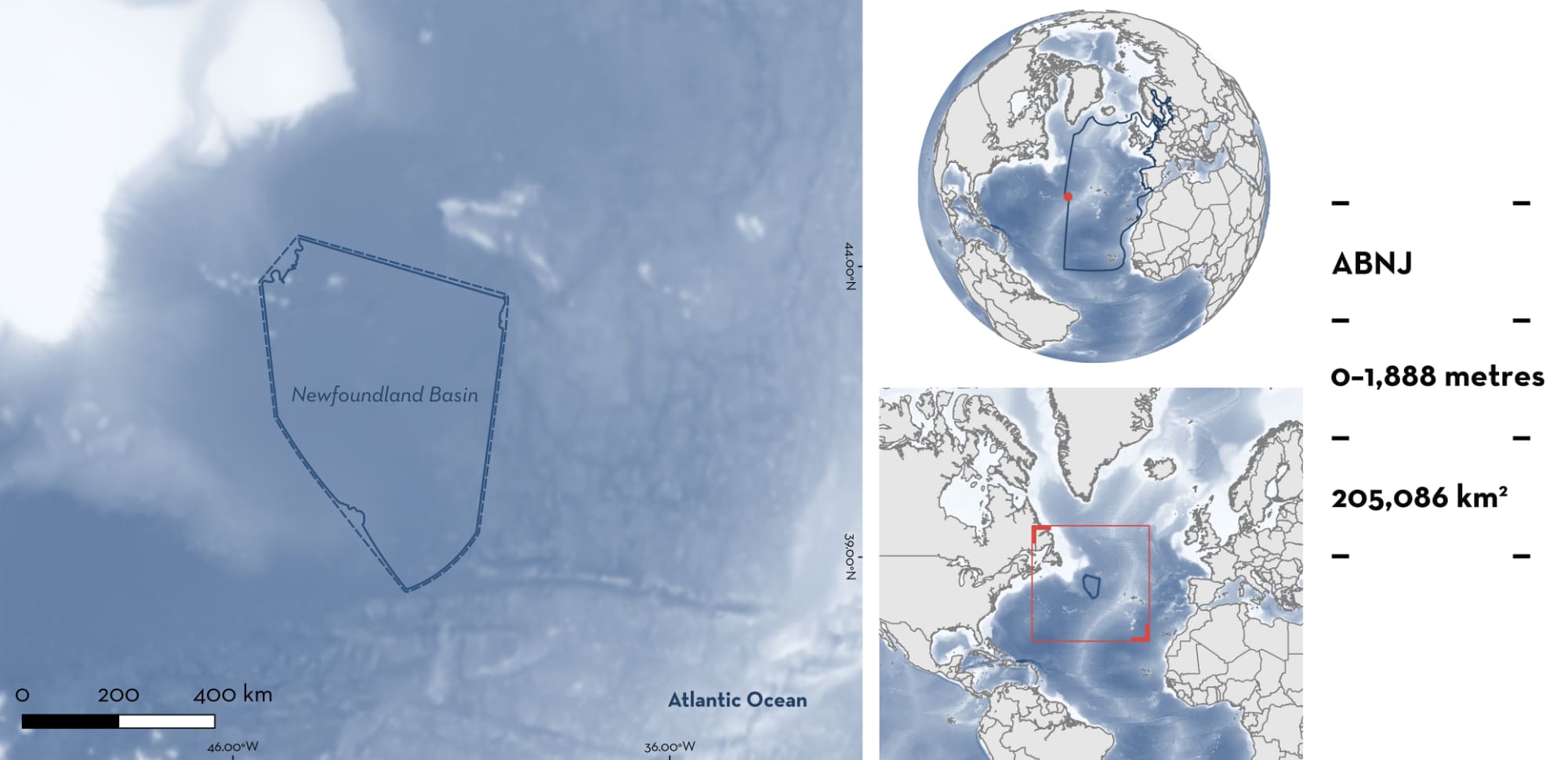
Newfoundland Basin is located in Areas Beyond National Jurisdiction (ABNJ) off Canada in the North Atlantic. It encompasses the Newfoundland Ridge and Newfoundland Basin. The area is characterised by ridges, seamounts, and part of the continental slope. It is influenced by the subpolar and subtropical gyres, and the convergence between the Labrador Current and North Atlantic Current. This area overlaps with the Mid-North-Atlantic Frontal System Ecologically or Biologically Significant Marine Area. Within this area there are: threatened species and feeding areas (Shortfin Mako Isurus oxyrinchus).
Download factsheet
Newfoundland Basin
DESCRIPTION OF HABITAT
Newfoundland Basin is located in Areas Beyond National Jurisdictions (ABNJ) off Canada in the North Atlantic. It encompasses the Newfoundland Ridge and Newfoundland Basin. The area is characterised by ridges, seamounts, and part of the continental slope from the Grand Banks and Flemish Cap.
The area is influenced by the subpolar and subtropical gyres, where the cold, fresh Labrador Current meets the warm, saline North Atlantic Current. These two strong currents flow along the basin’s western and eastern flanks, respectively, driving strong seasonal variation in sea-surface temperature (SST; 7–17.5°C) and salinity (Rashid et al. 2021). In the boreal summer, the North Atlantic Current dominates, raising SSTs in the southeastern basin, while in the rest of the year the Labrador Current’s influence expands, cooling the region (Rashid et al. 2021). Newfoundland Basin’s position in a mixing zone makes it a key oceanographic transition area in the Northwest Atlantic (Rashid et al. 2021) and a key ecological hotspot in the North Atlantic, due to dynamic oceanographic processes, such as anticyclonic eddies and recirculation features, that support rich mesopelagic communities (Pagniello et al. 2023; Ferter et al. 2024). This area includes the Mann Eddy, a long-lived, quasi-stationary mesoscale anticyclone trapped by the basin’s bowl-like topography (Solodoch et al. 2021).
This area overlaps with the Mid-North-Atlantic Frontal System Ecologically or Biologically Significant Marine Area (EBSA; CBD 2025).
This Important Shark and Ray Area is pelagic and is delineated from surface waters (0 m) to 1,888 m based on the depth range of the Qualifying Species.
CRITERION A
VULNERABILITY
One Qualifying Species considered threatened with extinction according to the IUCN Red List of Threatened Species regularly occurs in the area. This is the Endangered Shortfin Mako (Rigby et al. 2019).
CRITERION C
SUB-CRITERION C2 – FEEDING AREAS
Newfoundland Basin is an important feeding area for one shark species.
The area is an important seasonal feeding ground for Shortfin Mako that feed on demersal and pelagic fishes and cephalopods during spring–autumn. Between 2007–2009, Shortfin Mako were assessed for stomach contents during a commercial longline operation within the area and surrounding areas in the North Atlantic Ocean. Data collected included date, coordinates, fork length (FL), sex, and prey items identified to the lowest possible taxonomic level. The importance of each prey in the Shortfin Mako’s diet was assessed by calculating its percentage frequency of occurrence (%F), and the Index of Relative Importance (IRI) that shows how important a particular prey item is in the diet based on the frequency, weight, and number of prey individuals (Mucientes 2022).
A total of 271 stomachs from Shortfin Mako were collected in the North Atlantic Ocean, of which 139 stomachs (51.29%) contained food. Individuals comprised 135 females and 136 males, ranging in size between 83–235 cm FL (Mucientes 2022). Shortfin Mako were captured during spring (n = 109), summer (n = 63), autumn (n = 51), and winter (n = 48) (Mucientes 2022). A total of 88 animals all with stomachs containing food, were captured in the area, out of 154 individuals for which spatial information was available, mainly during spring, summer, and autumn. Individuals showed a higher proportion of stomachs containing food during spring–autumn (∼55–57%) and summer (50%), compared to winter (∼47%) while Shortfin Mako collected outside the area had a lower number of full stomachs (Mucientes 2022). Shortfin Mako in this area primarily fed on fish (50.36 %IRI), such as the Atlantic Saury Scomberesox saurus (34.45 %IRI), Longnose Lancetfish Alepisaurus ferox, Swordfish Xiphias gladius, and Thunnus spp., and squids Histioteuthis spp. (7.51 %IRI). Diet was similar for both sexes and all sizes, but significant seasonal changes in Shortfin Mako diet were observed in the region (Mucientes 2022). Squids and Longnose Lancetfish are key components of the diet during winter. Thunnus spp. and marine mammals are important in spring, while Atlantic Saury and Thunnus spp. dominate in autumn (Mucientes 2022). During the summer, the diet was based mainly on Atlantic Saury and squid, with a small portion of pelagic fishes (Mucientes 2022).
Newfoundland Basin is a highly productive area influenced by the convergence zone of the North Atlantic Current and its southern branch with the Labrador Current and the presence of permanent eddies (Browning et al. 2021; Rashid et al. 2021). Due to its high productivity, the area sustains a high effort of longline fisheries targeting pelagic fish such as Thunnus spp. during March–November (Queiroz et al. 2016), a period that overlaps with the presence of these species in the diet of the Shortfin Mako. Additionally, Atlantic Bluefin Tuna Thunnus thynnus, one of the main prey of Shortfin Mako, undertake directed migrations across the Atlantic to exploit the area’s mesopelagic productivity, which is hypothesised to be an important feeding ground during the winter for this species (Pagniello et al. 2023; Ferter et al. 2024). Although winter feeding surveys for Shortfin Mako were not conducted in the area, observer data from commercial fisheries indicate that a high proportion of Shortfin Mako captures occur in the area between April and December (Coelho et al. 2017). Targeted surveys of other Shortfin Mako prey, such as Atlantic Saury, have been conducted in the Newfoundland and Labrador region, but not as far offshore as the Newfoundland Basin (Chaput & Hurlbut 2010). In coastal Atlantic Canada, commercial fishers and media reports have described dense autumn aggregations of Atlantic Saury; although these observations were outside the area, offshore pelagic surface-trawl tows in August 2008 and September 2009 recorded the highest abundances of the species, with catches exceeding 50 kg per tow (Chaput & Hurlbut 2010).
Long-term records indicate the presence of all size classes within the area, including neonates and young-of-the-year between 1962–2018 (Natanson et al. 2020). Although stomach content analyses were conducted only between 2007–2009, fishery-dependent data show that this area supports some of the highest abundances of the species in the North Atlantic, with consistently elevated longline catches from 1989–2017 (Coelho et al. 2017, 2018). Seasonal variability in catch rates, peaking during April–December, further indicates predictable patterns of use (Coelho et al. 2017). The area has been identified as a high space-use zone, with behaviours suggesting it serves as a foraging ground for the species, based on data from 13 individuals fitted with satellite tags between 2009–2011 (Queiroz et al. 2016). Additionally, the area has been identified as an aggregation area for the species between March–July based on longline fisher interviews (n = 19) with fishing experience in the North Atlantic ranging from three to over 45 years (Dinkel & Sánchez-Lizaso 2020).
Download factsheet
SUBMIT A REQUEST
ISRA SPATIAL LAYER REQUEST
To make a request to download the ISRA Layer in either a GIS compatible Shapefile (.shp) or Google Earth compatible Keyhole Markup Language Zipped file (.kmz) please complete the following form. We will review your request and send the download details to you. We will endeavor to send you the requested files as soon as we can. However, please note that this is not an automated process, and before requests are responded to, they undergo internal review and authorization. As such, requests normally take 5–10 working days to process.
Should you have questions about the data or process, please do not hesitate to contact us.