
ISRA FACTSHEETS
ISRA FACTSHEETS
AUSTRALIA AND SOUTHEAST INDIAN OCEAN
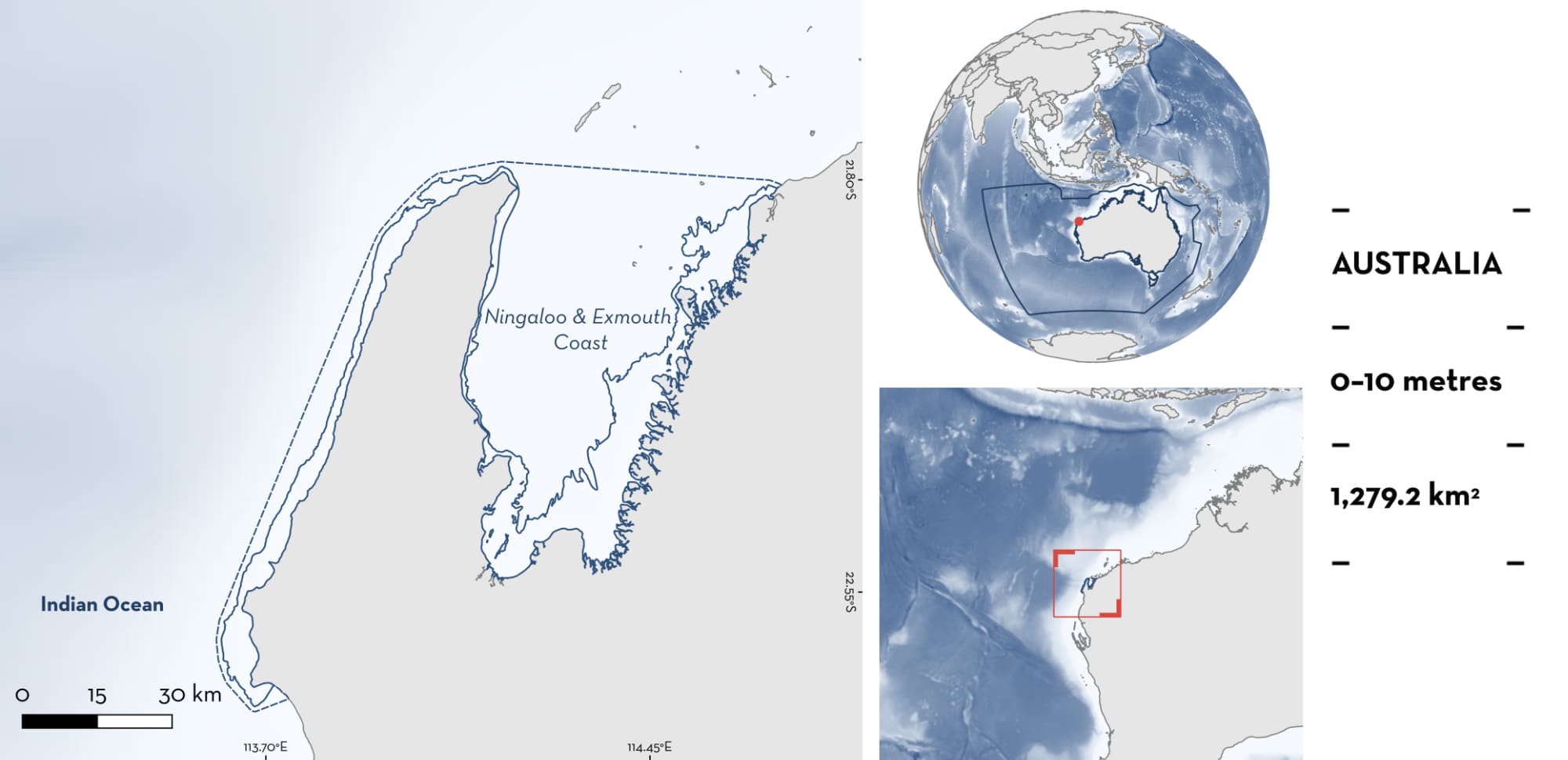
Ningaloo & Exmouth Coast
Summary
Ningaloo & Exmouth Coast is located in the Gascoyne region of Western Australia, Australia. This area encompasses the Ningaloo Lagoon and Exmouth Gulf. The Ningaloo Lagoon is a shallow coastal system bordered offshore by one of the world’s longest and most extensive fringing reefs. Exmouth Gulf is a wide, shallow, marine embayment. The habitats in this area are dominated by cyanobacterial mats, seagrass beds, mangroves, mudflats, macroalgae, and coral reefs. This area overlaps with a Key Biodiversity Area and two marine protected areas. Within this area there are: threatened species (e.g., Sharptooth Lemon Shark Negaprion acutidens); reproductive areas (e.g., Australian Whipray Himantura australis); feeding areas (e.g., Giant Guitarfish Glaucostegus typus); and undefined aggregations (e.g., Bluespotted Lagoon Ray Taeniura lymma).
Download factsheet
Ningaloo & Exmouth Coast
DESCRIPTION OF HABITAT
Ningaloo & Exmouth Coast is located in the Gascoyne region, Western Australia, Australia. It is situated in Thalanyji, Baiyungu, and Yinigurdira Countries. This area spans from Point Cloates (north of Coral Bay) to Urala Creek (south of Onslow), including Winderabandi Point, Mangrove Bay, Pelican Point, Bay of Rest, and Giralia Bay. It encompasses the Ningaloo Lagoon and Exmouth Gulf. The Ningaloo Lagoon is a shallow coastal system bordered offshore by one of the world’s longest and most extensive fringing reefs (Vanderklift et al. 2020). The lagoon supports a mosaic of sandy benthos, rocky reefs, seagrass and macroalgal meadows, coral outcrops, and a small mangrove system (Vanderklift et al. 2020). Sea surface temperatures at Ningaloo vary from ∼24–26°C on average (Falter et al. 2014). Exmouth Gulf is a wide, shallow, inverse estuary with a wide high intertidal salt flat. It is the only sheltered embayment in the Pilbara, and one of the few along the Western Australian coast. Water temperatures fluctuate in Exmouth Gulf across seasons, between ~30°C (austral summer) and ~19–20°C (winter) (WAMSI 2025). The habitats in this area are dominated by seagrass beds, mangroves, mudflats, macroalgae, and cyanobacterial mats (WAMSI 2025). Cyanobacterial mats are an important source of primary production in Exmouth Gulf and provide important habitat for a range of fish and invertebrates (Penrose 2011).
The region is hot and arid with freshwater runoff from land being low. Rainfall is highly variable and largely tied to the summer monsoon season (November–April), and tropical cyclones, which can bring heavy downpours, flooding, and freshwater pulses, specially into the gulf (Vanderklift et al. 2020).
This area overlaps with the Exmouth Gulf Mangroves Key Biodiversity Area (KBA 2025), Ningaloo Marine Park, and Exmouth Gulf Marine Park (WA DBCA 2025).
This Important Shark and Ray Area is benthic and pelagic and is delineated from inshore and surface waters (0 m) to 10 m based on the depth range of Qualifying Species in the area.
CRITERION A
VULNERABILITY
Six Qualifying Species considered threatened with extinction according to the IUCN Red List of Threatened Species regularly occur in the area. Threatened sharks comprise one Endangered species and one Vulnerable species; threatened rays comprise two Critically Endangered species and two Vulnerable species (IUCN 2025).
CRITERION C
SUB-CRITERION C1 – REPRODUCTIVE AREAS
Ningaloo & Exmouth Coast is an important reproductive area for three shark and four ray species.
Several studies, combined with unpublished data and citizen science, report large numbers of neonate, young-of-the-year (YOY), and older juvenile sharks and rays regularly and predictably occurring in this area. Fishery-independent gillnet surveys (150 mm mesh size, 60 m length) and visual observations from vessel-based surveys were conducted in southwestern Exmouth Gulf in 2021–2022 (RL Bateman-John unpubl. data 2022), and in southwestern and eastern Exmouth Gulf in 2024–2025 (KO Lear et al. unpubl. data 2025), both within this area. In 2024 and 2025, aerial drone surveys (flown at 2 m/s and 20 m height) were also conducted across the southwestern and eastern Exmouth Gulf (S Gudge & K Kliska unpubl. data 2025).
In January 2022 in the Bay of Rest, ten adult female Nervous Sharks (>91 cm total length; TL) were captured. Four of these (104–117 cm TL; 40% of adult females) bore bite marks around the pectoral fins or body, most likely mating scars (RL Bateman-John unpubl. data 2025). This suggests that this area is used for reproductive behaviours. In addition, Nervous Sharks are the most common shark species encountered in shallow areas of Exmouth Gulf: between 2024–2025, they comprised 84% of shark catches during gillnet surveys (100–150 mm mesh) in the southern and eastern Exmouth Gulf (KO Lear et al. unpubl. data 2025). Although YOY individuals (<60 cm TL) are not readily caught in 100–150 mm mesh size gillnets, 18 YOY individuals (<60 cm TL) were captured during these surveys (KO Lear et al. unpubl. data 2025). Further, one neonate or YOY (44 cm TL) was captured in the Bay of Rest in 2022 (RL Bateman-John unpubl. data 2025). Neonates and YOY are also often observed during vessel-based surveys, including at least five individuals estimated at 30–60 cm TL in the Bay of Rest from 2021–2022, and 65 individuals likely to be a mixture of YOY and older juveniles across the southern and eastern Exmouth Gulf in 2024–2025 (KO Lear et al. unpubl. data 2025). Nervous Shark size-at-birth is 35–40 cm TL (Ebert et al. 2021), and YOY individuals are estimated as those <60 cm TL (White et al. 2002). Size-at-maturity is estimated at 91–105 cm TL for females and 89–95 cm TL for males (White et al. 2002). Combined, this evidence indicates that this area is important for various life-stages of this species.
Between November 2012 and January 2014, Blacktip Reef Sharks were captured in shallow water with gillnets and rod-and-line in Mangrove Bay (Oh et al. 2017). Blacktip Reef Sharks (n = 13) ranged between 51–107 cm TL (mean = 63.9 cm TL). Most of the captured sharks were neonates or YOY with umbilical scars in various stages of healing (age <1 year), except for one Blacktip Reef Shark that was a juvenile female (Oh et al. 2017). Furthermore, in 2021–2022 and 2024–2025, gillnet surveys (100–150 mm mesh size, 60 m length) captured Blacktip Reef Sharks of various body sizes, although YOY individuals are not readily caught with the mesh size used in these surveys. Six YOY individuals (<70 cm TL) were visually observed during gillnet surveys in the Bay of Rest in 2021–2022 (RL Bateman-John unpubl. data 2022). In 2024–2025, seven Blacktip Reef Sharks were captured in gillnets in the northeastern and southwestern Exmouth Gulf, including three YOY (<70 cm TL) (KO Lear et al. unpubl. data 2025). An additional 18 Blacktip Reef Sharks were visually observed during these surveys; 16 were small and likely YOY or older juveniles (KO Lear et al. unpubl. data 2025). In Bundegi, aggregations of over 20 YOY Blacktip Reef Sharks are commonly observed. These groups have appeared during every recreational drone survey undertaken between 2018 and 2025, with at least 10 confirmed observation events (KO Murphy unpubl. data 2025). In northeastern Australia, size-at-birth, YOY, and age-1 Blacktip Reef Sharks range from 58–67 cm TL, 58–73 cm TL, and 62–85 cm TL, respectively (Chin et al. 2013). Here, YOY individuals are estimated as those <74 cm TL.
In March, November, and December 0f 2012, Sharptooth Lemon Sharks (n = 23) were captured in shallow water in Mangrove Bay with gillnets and rod-and-line and fitted with internal acoustic transmitters (Oh et al. 2017). Animals measured between 63–101 cm TL (mean = 75.2 cm TL) and were neonates or YOY with umbilical scars in various stages of healing (age <1 year). Umbilical scars and captures of neonate (<1 week old) Sharptooth Lemon Sharks between November–March indicate local pupping and extended occupancy (up to 17 months). Size-at-birth for Sharptooth Lemon Shark is 45–80 cm TL (Ebert et al. 2021). Tagged sharks were monitored for 2–544 days between March 2013 and May 2015 by 85 receivers across the northern Ningaloo Reef Marine Park: 71 receivers in Mangrove Bay and two cross-shelf lines of eight receivers at Tantabiddi and seven receivers at Turquoise Bay. Sharks showed high long-term residency (>30 days) with small activity spaces (mean 95% kernel area = 4.5 km2; Oh et al. 2017). In addition, between 2012–2018, 38 adult Sharptooth Lemon Sharks (23 females, 240–280 cm TL; 18 males, 234–266 cm TL) were captured using single circle-hooks and tagged in Mangrove Bay (Pillans et al. 2021). The acoustic receiver network spanned ~150 km of coastline and comprised five site groups, with most located within this area, except Coral Bay. Adults exhibited long-term site fidelity, with 79% of detections within Mangrove Bay. Pregnant, post-partum, and recently mated females were detected in successive years, confirming Mangrove Bay as a key reproductive habitat (Pillans et al. 2021). In 2021–2022 and 2024–2025, gillnet surveys (150 mm mesh size, 60 m length) captured 80 Sharptooth Lemon Sharks, with an additional 53 individuals observed during vessel-based surveys in shallow waters (RL Bateman-John unpubl. data 2022; KO Lear et al. unpubl. data 2025). Of the 80 captured, 42 (52%) were <80 cm TL, and 39 (73%) of visually observed Sharptooth Lemon Sharks were estimated to be <80 cm TL, including an aggregation of 13 individuals schooling in the shallows. YOY were caught in each year surveyed. In addition, in 2024–2025, a total of 384 Sharptooth Lemon Sharks were identified from drone surveys across shallow areas in the eastern and southern Exmouth Gulf (S Gudge & K Kliska unpubl. data 2025). Size of these sharks was not estimated during drone analyses, but given the shallow habitat surveyed and the dominance of YOY from captured sharks during the gillnet surveys, it is likely that the majority were YOY. Groups of up to five individuals were observed during the aerial surveys. As no growth data are available for this species, the growth rates for juvenile Lemon Shark (Negaprion brevirostris) were used (~10–25 cm TL per year) (Freitas et al. 2006; Tavares et al. 2020), estimating a YOY size of <70–85 cm TL. Given similar sizes-at-birth, maturity, and maximum size of both species, YOY Sharptooth Lemon Shark were here estimated as those <80 cm TL.
Between May 2006 and April 2007, visual surveys were conducted through an aboveground viewing platform, to determine the movements and estimate the abundance of Giant Guitarfish during their intertidal migration in Giralia Bay, southeastern Exmouth Gulf, in this area (Penrose 2011). Up to 2,049 individuals were observed migrating between mangrove and cyanobacterial mat habitats during a single tidal cycle per observation site, with an estimated density of 42.3–42.4 individuals per m2 per hour. This equates to an estimated 4,382 Giant Guitarfish in Giralia Bay. Body sizes of all the visually sighted Giant Guitarfish in this study were not reported, but >69% of individuals which underwent sampling for stomach content analysis (n = 57) in the same study site were neonates and YOY (<40–45 cm TL). It is likely that the majority of visually sighted individuals were of similar body size based on similar habitat and shallow depths (<50 cm depth) in the visually surveyed habitat. The size-at-birth of this species is 38–40 cm TL (Kyne et al. 2019), and YOY individuals are here assumed to be those <50 cm TL based on growth rates (White et al. 2014). Between 2007–2008, visual surveys were conducted in Ningaloo Lagoon in which aggregations of Giant Guitarfish were identified in nearshore areas (in a few cm of water depth; Stevens et al. 2009). Aggregations of up to 50 individuals were recorded at Winderabandi Point, Mangrove Bay, Point Cloates, and Pelican Point. Two of these aggregations (not specified) were comprised of neonates, and the aggregation at Winderabandi Point was comprised of individuals 40–100 cm TL. In total, 170 Giant Guitarfish were identified through visual surveys within the Ningaloo Lagoon (Stevens et al. 2009).
Giant Guitarfish records were collated from citizen science records and research surveys. Unpublished citizen science records of large-bodied rhino rays were collated from databases held within the following organizations: Fin Focus Research, Sharks and Rays Australia, Sawfish Conservation Society, and Murdoch University’s Centre for Sustainable Aquatic Ecosystems. These records included newspaper articles relating to occasional captures, sightings/captures from snorkellers, divers, recreational fishers, and other recreational ocean users. Records generally included the date, location (exact or approximate), a size estimation, and occasionally sex (Bateman et al. 2024). Most submissions were recent (within the last 15 years), historical submissions (n = 9) were also included from prior to 2008. Targeted research surveys used gillnets with a 150 mm mesh size, cast nets, and capture by hand (e.g., Morgan et al. 2015, 2017; Cooper 2022). These surveys were conducted across multiple years (2011–2022) and seasons (Bateman et al. 2024). A total of 771 Giant Guitarfish were recorded (473 from scientific surveys, 298 from citizen science submissions). Of the records, the majority (n = 641) were of neonates, YOY, and older juveniles (<150 cm TL). Large aggregations of neonates, YOY, and juveniles have been reported across multiple years at several sites, including Winderabandi Point (Ningaloo Reef), Bay of Rest, and Giralia Bay (Exmouth Gulf) (Bateman et al. 2024). These aggregations are often dominated by YOY, numbering up to 80 individuals (RL Bateman pers. obs. 2025).
Between 2020–2021, fishery surveys (using a gillnet with a 150 mm mesh size and 60 m length) conducted in the southern Pilbara (Ashburton River mouth, Hooley Lagoon, Hooley Creek, and Four Mile Creek) have also recorded YOY (n = 12) and older juvenile (n = 4) Giant Guitarfish (Ingelbrecht et al. 2024a, 2024b; KO Lear & D Morgan unpubl. data 2025). In April 2024, October 2024, and April 2025, visual and fishery-independent surveys (using a gillnet with a 150 mm mesh size and 60 m length) were conducted within the southern and eastern Exmouth Gulf, ranging from Bay of Rest to Urala Creek South, in this area (KO Lear et al. unpubl. data 2024–2025). During these surveys, 149 Giant Guitarfish were visually sighted from small vessels traversing the shallows in mangrove creeks and mudflat habitats, including aggregations of up to 20 individuals. Of these visually sighted individuals, at least 70 were likely to be YOY based on estimated sizes. An additional 21 individuals were physically captured in gillnets, of which 7 were <50 cm TL. Between April 2024–April 2025, aerial drone surveys have also been conducted throughout Exmouth Gulf (S Gudge & K Kliska unpubl. data 2024–2025). A total of 1,251 Giant Guitarfish were sighted during these surveys, including aggregations of up to 35 individuals. Visual size estimates spanned neonates to adults; however, most individuals, particularly in aggregations, were YOY or small juveniles (K Kliska pers. obs. 2025).
Australian Whiprays have been commonly visually observed within mangrove areas in Exmouth Gulf during gillnet sampling. This includes 127 individuals visually observed during gillnet surveys in the southern and eastern Exmouth Gulf in 2021, 2022, 2024, and 2025 (RL Bateman-John unpubl. data 2025; KO Lear et al. unpubl. data 2025). Small Australian Whiprays which are likely to be YOY, based on visual estimates, are particularly common in the Bay of Rest, where they enter mangrove areas at high tide, and can be observed emigrating from the mangroves in large numbers (~3–10 individuals per ~5 min) as the tide drops (KO Lear pers. obs. 2025). Of 127 survey observations, 90 individuals were visually sized; 66 of these (73%) were <40 cm disc width (DW), consistent with YOY or a mix of YOY and older juveniles. Between September 2021 and May 2022, groups of 4–15 Australian Whiprays of various body sizes were visually observed during vessel-based surveys on nine occasions in the southwestern Exmouth Gulf (RL Bateman-John unpubl. data 2022). In April and November 2024, groups of 4–5 small Australian Whiprays were recorded on two occasions during gillnet surveys in the southwestern and northeastern Exmouth Gulf (KO Lear et al. unpubl. data 2024). In 2024–2025, drone surveys were conducted throughout the southern and eastern Exmouth Gulf. Australian Whiprays, both YOY and larger individuals, are frequently observed in large mixed-species aggregations in this area (S Gudge & K Kliska unpubl. data 2025). Australian Whiprays are not readily captured during gillnet surveys which have been the dominant catch method used during scientific surveys in Exmouth Gulf. As a result, captures of this species are limited. The size-at-birth of Australian Whiprays is ~29 cm DW, and size-at-maturity for males is estimated at 112 cm DW (Last et al. 2016; White et al. 2017). No growth information is available for this species.
Broad Cowtail Rays have been commonly observed during gillnet sampling across the southern and eastern Exmouth Gulf. During vessel-based surveys, at least three large aggregations of 10–15 small individuals were seen in the shallows, and 46 individuals were recorded in southern and eastern Exmouth Gulf in 2024–2025. Among 34 individuals with visual size estimates, 15 (44%) were estimated to be under 40 cm DW, indicating a mix of YOY and small juvenile stages (KO Lear et al. unpubl. data 2025). Drone surveys across the southwestern, southern, and eastern Gulf in 2024–2025 counted 255 Broad Cowtail Rays (S Gudge & K Kliska unpubl. data 2025). Drone footage confirms the common presence of small individuals, likely to be YOY or older juveniles. In 2021–2022, at least 96 individuals were visually observed from vessels during gillnet surveys in the Bay of Rest and adjacent areas, in this area. Of 55 individuals visually estimated, 45 were likely YOY or juveniles (RL Bateman-John unpubl. data 2022). Small individuals that are likely to be YOY are also common within mixed species aggregations in this area, and these individuals can be observed exiting the mangrove areas in the Bay of Rest on falling tides in large numbers (~3–5 per five-minute period; KO Lear pers. obs.). Only three Broad Cowtail Rays were captured in gillnets during 2021–2025 with one individual measuring <30 cm DW and likely a YOY. Broad Cowtail Rays were among the most frequently observed shark or ray in the Bay of Rest but are seldom captured in gillnets, the primary scientific survey method used in Exmouth Gulf. Size-at-birth is ~18 cm DW (Last et al. 2016); growth data are unavailable, precluding a precise YOY size threshold.
In April and October 2024–2025, gillnet surveys were conducted in Urala Creek South, within this area (KO Lear unpubl. data 2025). Ten YOY and 14 juvenile Green Sawfish were reported in Urala Creek South in 2020 and 2022–2025 (RL Bateman-John unpubl. data 2025; KO Lear unpubl. data 2025). No adult Green Sawfish have been captured in this area. A YOY Green Sawfish tagged in Urala Creek South in April 2024 was recaptured there in October, with acoustic data showing ~10 months of residency until a cyclone in February 2025, and three age 1+ juveniles tagged in April and October 2024 also showed high residency until the same event (KO Lear, S Gudge, RL Bateman-John unpubl. data 2025). Neonate and YOY Green Sawfish measure <90 and <100 cm TL, respectively (Lear et al. 2023).
CRITERION C
SUB-CRITERION C2 – FEEDING AREAS
Ningaloo & Exmouth Coast is an important feeding area for two ray species.
Between May 2006 and April 2007 (April–May and October–November), gill and fyke nets were used to capture Giant Guitarfish within the mangrove and the cyanobacterial mat habitats at three sites in Giralia Bay (Penrose 2011). Stomach contents and muscle samples (liver and muscle tissues) of 57 individuals with a body size of 39–108 cm TL, which corresponds to neonates, YOY, and older juveniles, were used for stomach and stable isotope analyses to estimate trophic dependency to the intertidal estuary habitat and ontogenetic dietary shifts of Giant Guitarfish (Penrose 2011).
Penaeid prawns (Western School Prawn Metapenaeus dalli; 72% Index of Relative Importance; IRI) and brachyuran crabs (20% IRI) were the most important dietary categories for juvenile Giant Guitarfish. Penaeid prawns were present in 82.5% of all stomachs and made the greatest contribution to the total numbers and volumes of all dietary categories. This indicates that early life-stages of this ray has a narrow diet composed mainly of crustaceans. The stomach content data suggest dietary overlap between the two size classes (<60 cm [mostly neonates and YOY] and 60–100 cm TL), whereas the stable isotope data indicate that the primary production sources supporting Giant Guitarfish food webs changes with size (age). Size-at-birth is 38–40 cm TL (Kyne et al. 2019), and individuals <50 cm TL are classified as YOY based on early growth rates (White et al. 2014). Isotopic values of muscle tissue and liver tissue were consistent with a dependency on high intertidal cyanobacterial mat (30–76%) and seagrass-based (9–55%) food webs. Reliance on the high intertidal cyanobacterial mat was not reflected in either liver or muscle tissue until sufficient growth had occurred. At approximately 90 cm TL, the isotopic values (δ13C) of Giant Guitarfish tissues reach equilibrium with their post-natal benthic nearshore food resources. The carbon isotope composition of smaller (<90 cm TL) individuals reflects the maternal dietary influence from an offshore food web.
The mean number of Giant Guitarfish that undertook tidal migrations onto the high intertidal cyanobacterial mat varied between sites but ranged from 1,356 ± 271 to 1,060 ± 177 per hr. At one site, the maximum number of observed rays migrating between the habitats during the first hour of flood tide was 2,049 individuals. The mean density of Giant Guitarfish per m2 per hr on the cyanobacterial mat was similar between sites, ranging between 42.3 ± 4.4 and 42.4 ± 3.6 individuals. These visual surveys indicate that juvenile Giant Guitarfish undertake tidal migrations to the high intertidal cyanobacterial mats in high numbers to feed on a highly productive intertidal environment (Seckbach & Oren 2010; Penrose 2011).
No recent studies have examined the diet of Giant Guitarfish in this area; however, unpublished drone surveys continue to record large aggregations of YOY near or on cyanobacterial mats in the southern and eastern Exmouth Gulf (KO Lear et al. unpubl. data 2025).
The shallow mudflats, mangroves, seagrass, and algal beds of eastern and southern Exmouth Gulf form key nursery habitats for juvenile prawns (Loneragan et al. 2013; Kangas et al. 2015). These productive areas support high abundances of Western King and Tiger Prawns, with central gulf waters yielding the greatest catches, surpassing other Pilbara trawl fisheries. This productivity, linked to extensive nursery grounds, likely sustains additional crustacean species dependent on similar habitats (Loneragan et al. 2013; Kangas et al. 2015; WAMSI 2025).
Since 2015, Reef Manta Rays have been systematically recorded using this area for feeding. The behaviour displayed by each individual when sighted was categorised (Germanov et al. 2019) and was informed by ancillary observations reported by tourism operators or trained observers, or through indications of behaviour evident in photographs since 2015. A total of 201 behavioural observations of Reef Manta Rays were recorded in this area (Armstrong et al. 2020). Feeding was the most common reported behaviour with 94% of observations. Rays are often observed feeding on plankton within tide lines that run parallel to the shore in the northwestern gulf, especially between the Exmouth Marina and the Navy Pier (Sprogis & Parra 2022; Irvine et al. 2025). They are mostly found year-round, but sightings peak in August–October (Armstrong et al. 2020). Reef Manta Rays are mostly sighted individually or in small groups, but large feeding aggregations of over 100 individuals have been observed (WAMSI 2025). Manta rays are the most important ray species for the ecotourism industry in Exmouth Gulf (WAMSI 2025).
CRITERION C
SUB-CRITERION C5 – UNDEFINED AGGREGATIONS
Ningaloo & Exmouth Coast is important for undefined aggregations and assemblages of three ray species.
Various sources have recorded large aggregations of rays within the shallow mangrove-associated habitats in this area. This includes drone surveys conducted across the southern and eastern Exmouth Gulf between 2024–2025 (S Gudge & K Kliska unpubl. data 2025); visual observations during fishery-independent gillnet surveys conducted in the southwestern Exmouth Gulf in 2021–2022 (RL Bateman-John unpubl. data 2022) and across the southern and eastern Exmouth Gulf in 2024–2025 (KO Lear et al. unpubl. data 2025); and various citizen science contributions. These have included single-species aggregations of 10–35 individuals of Broad Cowtail Rays and Blue-spotted Fantail Rays, as well as large mixed-species assemblages generally including Australian Whiprays and Broad Cowtail Rays.
Between September 2021–May 2022, during fishery-independent gillnet surveys, groups of 4–15 Australian Whiprays of various body sizes were visually observed during vessel-based surveys on nine occasions in the southwestern Exmouth Gulf (RL Bateman-John unpubl. data 2022). In April and November 2024, groups of 4–5 Australian Whiprays were recorded on two occasions during gillnet surveys in the southwestern and northeastern Exmouth Gulf (KO Lear et al. unpubl. data 2024). In 2024–2025, drone surveys were conducted throughout the southern and eastern Exmouth Gulf. Australian Whiprays, both YOY and larger individuals, were frequently observed in large mixed-species aggregations in this area (S Gudge & K Kliska unpubl. data 2025).
Between September 2021 and May 2022, during fishery-independent gillnet surveys, groups of 4–15 Broad Cowtail Rays were visually recorded on nine occasions in and near the Bay of Rest, and between April 2024 to April 2025, groups of 5–7 were noted resting or feeding on four occasions (KO Lear et al. unpubl. data 2024). Drone surveys between August 2024 and March 2025 documented groups of 4–11 resting and/or feeding on six occasions (S Gudge & K Kliska unpubl. data 2025). During vessel-based surveys, at least three large aggregations of 10–15 small individuals were seen in the shallows.
In January 2022, six subadult–adult Bluespotted Lagoon Rays were recorded in an aggregation near Wapet Creek (RL Bateman-John unpubl. data 2022). In November 2024, 10–15 juvenile and adult individuals were observed near Doole Island (KO Lear et al. unpubl. data 2024). Drone surveys in 2024–2025 recorded the following aggregations: (1) 10 and 15 individuals, each within three minutes in August 2024; (2) 10 individuals within six minutes in November 2024; and (3) 47 individuals within ten minutes in April 2025 (S Gudge & K Kliska unpubl. data 2025). Across 2024–2025 surveys, 85% of all records for this species were from these aggregations, with single individuals rarely observed.
For the mixed-species assemblages, in January 2022, during fishery-independent gillnet surveys, groups of 10–20 rays, consisting of Australian Whiprays and Broad Cowtail Rays were observed on three occasions in the southwestern Exmouth Gulf (RL Bateman-John unpubl. data 2022). Between April and October 2024, during drone surveys, groups of 4–13 unidentified whiprays, likely Australian Whiprays were recorded on three occasions (S Gudge & K Kliska unpubl. data 2024). In September 2021, April 2024, and March 2025, mixed-species assemblages of approximately 15–30 juveniles, including Australian Whiprays and Broad Cowtail Rays, were observed on several occasions in the northwestern Bay of Rest (KO Lear pers. obs. 2025). These aggregations are likely driven by either foraging (notably when adults are prevalent) or shallow-water refuge, with neonates, YOY, and juveniles of multiple species often mixing in extreme shallows at high tide. More information is needed to understand the nature and function of these aggregations.
Download factsheet
SUBMIT A REQUEST
ISRA SPATIAL LAYER REQUEST
To make a request to download the ISRA Layer in either a GIS compatible Shapefile (.shp) or Google Earth compatible Keyhole Markup Language Zipped file (.kmz) please complete the following form. We will review your request and send the download details to you. We will endeavor to send you the requested files as soon as we can. However, please note that this is not an automated process, and before requests are responded to, they undergo internal review and authorization. As such, requests normally take 5–10 working days to process.
Should you have questions about the data or process, please do not hesitate to contact us.

