
ISRA FACTSHEETS
ISRA FACTSHEETS
AUSTRALIA AND SOUTHEAST INDIAN OCEAN
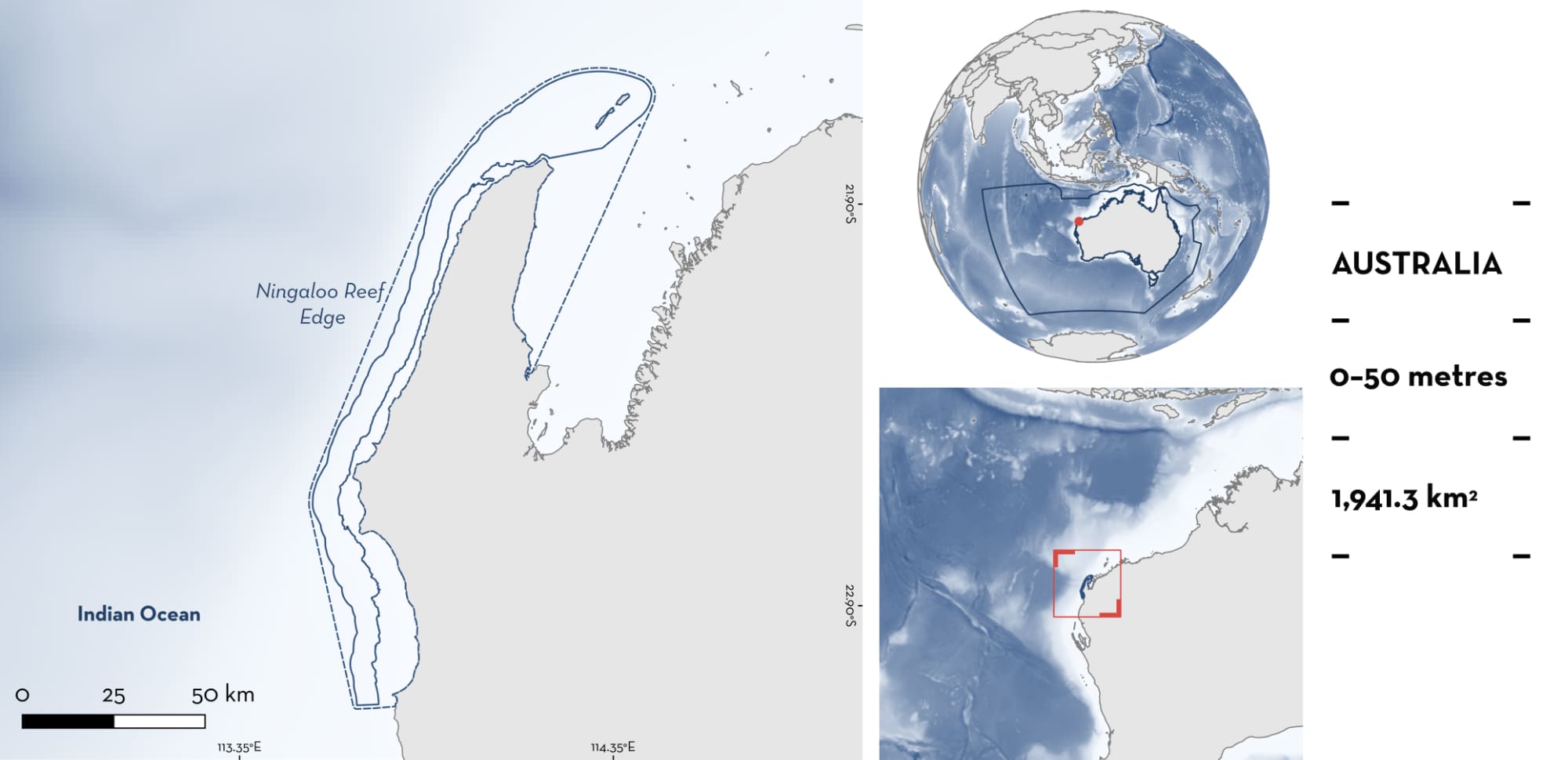
Ningaloo Reef Edge
Summary
Ningaloo Reef Edge is located in Western Australia, Australia. This area hosts one of the world’s longest and most extensive fringing coral reef systems. Ningaloo Reef Edge is situated outside the lagoon, along the outer reef. It is influenced by the Leeuwin Current and marked by seasonally elevated productivity during the austral autumn and winter. The area overlaps with the Commonwealth Ningaloo Marine Park. Within this area there are: threatened species (e.g., Reef Manta Ray Mobula alfredi); feeding areas (e.g., Whale Shark Rhincodon typus); and undefined aggregations (Australian Cownose Ray Rhinoptera neglecta).
Download factsheet
Ningaloo Reef Edge
DESCRIPTION OF HABITAT
Ningaloo Reef Edge is located in Western Australia, Australia. This area hosts one of the world’s longest and most extensive fringing coral reef systems, representing Australia’s largest fringing reef, which lies within 3 km of the shoreline (Vanderklift et al. 2020). Ningaloo Reef Edge is situated outside the lagoon, along the outer reef. The substrate is composed of a limestone platform shaped by wave energy into spur-and-groove formations, extending to 30–35 m depth (Vanderklift et al. 2020). The substrate is mainly consolidated limestone covered with crustose coralline algae and coral, transitioning to sediment-covered shelf beyond 35 m (Vanderklift et al. 2020).
The reef is influenced year-round by the Leeuwin Current, a shallow (<300 m), narrow (<100 km) poleward flow strongest in May–August with a core near the shelf break. The warm, low-salinity waters, advected from the Pacific through the Indonesian Archipelago, shape the shelf’s distinctive oceanography. These conditions are thought to drive higher rates of pelagic production here compared to most other parts of Western Australia (Hanson et al. 2005; Rousseaux et al. 2012). Seasonally, the system is characterised by elevated productivity during the austral autumn (March–May) and winter (June–August), when upwelling along the reef front near the continental shelf interacts with ocean currents (Hanson et al. 2005; Sleeman et al. 2010; Vanderklift et al. 2020). Productivity peaks as the southward-flowing, warm Leeuwin Current intensifies alongside the cooler, northward-flowing Ningaloo Current (Wilson et al. 2001; Hanson et al. 2005). These dynamics generate strong oceanographic fronts near reef passages, where dense lagoon waters mix with fresher shelf waters, supporting rich plankton assemblages (Wilson et al. 2002). Offshore, mesoscale eddy activity further enhances productivity by aggregating prey and driving localised upwelling that sustains high primary production in the upper water column (Woo et al. 2006; Xu et al. 2013; D’Antonio et al. 2024).
This area overlaps with the Commonwealth Ningaloo Marine Park (Parks Australia 2025).
This Important Shark and Ray Area is benthic and pelagic and is delineated from inshore and surface waters (0 m) to 50 m based on the depth range of Qualifying Species in the area.
CRITERION A
VULNERABILITY
Five Qualifying Species considered threatened with extinction according to the IUCN Red List of Threatened Species regularly occur in the area. Threatened sharks comprise three Endangered species and one Vulnerable species; threatened rays comprise one Vulnerable species (IUCN 2025).
CRITERION C
SUB-CRITERION C1 – REPRODUCTIVE AREAS
Ningaloo Reef Edge is an important feeding area for four shark and one ray species.
This area is an important feeding assemblage for three species of sharks: Grey Reef Shark, Spinner Shark, and Dusky Shark. These species form assemblages in the area by aggregating to feed on schooling fish. Reports on social media have recorded these feeding aggregations with an average of at least 7 individuals (2–15) together on at least 14 occasions between November–April from 2022–2025. A diver who regularly visits this area 3–4 times per week for seven months each year reports observing these aggregations five times annually between November–April (DT Browne pers. obs. 2025).
Research on Whale Sharks within this area spans decades with diverse methods used to examine seasonal aggregations, demographics, and foraging ecology. Overall, this area has been identified among the 25 largest aggregation sites for Whale Sharks globally (Araujo et al. 2022). Early work used aerial surveys and spotter planes to document seasonal aggregations, while hydro-acoustic surveys and water sampling linked their presence to zooplankton availability. Acoustic telemetry, archival, and satellite tagging later revealed fine- and broad-scale movements, complemented by vessel surveys, and photo-identification to describe population structure, site fidelity, and feeding ecology.
Initial observations of Whale Sharks in 1982, 1983, and 1985 had documented a seasonal aggregation in this area (Taylor 1989, 1994). Later studies established this area as a critical feeding ground for Whale Sharks. Aerial surveys (1989–1992) showed seasonal aggregations along the reef front, where sharks swam mainly parallel to the reef in turbid waters (Taylor 1996). The maximum density in any sector of the reef at any one time was four sharks per km2. Their arrival coincided with the annual mass coral spawning after the March–April full moon, when zooplankton levels rise (Simpson 1991; Taylor 1996; Rosser & Gilmour 2008). Hydro-acoustic surveys confirmed Whale Shark associations with frontal zones at reef passages, where zooplankton were concentrated (Wilson et al. 2002). Feeding behaviour was frequently observed, including suction and ram filter feeding, with prey such as coral spawn, the tropical krill Pseudeuphausia latifrons, mysids, and jellyfish (Norman 1999; Taylor 2007). Dense schools of the tropical krill, the dominant krill species in faecal DNA samples, were particularly important prey (Taylor 1996; Wilson et al. 2003a, 2003b; Jarman & Wilson 2004). Chlorophyll-a concentrations were also identified as drivers of distribution, as sharks were often sighted in higher-productivity regions (Sleeman et al. 2007). In 2018, vessel-based acoustic surveys and oceanographic profiling linked Whale Shark space use to prey distribution, showing that sharks concentrated feeding activity along reef gutters and pinnacles where copepods and krill were most abundant (D’Antonio et al. 2024).
Research during the mid-1990s showed Ningaloo Whale Shark aggregations dominated by juvenile males (~600–800 cm total length [TL]; range 400–1,200 cm TL), with ~85% males. Females were rarer and smaller (mean 620 cm TL). Photo-identification (1992–2004) recorded 159 sharks (74% male; 300–1,000 cm TL) and a super-population of ~300–500. In 2018, juveniles remained male-biased (68% of 400; 300–900 cm TL) (Norman 1999; Norman & Stevens 2007; Meekan et al. 2006; D’Antonio et al. 2024).
Photo-identification between 1992–2004 showed strong philopatry; 29% of 159 sharks were resighted within the same year, and 33 across years, typically after 1–3 years, with two after 12 years (Meekan et al. 2006). One shark returned over 19 years (1995–2016). This shows that individuals have repeatedly used this area for feeding across decades (Norman & Morgan 2016). Telemetry studies on Whale Sharks in the area since the 1990s have also confirmed characteristic surface-feeding behaviours and close association with the reef (Gunn et al. 1999; Wilson et al. 2001; Gleiss et al. 2011, 2013). Tour-operator data from 2006–2010 also documented a sharp rise in Whale Shark interactions (350% increase; n = 3,254), showing predictable seasonal aggregations between March–July, with encounters concentrated near reef passages within 3–6 km of the reef crest (Anderson et al. 2014). Fine-scale studies in 2018 revealed that tagged sharks used both surface waters and deeper zones (40–60 m), linking their diving behaviour to mesozooplankton distribution and local oceanographic features (D’Antonio et al. 2024).
Since 2015, ventral photographs of Reef Manta Rays sighted in this area have been catalogued in a photo-identification image database along with metadata such as date and location of sighting (Armstrong et al. 2020; AWJ 2025). Photographs from tourism operators are associated with the peak tourism season (April–September) (Armstrong et al. 2020). The behaviour displayed by each individual when sighted was categorised (following Germanov et al. 2019) and was informed by observations reported by tourism operators or trained observers, or through indications of behaviour evident in the photographs. Between 2015–2020, a total of 152 behavioural observations of Reef Manta Rays were recorded at this area (Armstrong et al. 2020). Feeding was the most common reported behaviour with 79.6% of observations (Armstrong et al. 2020).
CRITERION C
SUB-CRITERION C5 – UNDEFINED AGGREGATIONS
Ningaloo Reef Edge is important for undefined aggregations of one ray species.
Aggregations of Australian Cownose Ray have been regularly documented through passive citizen science within the area. Between 2017–2023, 12 social media reports recorded groups of at least 20 individuals each with most aggregations composed of ~30 individuals (~20–100). A potential courtship behaviour was recorded in one of these reported observations. Further information is required to determine the nature and function of these aggregations.
Download factsheet
SUBMIT A REQUEST
ISRA SPATIAL LAYER REQUEST
To make a request to download the ISRA Layer in either a GIS compatible Shapefile (.shp) or Google Earth compatible Keyhole Markup Language Zipped file (.kmz) please complete the following form. We will review your request and send the download details to you. We will endeavor to send you the requested files as soon as we can. However, please note that this is not an automated process, and before requests are responded to, they undergo internal review and authorization. As such, requests normally take 5–10 working days to process.
Should you have questions about the data or process, please do not hesitate to contact us.

