ISRA FACTSHEETS
ISRA FACTSHEETS
AUSTRALIA AND SOUTHEAST INDIAN OCEAN
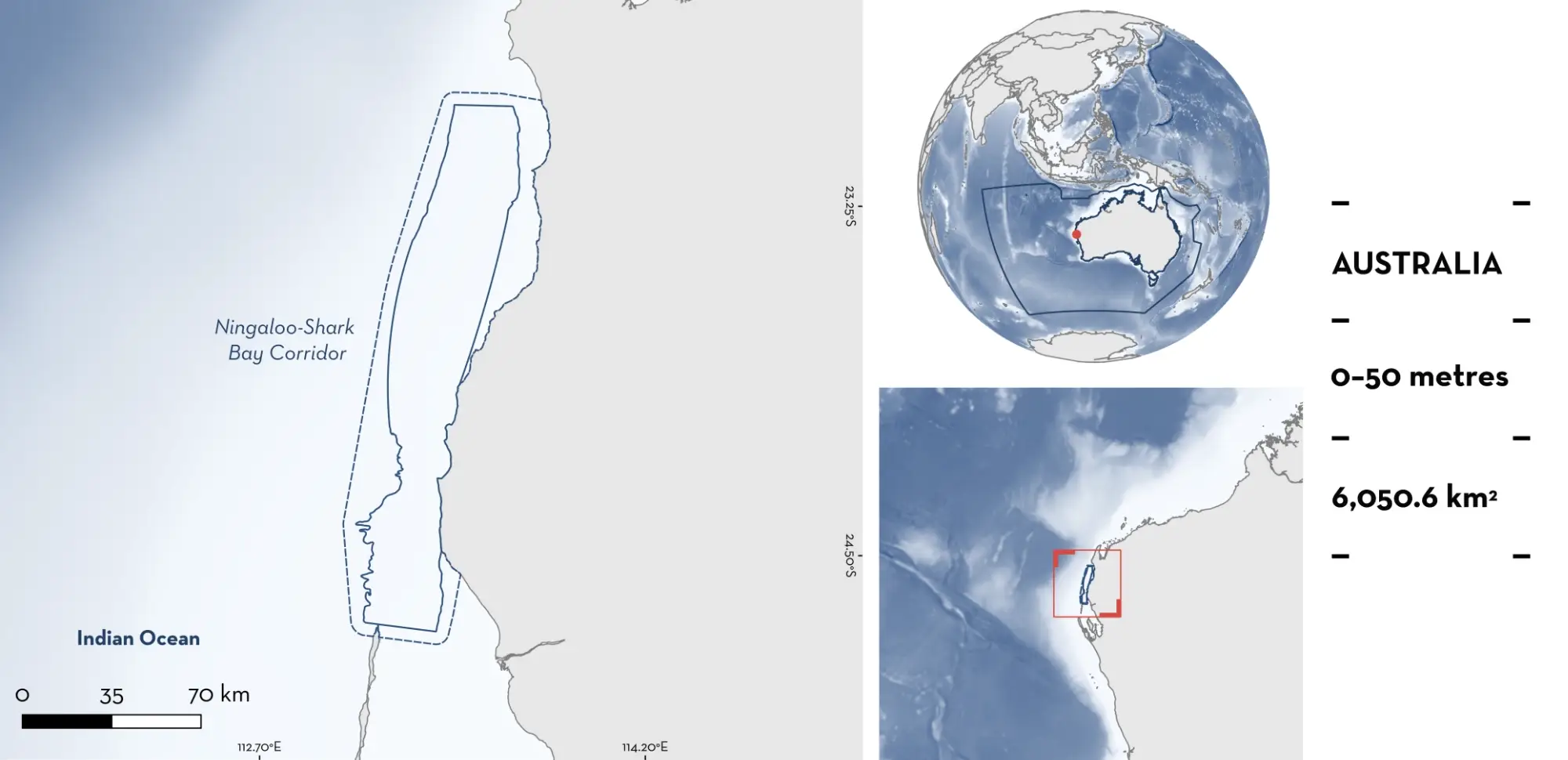
Ningaloo-Shark Bay Corridor
Summary
Ningaloo-Shark Bay Corridor is located in Western Australia, Australia. This area lies within the Gascoyne Bioregion, where clear, warm waters and a predominantly arid coastline create a relatively low nutrient but highly dynamic marine environment. The coastal waters between Shark Bay and Ningaloo Reef form a dynamic transition zone shaped by seasonal currents, wind patterns, and shelf topography. Within this area there are: threatened species and areas important for movement (Reef Manta Ray Mobula alfredi).
Download factsheet
Ningaloo-Shark Bay Corridor
DESCRIPTION OF HABITAT
Ningaloo-Shark Bay Corridor is located in Western Australia, Australia. The area lies within the Gascoyne Bioregion, where clear, warm waters and a predominantly arid coastline create a relatively low nutrient but highly dynamic marine environment (Suthers & Waite 2007). The coastal waters between Shark Bay and Ningaloo Reef form a dynamic transition zone shaped by seasonal currents, wind patterns, and continental shelf topography.
The dominant oceanographic feature is the poleward-flowing Leeuwin Current, which is strongest during the austral autumn and winter, transporting warm, low salinity tropical water southward along the outer shelf. In contrast, during summer, strong southerly winds drive the northward-flowing Ningaloo Current along the inner shelf (Suthers & Waite 2007).
This Important Shark and Ray Area is pelagic and is delineated from inshore and surface waters (0 m) to 50 m based on the depth range of Qualifying Species in the area.
CRITERION A
VULNERABILITY
One Qualifying Species considered threatened with extinction according to the IUCN Red List of Threatened Species regularly occurs in the area. This is the Vulnerable Reef Manta Ray (Marshall et al. 2022).
CRITERION C
SUB-CRITERION C4 – MOVEMENT
Ningaloo-Shark Bay Corridor is an important area for the movement of one ray species.
Telemetry and photo-identification data indicate that this area functions as a movement corridor linking the feeding areas of Coral Bay and Ningaloo Reef to the north and Denham Sound to the south.
Between 2016–2019, Reef Manta Rays (n = 22) were tagged with miniature pop-up archival satellite tags at sites along the Western Australian coastline: 10 in Coral Bay (May 2016), 10 in Exmouth Gulf (September 2016), and two in Steep Point, Shark Bay (March 2019) (Armstrong et al. 2020). Twelve of the 22 tracks (seven females, five males) reported enough observations for light-based geolocation with their deployments spanning 12–112 days (mean = 62.6 days, standard deviation = 31.9). Eight of the 12 individuals tagged reported southerly latitudinal displacement, using this area, with October deployments featuring a southerly shift compared to May–June deployments. The mean track length for all tags was 839 km (range = 118–1,817 km), with a mean daily distance of 12.3 km/day (range = 6.9–18.6 km/day; 0.3–0.77 km/hr). Reef Manta Rays predominantly remained on the shelf where 94% of depth records are <50 m (Armstrong et al. 2020). Comparison of real tracks against those produced by correlated random walk simulations revealed directional dispersal and connectivity between the Ningaloo Reef and Shark Bay. The only individual tagged in Shark Bay in late March that transmitted data showed a northerly latitudinal movement, using this area, with its final recorded position at northern Ningaloo Reef in late September. This movement range is comparable to seasonal Reef Manta Rays migration observed at similar latitudes on the Australian east coast (Capricorn Cays–Byron Bay).
Ventral photographs of Reef Manta Rays sighted in Coral Bay have been catalogued since 2006 in a photo-identification image database along with metadata such as date and location of sighting (McGregor et al. 2019; Armstrong et al. 2020). Photos were collected primarily by tourism operators who run in-water megafauna interaction tours year-round (2002–2018). As of 2015, long-term photo-identification studies have identified 800 individuals in Coral Bay (Venables et al. 2016; Armstrong et al. 2020; F McGregor unpubl. data 2015). Photo-identification in Shark Bay has been opportunistic with a low sampling effort. Two photo-identified individuals were recorded in Exmouth Gulf and Steep Point in Shark Bay. This suggests that these individuals use this area to move between these two locations with the fastest undertaking the northbound journey in a maximum of 111 days at an average velocity of 4.7 km/day.
Download factsheet
SUBMIT A REQUEST
ISRA SPATIAL LAYER REQUEST
To make a request to download the ISRA Layer in either a GIS compatible Shapefile (.shp) or Google Earth compatible Keyhole Markup Language Zipped file (.kmz) please complete the following form. We will review your request and send the download details to you. We will endeavor to send you the requested files as soon as we can. However, please note that this is not an automated process, and before requests are responded to, they undergo internal review and authorization. As such, requests normally take 5–10 working days to process.
Should you have questions about the data or process, please do not hesitate to contact us.