ISRA FACTSHEETS
ISRA FACTSHEETS
AUSTRALIA AND SOUTHEAST INDIAN OCEAN
Norman River
Summary
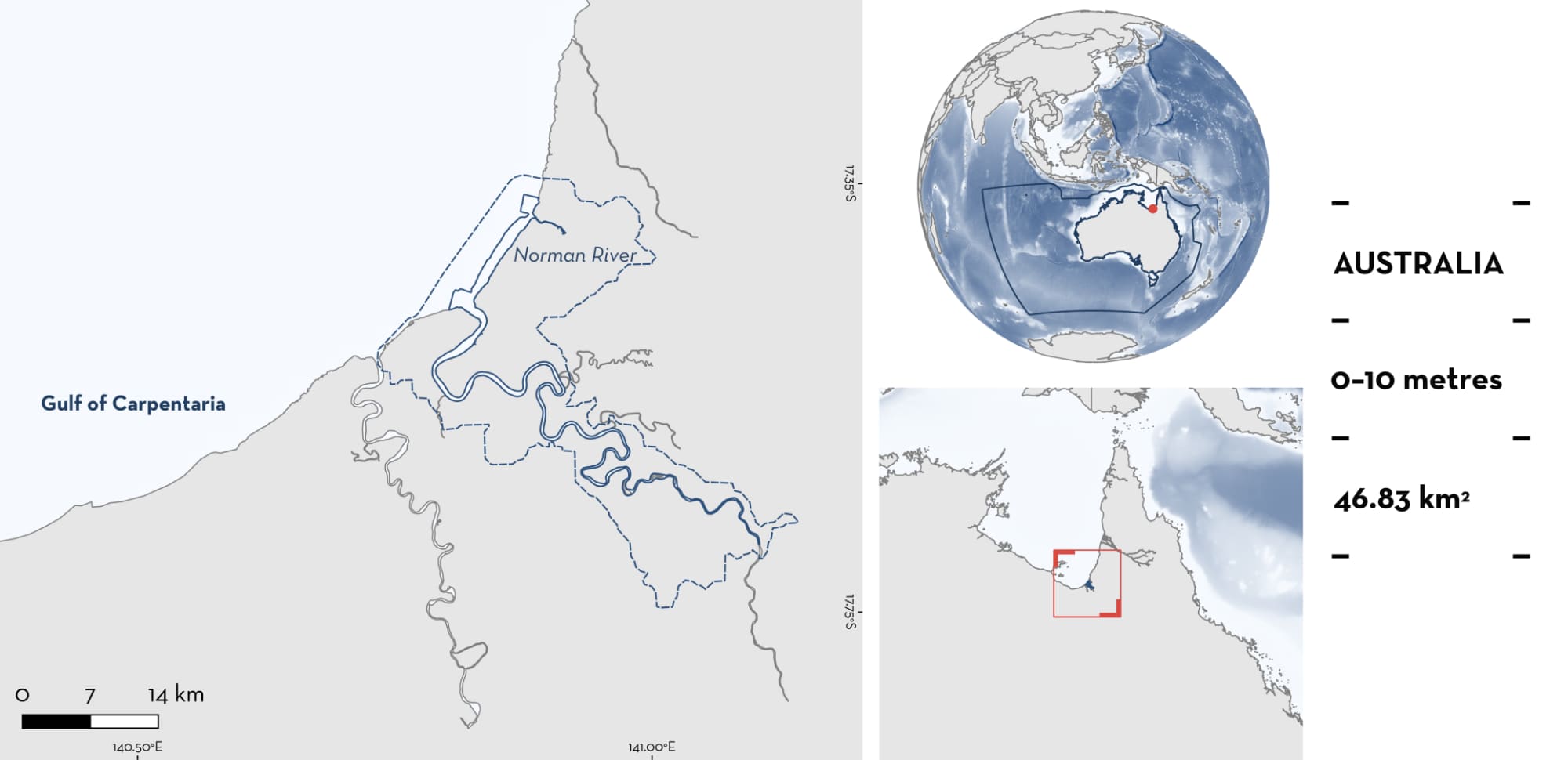
Norman River is located on western Cape York, Queensland, Australia. It encompasses the Norman River and part of the Gulf of Carpentaria coast with an adjacent estuary (Bronco’s Inlet) to the east. The area is characterised by the long Norman estuary, with extensive mangroves confined to a narrow fringe along the inter-tidal mud banks. The area is influenced by diurnal tides, high turbidity, fast current speeds, and a large freshwater input during the monsoon season. This area overlaps with the Gulf Plains Key Biodiversity Area. Within the area there are: threatened species (e.g., Largetooth Sawfish Pristis pristis) and reproductive areas (e.g., Narrow Sawfish Anoxypristis cuspidata).
Download factsheet
Norman River
DESCRIPTION OF HABITAT
Norman River is located on western Cape York, Queensland, Australia. It is situated in the Aboriginal Country of the Gkuthaarn and Kukatji People, and Aboriginal Country of the Kurtijar People, represented by Carpentaria Land Council Aboriginal Corporation. It encompasses the Norman River and its estuary, and part of the mangrove coast with an adjacent estuary (Bronco’s Inlet) to the east. This river system extends for about 420 km and enters the southern Gulf of Carpentaria, with a catchment area of approximately 46,000 km2 (Wolanski & Chappell 1996). The area is characterised by a 68 km long estuary, with extensive mangroves confined to a narrow fringe along the inter-tidal mud banks (Salini et al. 1998).
The area is influenced by diurnal tides that can penetrate the river up to 60 km from the mouth (Wolanski & Chappell 1996; Salini et al. 1998). It has high turbidity, fast current speeds, deep open water channels, and receives a large freshwater input during the monsoon season (November to May) (Salini et al. 1998).
This area overlaps with the Gulf Plains Key Biodiversity Area (KBA 2025).
This Important Shark and Ray Area is benthic and pelagic and is delineated from inshore and surface waters (0 m) to 10 m depth based on the bathymetry in the area.
CRITERION A
VULNERABILITY
Two Qualifying Species considered threatened with extinction according to the IUCN Red List of Threatened Species regularly occur in the area. These are the Critically Endangered Narrow Sawfish (Haque et al. 2023) and Largetooth Sawfish (Espinoza et al. 2022).
CRITERION C
SUB-CRITERION C1 – REPRODUCTIVE AREAS
Norman River is an important reproductive area for two ray species.
During 2015 and between 2017–2019, annual nine-day sampling trips in the Norman River basin were conducted during the dry season in July (2017), August (2018), September (2019), and November (2015, 2018; SARA unpubl. data 2025; BE Wueringer unpubl. data 2025). Gillnets (up to 50 m length) were set for up to six days per field trip, with three sets per day. In total, 53 nets were deployed for a total of 214.7 hrs, with a mean soak time of 4.10 ± 2.10 hrs per set (BE Wueringer unpubl. data 2025). Drumlines were also used, with 68 lines deployed for a total of 226.3 hrs and a mean soak time of 3.50 ± 1.40 hrs per set. Both tidal and non-tidal waters were also sampled using 35 hand lines, with a mean soak time of 1.50 ± 0.80 hrs and a total effort of 52 hrs. All specimens captured were measured (total length; TL) and sexed. Additionally, between 2016–2025, citizen science records (n = 52) from recreational fishers and locals, including photos, capture details, species identification, and TL (either reported directly or estimated using rostrum morphometrics), were collected during the wet season (Biskis et al. 2025; SARA 2025).
Historical records (2002) reported a sexually mature female Largetooth Sawfish measuring 582 cm TL and carrying full-term embryos captured in the Norman River by commercial gillnet fishers (M McDavitt pers. comm. 2002). Between 2015–2023, a total of 19 Largetooth Sawfish were captured or observed in the area from the river mouth to more than ~60 km upstream (SARA 2025; BE Wueringer unpubl. data 2025). Of these, eight (23.3%) were YOY Largetooth Sawfish, ranging in size between 70–130 cm TL (BE Wueringer unpubl. data 2025). Animals were captured during field surveys (n = 3) in 2015, 2019, and 2022, and submitted through citizen science (n = 5) with size information in 2018, 2021, and 2022 (SARA 2025; BE Wueringer unpubl. data 2025). Size-at-birth of the species is 72–91 cm TL and YOY sizes are estimated at <130 cm TL based on growth curves (Peverell 2009). All records occurred between March–November, which is likely due to lower accessibility during the wet season (December–March). The area is also important for juvenile Largetooth Sawfish with 10 individuals captured in total, and eight within the area ranging in size between 148–263 cm TL either captured in field surveys (n = 1), or from citizen science submissions with size information (n = 9; BE Wueringer unpubl. data 2025). Since Largetooth Sawfish leave rivers only upon reaching sexual maturity (Peverell 2009), the presence of YOY and juveniles indicates that Norman River is an important reproductive area for the species. Based on this monitoring effort across several rivers and estuaries, this area, together with the Mitchell-Palmer-Walsh Rivers, holds the largest contemporary records of YOY Largetooth Sawfish on the east coast of the Gulf of Carpentaria (BE Wueringer unpubl. data 2025).
Between 2010–2021, a total of seven neonate and YOY Narrow Sawfish were captured or reported in the area ranging in size between 79–150 cm TL (BE Wueringer unpubl. data 2025; SARA 2025). Size-at-birth of the species is 43–70 cm TL (Last et al. 2016) and YOY sizes are estimated at <150 cm TL, based on growth curves (Peverell 2009). Individuals were captured and reported by citizen science in 2016, 2019, 2020, and 2021 (SARA 2025). An additional three immature Narrow Sawfish (168–200 cm TL) were reported in 2018 and 2022 (SARA 2025; BE Wueringer unpubl. data 2025). While no adults were captured or reported during these field efforts, Narrow Sawfish have been regularly captured offshore of this area in commercial fisheries between 1984–2025. Size data for these fishery captures are not available, but adults of this species are typically found offshore in the Gulf of Carpentaria, whereas nursery habitats occur in estuaries and adjacent coastal waters (Peverell 2005). The area holds the second highest number of records for neonate and YOY Narrow Sawfish on the east coast of the Gulf of Carpentaria, highlighting the importance of this area for early life-stages.
Download factsheet
SUBMIT A REQUEST
ISRA SPATIAL LAYER REQUEST
To make a request to download the ISRA Layer in either a GIS compatible Shapefile (.shp) or Google Earth compatible Keyhole Markup Language Zipped file (.kmz) please complete the following form. We will review your request and send the download details to you. We will endeavor to send you the requested files as soon as we can. However, please note that this is not an automated process, and before requests are responded to, they undergo internal review and authorization. As such, requests normally take 5–10 working days to process.
Should you have questions about the data or process, please do not hesitate to contact us.