
ISRA FACTSHEETS
ISRA FACTSHEETS
AUSTRALIA AND SOUTHEAST INDIAN OCEAN
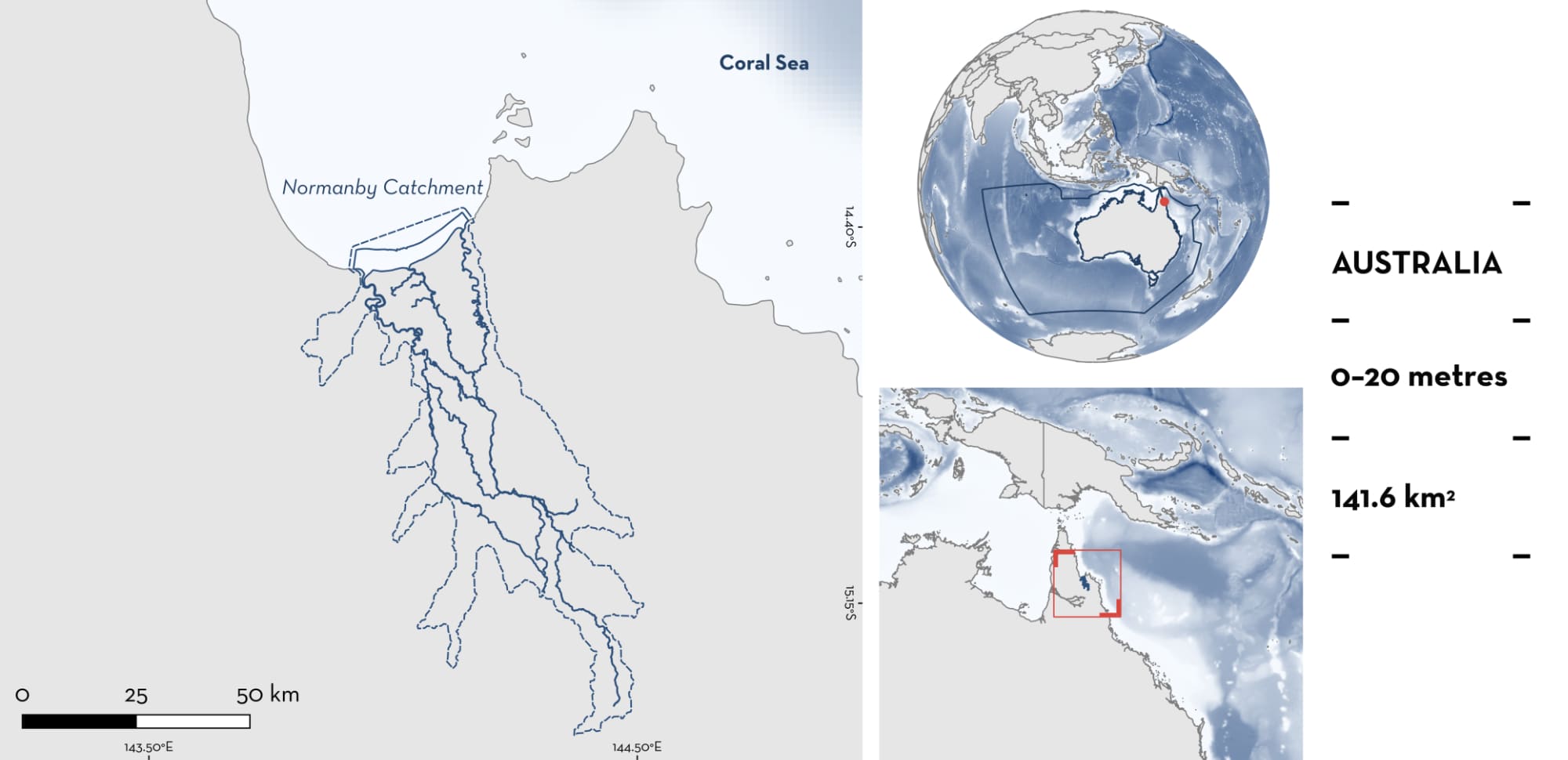
Normanby Catchment
Summary
Normanby Catchment is located in Far North Queensland, Australia. It includes the North Kennedy River to the west, the Bizant River, and the Normanby River to the east and part of the Laura River upstream. The area is characterised by wetlands, permanent rivers and streams, riverine floodplains, seasonal and permanent freshwater lakes, and saline marshes. The area is influenced by a wet-dry tropical climate with extreme seasonal variation in rainfall. Within the area there are: threatened species (e.g., Largetooth Sawfish Pristis pristis); and reproductive areas (e.g., Freshwater Whipray Urogymnus dalyensis).
Download factsheet
Normanby Catchment
DESCRIPTION OF HABITAT
Normanby Catchment is located in Far North Queensland, Australia. It includes the North Kennedy River to the west, the Bizant River, and the Normanby River to the east and part of the Laura River upstream. The area is situated on the lands of the Gugu-Yimithirr, Lama Lama, the Bagaarrmugu, Mbarimakarranma, Muunydyiwarra, Magarrmagarrwarra, Balnggarrwarra and Gunduurwarra, Kuku Warra Traditional Owners. These river systems flow from the eastern flank of Cape York Peninsula to the Coral Sea, with a catchment area of ~24,228 km2 (Howley et al. 2013). The North Kennedy and Normanby rivers are connected via linking branches during major flood events in the wet season and the Bizant River, a major lowland distributary, also connects to both rivers, depending on which is in flood. These rivers flow through wet-dry savannah and sandstone escarpments in the southwest and wet tropical rainforest in the southeast, discharging into Princess Charlotte Bay. The area is characterised by wetlands, permanent rivers and streams, riverine floodplains, seasonal and permanent freshwater lakes, and saline marshes (Howley et al. 2013).
The area is influenced by a wet-dry tropical climate with extreme seasonal variation in rainfall. Approximately 95% of annual rainfall occurs during the wet season between November and April. The average annual rainfall within the catchment is estimated at 1,085 mm (Howley et al. 2013). Parts of the Normanby River and its tributaries flow only at certain times of the year and by the end of the dry season, most surface water remains in a series of waterholes that stay linked below the surface by the river’s sandy substrate (Howley et al. 2013). During the wet season, floods spread across the alluvial and coastal plains of the lower catchment, replenishing large wetland areas and connecting wetlands and nearby rivers that are otherwise separate (Howley et al. 2013).
This Important Shark and Ray Area is benthic and pelagic and is delineated from inshore and surface waters (0 m) to 20 m depth based on the bathymetry in the area.
CRITERION A
VULNERABILITY
Two Qualifying Species considered threatened with extinction according to the IUCN Red List of Threatened Species regularly occur in the area. These are the Critically Endangered Largetooth Sawfish (Espinoza et al. 2022) and the Vulnerable Bull Shark (Rigby et al. 2021).
CRITERION C
SUB-CRITERION C1 – REPRODUCTIVE AREAS
Normanby Catchment is an important reproductive area for one shark and two ray species.
Between 2020–2025, annual sampling trips (over 7–10 days) in Rinyirru National Park, including the area, were conducted during the dry season in October 2020, October 2021, August 2022, September 2023, June, July, and November 2024, and July 2025 (SARA 2025; BE Wueringer unpubl. data 2025). Monofilament gillnets were bottom set (mesh size 6”, net length 25–50 m) and were placed at an average depth of 3.7 m, with a maximum depth of 6.25 m. In total, 38 nets were deployed for 145.3 hrs, with a mean soak time of 3.8 ± 1.2 hrs (BE Wueringer unpubl. data 2025). Baited drum lines were also used, with 43 lines deployed for 136.6 hrs and a mean soak time of 3.2 ± 1.8 hrs, with an average set depth of 5.8 m. Handlines were set from the shoreline, at an average depth of 1.8 m, using a total of 426 handlines, with a mean soak time of 3.25 ± 1.90 hrs and a total effort of 1,386 hrs. All specimens captured were measured (total length and disc width; TL and DW, respectively) and sexed. Additionally, between 2016–2025 citizen science data (n = 71 sightings) from recreational fishers, along with reports from Indigenous Land and Sea rangers – Laura Rangers, and Rangers of Rinyirru Corporation and Queensland Park and Wildlife Services rangers, were collected including photos, capture details, species identification, and TL or DW (either reported directly or estimated using rostrum morphometrics; BE Wueringer & VN Biskis unpubl. data 2025).
Between 2023–2025, 31 Bull Sharks ranging in size between 80–200 cm TL (average = 107.2 cm TL) were captured during field surveys (n = 28) or submitted by citizen scientists (n = 3) in the area (BE Wueringer unpubl. data 2025). Of these, 20 (64.5%) were neonates and young-of-the-year (YOY) ranging in size between 80–95 cm TL (BE Wueringer unpubl. data 2025). Size-at-birth of the species is 56–81 cm TL (Ebert et al. 2021) and YOY showing umbilical scars of up to 99 cm TL have been captured in the broader region (Pillans et al. 2020). These life-stages were captured in September 2023 (n = 2), June and July 2024 (n = 16), and July 2025 (n = 2; BE Wueringer unpubl. data 2025). Juveniles (n = 7) ranged between 100–118 cm TL and were captured in November 2024 (BE Wueringer unpubl. data 2025). These were likely between 1–2 years of age, based on a calculated growth rate of 18 cm/year within the first 5 years (Tillet et al. 2011). Although no pregnant females have been confirmed in the area, an adult female of 166 cm TL was captured more than 50 km upstream (BE Wueringer unpubl. data 2025).
Between 2012–2025, a total of 39 YOY Largetooth Sawfish ranging in size between 50–130 cm TL were captured (n = 1) and reported through citizen science submissions (n = 38) in the area (BE Wueringer & VN Biskis unpubl. data 2025). These represented 72% of the 55 Largetooth Sawfish reported (n = 52) and captured (n = 3) in the area. Size-at-birth of the species is 72–91 cm TL and YOY are estimated at <130 cm TL based on growth curves (Peverell 2009). The YOY Largetooth Sawfish captured during field surveys measured 115 cm TL and was caught in October 2021, while YOY reported through citizen science (n = 38) were encountered in all years between 2016–2025 from May to January (BE Wueringer & VN Biskis unpubl. data 2025). Reports are concentrated in the dry season due to accessibility (the National Park and one of its main river crossings are closed during the wet season). Of all YOY reported, 12 were verified by photographs (BE Wueringer & VN Biskis unpubl. data 2025). The area is also important for juvenile Largetooth Sawfish with two individuals ranging between 152–185 cm TL captured during field surveys in 2020 and 2024 (BE Wueringer unpubl. data 2025) and 16 juveniles reported by citizen scientists ranging between 131–281 cm TL (mean = 178 cm TL) in 2014, 2016, 2018–2022, and 2024 (BE Wueringer & VN Biskis unpubl. data 2025).
Between 2017–2025, 18 (14 with available size) Freshwater Whiprays ranging in size between 38–100 cm DW (average = 76.5 cm DW) were captured during field surveys (n = 12) or submitted by citizen scientists (n = 6) (BE Wueringer unpubl. data 2025). Of these, 8 (44% of sized individuals) were immature ranging in size between 38–82 cm DW (mean = 56.3 cm DW) and were captured during field surveys in 2021, 2023, 2024, and 2025 (BE Wueringer unpubl. data 2025). The three smaller individuals (38–40 cm DW) were captured in October 2021 and observed in September 2023. Size-at-birth of the species is unknown, but size-at-maturity is estimated at 87 cm DW (Constance et al. 2024). One likely pregnant female (based on distended abdominal cavity from photographs) was reported in June 2024 in the area, while another female likely postpartum (based on a distended but not firm abdomen) measuring 100 cm DW was captured in July 2024 during field surveys (BE Wueringer unpubl. data 2025). This species appears to be highly resident, especially females, in other river systems within the Gulf of Carpentaria (Campbell et al. 2012) and to give birth during the onset of the austral wet season (November to January; Constance et al. 2024). Considering the restricted movements of the species and the number of immature individuals recorded, the area represents an important reproductive habitat for the species.
Download factsheet
SUBMIT A REQUEST
ISRA SPATIAL LAYER REQUEST
To make a request to download the ISRA Layer in either a GIS compatible Shapefile (.shp) or Google Earth compatible Keyhole Markup Language Zipped file (.kmz) please complete the following form. We will review your request and send the download details to you. We will endeavor to send you the requested files as soon as we can. However, please note that this is not an automated process, and before requests are responded to, they undergo internal review and authorization. As such, requests normally take 5–10 working days to process.
Should you have questions about the data or process, please do not hesitate to contact us.

