ISRA FACTSHEETS
ISRA FACTSHEETS
EUROPEAN ATLANTIC
Normano-Breton Gulf
Summary
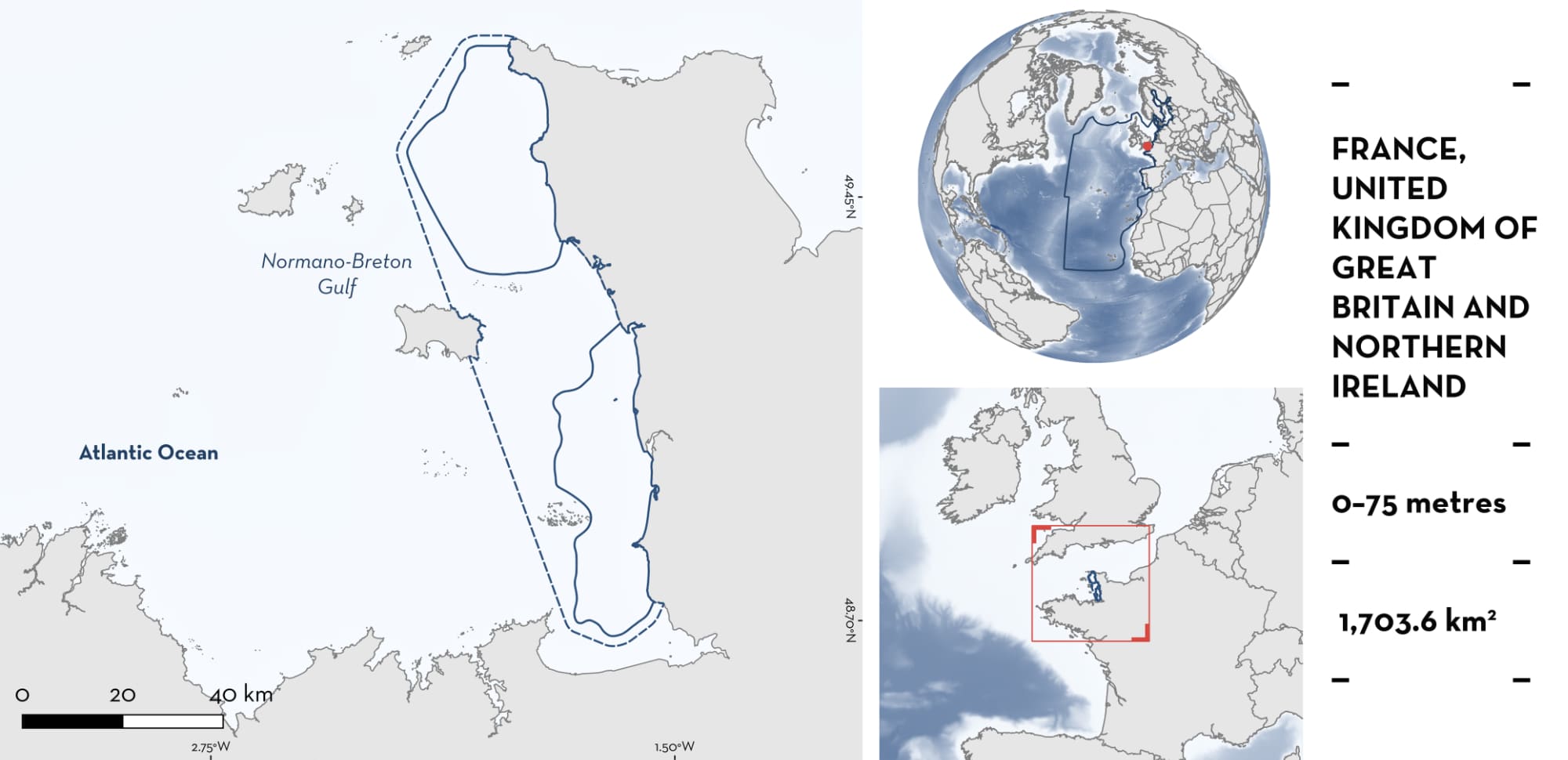
Normano-Breton Gulf is located in northern France and the eastern Channel Islands of the United Kingdom of Great Britain and Northern Ireland. This area is shallow and is influenced by a large tidal amplitude and strong tidal currents. The habitat is mainly characterised by soft substrates of sandy-mud and coarse sediments, and by rocky plateaus and reefs. The area overlaps with the Les Écréhous & Les Dirouilles, Jersey Ramsar Site. Within this area there are: reproductive areas (e.g., Blonde Skate Raja brachyura).
Download factsheet
Normano-Breton Gulf
DESCRIPTION OF HABITAT
Normano-Breton Gulf is located in northern France and the eastern Channel Islands of the United Kingdom of Great Britain and Northern Ireland. This split area includes one part extending from the northwestern tip of the Cotentin Peninsula to north of Jersey Island and another part stretching along the coast of the southwestern Cotentin Peninsula. The rugged seabed and shallow depth of the area, combined with its complex hydrodynamics result in a natural mosaic of marine habitats. It is characterised by sandy-mud and coarse sediment substrates for the most part, dotted with areas of rocky reefs, eelgrass beds (Zostera spp.), kelp forests, benches of marine worms (e.g., Lanice spp.), and biogenic Hermelles reefs (Furgerot et al. 2019). The area is also punctuated by islands and rocky plateaus.
These plateaus and reefs, mainly concentrated around the Anglo-Norman archipelagos and Chausey, influence the circulation and direction of the tidal currents. The Alderney Race between the Cotentin Peninsula and Alderney Island has the strongest currents in Europe, driven by tidal fluctuations which reach 12 m on average in Mount Saint Michel Bay (Furgerot et al. 2019). The area is also influenced by freshwater and sediment inputs from the Sélune, Sée, and Couesnon rivers.
This area overlaps with the Les Écréhous & Les Dirouilles, Jersey Ramsar Site (Wetland of International Importance; Ramsar 2025).
This Important Shark and Ray Area is benthic and is delineated from inshore and surface waters (0 m) to 75 m based on the bathymetry of the area.
CRITERION C
SUB-CRITERION C1 – REPRODUCTIVE AREAS
Normano-Breton Gulf is an important reproductive area for two ray species.
Blonde Skate and Undulate Skate neonates and young-of-the-year (YOY) regularly occur in this area according to data collected from fisheries surveys. Data were compiled from the French fisheries on-board observer program (ObsMer; IFREMER SIH 2022) and from the International Council for the Exploration of the Sea (ICES) Database on Trawls Surveys (campaigns: BTS, BTS-VIII, EVHOE, FR-CGFS, IE-IAMS, IE-IGFS, NIGFS, NS-IBTS, PT-IBTS, SCOWCGFS, SP-NORTH, SWC-IBTS) (ICES 2025) between 2010–2021. These surveys and observations span over a wide region from northern Spain to Scotland. Effort was not higher within this area compared to outside of it, considering the gear suitable for catching Blonde Skate and Undulate Skate neonates and YOY. The fishing methods capturing these species included mostly benthic trawl (i.e., 61% of Blonde Skate catches and 53% of Undulate Skate catches). In this area, an average of 16 benthic trawl hauls are sampled each year.
Blonde Skate neonates and YOY were defined as being <21 cm total length (TL), considering a size-at-birth of 18 cm TL for the species and a slow growth coefficient of 0.12 (Last et al. 2016; Ellis et al. 2023). Neonates and YOY (n = 71) were captured in 11 of the 12 years (2010–2021) within this area. They comprised 13.4% of the total captures for the species, which is high considering that small skates are rarely captured. This area had more records of neonate and YOY Blonde Skates than other parts of the region (IFREMER SIH 2022; ICES 2025), highlighting its importance for the early life stages of the species. Additionally, egg cases observed during beach surveys throughout France from 2005–2017 were counted and identified to species (APECS unpubl. data 2025). Normano-Breton Gulf was the hotspot for Blonde Skate egg cases, with a mean of up to ~150 eggs per survey on some beaches in this area (APECS unpubl. data 2025).
Undulate Skate neonates and YOY were defined as being =<16 cm TL, considering a size-at-birth of 14 cm TL and a slow growth coefficient of 0.13 (Last et al. 2016; Ellis et al. 2023). Neonates and YOY (n = 39) were captured in 9 of the 12 survey years (2010–2021) within this area and comprised 1.3% of the total captures for the species, which is considered high since small skates are rarely captured. This area had the most records of neonate and YOY Undulate Skates compared to other parts of the region (IFREMER SIH 2022; ICES 2025), highlighting its importance for the early life stages of the species. Additionally, egg cases observed during beach surveys throughout France from 2005–2017 were counted and identified to species (APECS unpubl. data 2025). Normano-Breton Gulf was one of three hotspots for Undulate Skate egg cases, with a mean of up to ~300 eggs per survey on multiple beaches in this area (APECS unpubl. data 2025).
Download factsheet
SUBMIT A REQUEST
ISRA SPATIAL LAYER REQUEST
To make a request to download the ISRA Layer in either a GIS compatible Shapefile (.shp) or Google Earth compatible Keyhole Markup Language Zipped file (.kmz) please complete the following form. We will review your request and send the download details to you. We will endeavor to send you the requested files as soon as we can. However, please note that this is not an automated process, and before requests are responded to, they undergo internal review and authorization. As such, requests normally take 5–10 working days to process.
Should you have questions about the data or process, please do not hesitate to contact us.