
ISRA FACTSHEETS
ISRA FACTSHEETS
AUSTRALIA AND SOUTHEAST INDIAN OCEAN
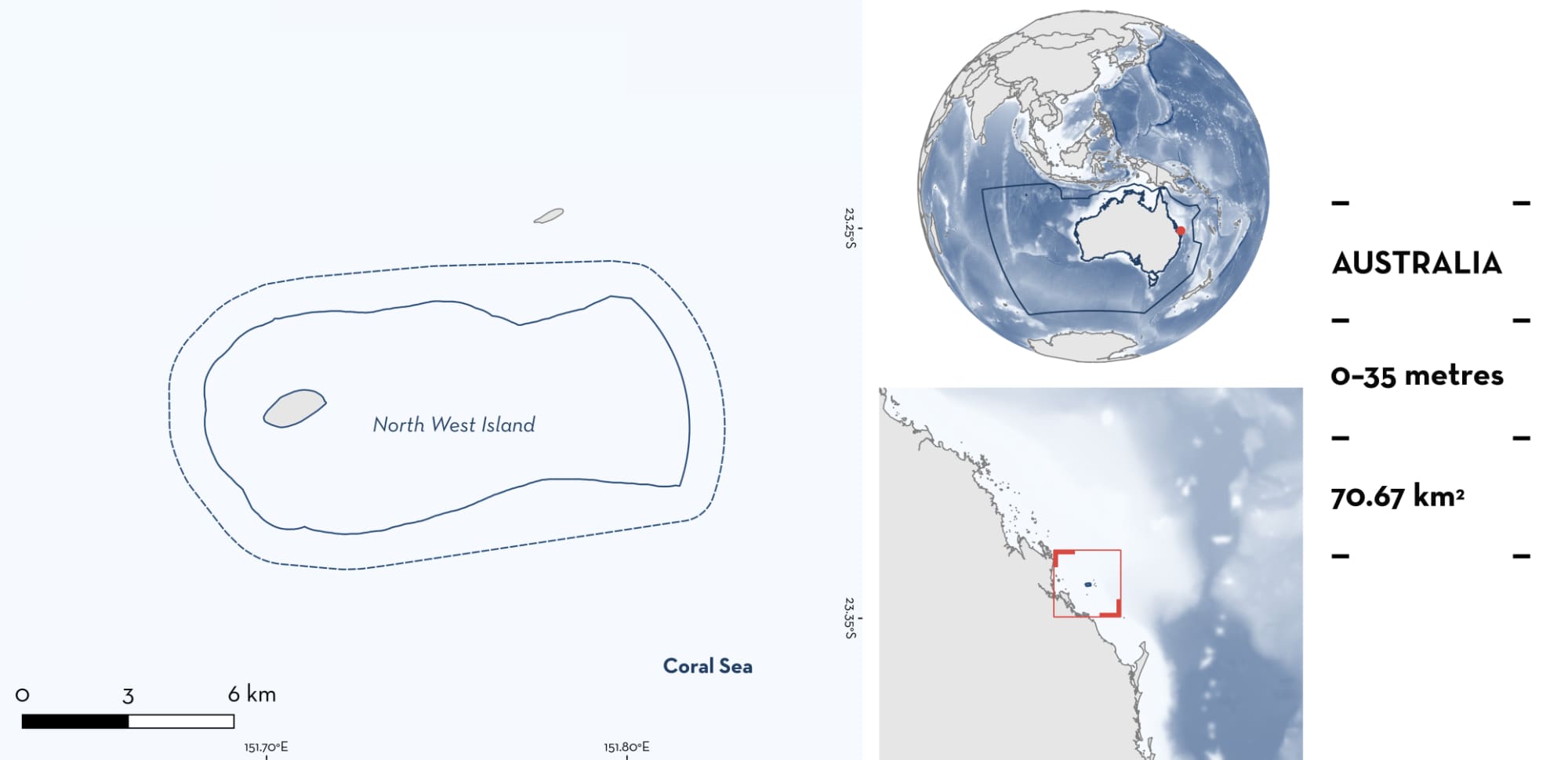
North West Island
Summary
North West Island is located in Queensland, Australia. It is situated ~75 km northeast of Gladstone and is part of the Capricorn-Bunker group of reefs and islands in the southern Great Barrier Reef. This area comprises the reef surrounding a small coral cay island, including the large shallow lagoon and reef flat. The habitat is characterised by a lagoon, reef fore-slope, sandy substrate, and pelagic waters. The area is influenced by tides and by the East Australian Current. It overlaps with the Great Barrier Reef Marine Park and the Capricornia Cays Key Biodiversity Area. Within this area there are: threatened species (e.g., Pigeye Shark Carcharhinus amboinensis); reproductive areas (e.g., Broad Cowtail Ray Pastinachus ater); feeding areas (e.g., Great Hammerhead Sphyrna mokarran); and undefined aggregations (e.g., Sandbar Shark Carcharhinus plumbeus).
Download factsheet
North West Island
DESCRIPTION OF HABITAT
North West Island is located in Queensland, Australia. It is situated ~75 km northeast of Gladstone and is part of the Capricorn-Bunker group of reefs and islands in the southern Great Barrier Reef. The area surrounds a small coral key island and comprises a ~11 x 3 km shallow lagoon and reef top, and the surrounding reef. The island is located on the western end of the reef. The habitat is characterised by a shallow reef flat, sandy substrate, fore-slope, and pelagic waters.
This area is influenced by the East Australian Current (EAC), the poleward flowing western boundary current of the South Pacific Gyre (Suthers et al. 2011). The EAC flow is strongest in the austral summer, and the formation of eddies along this coastline also fluctuates seasonally (Ridgway & Hill 2009). Tides also influence this area, particularly the shallow reef flat and lagoon.
This area partially overlaps with the Great Barrier Reef Marine Park – Marine National Park Zone (UNEP-WCMC & IUCN 2025) and the Capricornia Cays Key Biodiversity Area (KBA 2025).
This Important Shark and Ray Area is benthic and pelagic and is delineated from inshore and surface waters (0 m) to 35 m based on the bathymetry of the area.
CRITERION A
VULNERABILITY
Five Qualifying Species considered threatened with extinction according to the IUCN Red List of Threatened Species regularly occur in the area. Threatened sharks comprise one Critically Endangered species, one Endangered species, and two Vulnerable species; threatened rays comprise one Vulnerable species (IUCN 2025).
CRITERION C
SUB-CRITERION C1 – REPRODUCTIVE AREAS
North West Island is an important reproductive area for one shark and one ray species.
Drone survey flights (n = 77) were conducted at North West Island as part of a shark management program (N Lubitz et al. unpubl. data 2025). All surveys were undertaken in October 2022, February 2023, March 2023, August 2023, and February 2024 using a DJI Mavic 3 Cine drone. In each case, the drone was flown at a height of 70 m around the edge of the whole island, when water filled the lagoon during high tide and the wind speed was not too strong to prevent flying (<25 knots). The height of flights resulted in a ~100 m wide transect from the edge of the island towards the sea. When an animal was sighted, one of the drone’s three cameras zoomed in for species identification. For difficult identifications, the drone was dropped to 50 m before returning to 70 m and continuing the transect. Survey times varied between 13 and 20 min (mean = 17 min) depending on wind speed and on the number of individuals and species observed. All species were identified and sizes estimated by experts.
Blacktip Reef Sharks were observed in the shallow reef flats during 27 flights (35% of total) in all survey months, sometimes in groups of >30 individuals, with size estimates ranging from 50–70 cm total length (TL) for all individuals. The size-at-birth for the species is 30–52 cm TL and the size-at-one-year is ~72 cm TL (Chin et al. 2013; Ebert et al. 2021), demonstrating that these were neonates or young-of-the-year (YOY). No larger individuals were observed, highlighting that the shallow lagoon of this area is important for early life-stages of the species.
Broad Cowtail Rays were observed on 44 flights (57% of total), often gathering in large groups of ~30–50 individuals aggregating against the shoreline. Within these large aggregations, individuals of an estimated size of 30–50 cm disc width (DW) occurred in all transects among larger juveniles, indicating that YOY are consistently present in the shallow reef lagoon of this area. The size-at-birth for the species is 18 cm DW and they grow to ~40–45 cm DW at one year of age (O’Shea et al. 2013; Last et al. 2016). Interestingly, the smallest rays were often closest to the shoreline, and drone footage shows large Great Hammerheads and Sharptooth Lemon Sharks pursuing and killing small Broad Cowtail Rays in these shallow habitats. These rays likely benefit from aggregating within the shallow waters of this area in groups including larger Broad Cowtail Rays where there are fewer predators.
CRITERION C
SUB-CRITERION C2 – FEEDING AREAS
North West Island is an important feeding area for two shark species.
Between October 2022–February 2024, drumline and longline surveys at North West Island captured 145 sharks, out of which 65 were Tiger Sharks (catch-per-unit-effort = 0.04 individuals per hour), representing the most commonly caught species in the area (N Lubitz et al. unpubl. data 2025). Tiger Sharks ranged from 97–440 cm TL. Multiple individuals regurgitated relatively fresh bird feathers, indicating recent feeding on seabirds. This area is one of the most important breeding sites for Black Noddy (Anous minutus) and Wedge-tailed Shearwaters (Ardenna pacifica), as well as a major Green Turtle (Chelonia mydas) nesting site, a known Tiger Shark prey (Dyer et al. 2005; Fitzpatrick et al. 2012). Wedge-tailed Shearwaters fledge in late April–early May (Swanson et al. 2023), while the Black Noddy fledging season is longer, from January–June (Hill et al. 1997). Green Turtles nest between November–April in this region (Booth & Freeman 2006), highlighting that pulses of different prey are available for more than half of the year.
Acoustic tracking data of Tiger Sharks show aggregation behaviour likely linked to exploiting the food pulses of breeding turtles and seabirds. A total of 70 Tiger Sharks tagged with acoustic transmitters were detected on the receivers within this area but 26 were detected <100 times and these were excluded, leaving 44 individuals detected between March 2021 and October 2024 in the dataset. There were ~128,000 detections recorded in this area. A total of 401 five-minute bins with aggregations, defined as three or more individuals detected on the same receiver, were recorded within the area, grouped into 303 aggregation events that lasted between 0.5–23.4 min (mean = 4.7 min). Aggregations comprised 3–5 individuals (mean = 3.1 individuals) and occurred on 6.6% of all monitoring days. Aggregations were recorded at stations throughout the area. There was a strong seasonal signal, with most aggregations (77.2%) recorded in May (N Lubitz et al. unpubl. data 2025). It is likely that aggregations coincide with a pulse in prey availability.
Adult Great Hammerheads are likely ray specialists (Lubitz 2023; Lubitz et al. 2023; N Lubitz unpubl. data 2025). Six large individuals were captured and released in the drumline and longline survey between October 2022–February 2024. One of those was later seen on two separate drone flights hunting and consuming Broad Cowtail Rays on the reef flats in the area. Additionally, drone footage from three separate flights captured other individuals also pursuing ray prey and/or patrolling the reef flat next to ray aggregations and/or assemblages. Three of the six captured individuals were equipped with internal acoustic trackers and external satellite trackers and all showed high residency to North West Island and surrounding islands. Two individuals only left this region for short periods (max 2–3 months each year) before returning to the area, while one shark remained near North West Island throughout the tracking period of 1.5 years. All three exhibited fine-scale movements along the reef flats on the eastern side of the island. While they spent a lot of their time in the region around North West Island, their smaller-scale foraging movements are tidally-influenced, moving onto the shallow reef flat at high tide to hunt rays. Drone surveys (n = 77; October 2022–February 2024) showed very high density of Broad Cowtail Stingrays and Spotted Eagle Rays (up to ~50 individuals in a single frame; 100’s around the island), both observed prey of Great Hammerheads in this area.
CRITERION C
SUB-CRITERION C5 – UNDEFINED AGGREGATIONS
North West Island is an important area for undefined aggregations of two shark species.
A passive acoustic telemetry study tracked sharks on 13 receiver stations within this area between October 2020 and September 2025 (N Lubitz et al. unpubl. data 2025). These data were used to assess aggregations. Aggregations were defined as three or more tagged individuals detected on a receiver within five minutes. The approximate range in which receivers detect tagged sharks 100% of the time is ~400 m, based on range tests on another reef in Queensland (Barnett et al. 2012). Aggregations in consecutive five-minute bins were grouped into an event and its duration was calculated.
A total of 11 Pigeye Sharks tagged with acoustic transmitters were detected on the receivers within this area but one was detected <100 times and was excluded, leaving 10 individuals detected between October 2022 and September 2025 in the dataset. There were ~122,000 detections recorded in this area. A total of 620 five-minute bins with aggregations were recorded within the area, grouped into 453 aggregation events that lasted between 0.3–28.5 min (mean = 4.9 min). Aggregations comprised 3–5 individuals (mean = 3.2 individuals), which equals 30–50% of the tagged sharks detected on the same receiver at the same time. Aggregations occurred on 12% of all monitoring days and were recorded at stations throughout the area. Although the species is detected in this area throughout the year, most aggregations (89.7%) were recorded between August–October (N Lubitz et al. unpubl. data 2025). These aggregations do not overlap with the turtle and bird nesting seasons, indicating they may not be feeding related. Is it possible that aggregations are related to courtship or reproduction, but further information is needed to examine this.
A total of 10 Sandbar Sharks tagged with acoustic transmitters were detected on the receivers within this area but one was detected <100 times and was excluded, leaving nine individuals detected between March 2023 and September 2025 in the dataset. There were ~106,000 detections recorded in this area. A total of 1,773 five-minute bins with aggregations were recorded within the area, grouped into 1,174 aggregation events that lasted between 0.4–77.9 min (mean = 5.7 min). Aggregations comprised 3–5 individuals (mean = 3.1 individuals), which equals 33–55% of the tagged sharks detected on the same receiver at the same time. Aggregations occurred on 24% of all monitoring days and were recorded at stations throughout the area. Although the species is detected in this area throughout the year, most aggregations (76%) were recorded between August–October (N Lubitz et al. unpubl. data 2025). These aggregations do not overlap with the turtle and bird nesting seasons, indicating they may not be feeding related. It is possible that aggregations are related to courtship or reproduction, but further information is needed to examine this.
Download factsheet
SUBMIT A REQUEST
ISRA SPATIAL LAYER REQUEST
To make a request to download the ISRA Layer in either a GIS compatible Shapefile (.shp) or Google Earth compatible Keyhole Markup Language Zipped file (.kmz) please complete the following form. We will review your request and send the download details to you. We will endeavor to send you the requested files as soon as we can. However, please note that this is not an automated process, and before requests are responded to, they undergo internal review and authorization. As such, requests normally take 5–10 working days to process.
Should you have questions about the data or process, please do not hesitate to contact us.

