ISRA FACTSHEETS
ISRA FACTSHEETS
EUROPEAN ATLANTIC
Northeast Dogger Bank
Summary
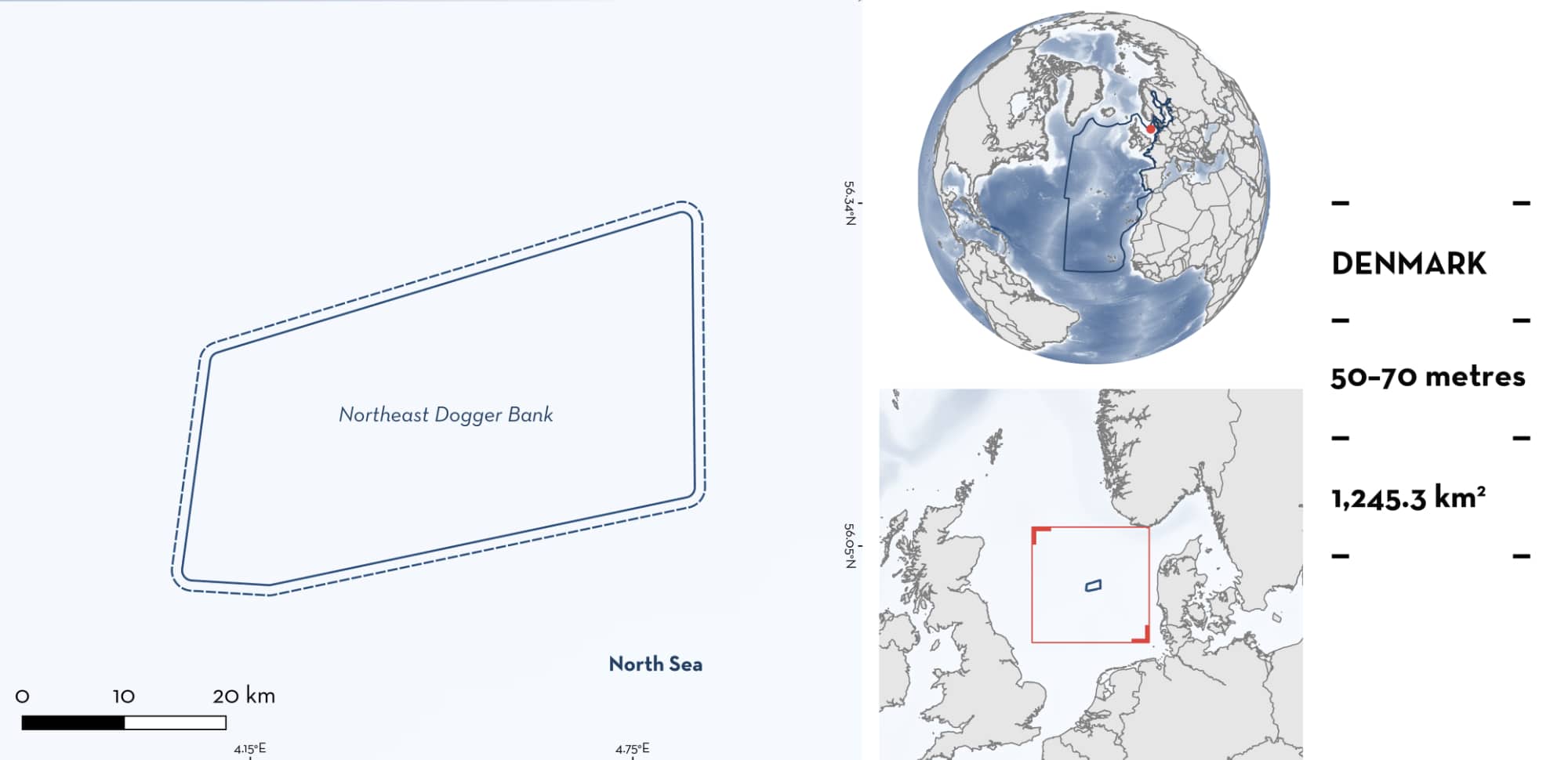
Northeast Dogger Bank is located in the central North Sea, within the Danish Exclusive Economic Zone. The area is situated within the easternmost extent of Dogger Bank, characterised by a raised sandbank. It is influenced by fronts caused by multiple water masses. Within this area there are: threatened species and reproductive areas (Thorny Skate Amblyraja radiata).
Download factsheet
Northeast Dogger Bank
DESCRIPTION OF HABITAT
Northeast Dogger Bank is located in the central North Sea, within the Danish Exclusive Economic Zone. The area is situated within the easternmost extent of Dogger Bank, an extensive raised sandbank (Diesing et al. 2009), characterised by a dominance of sandy substrate.
This area is influenced by a front created by cooler Atlantic water masses and warmer inflow from the English Channel (Emery et al. 2019).
This Important Shark and Ray Area is benthic and subsurface and is delineated from 50–70 m based on the depth range of Qualifying Species in the area.
CRITERION A
VULNERABILITY
One Qualifying Species considered threatened with extinction according to the IUCN Red List of Threatened Species regularly occurs in the area. This is the Vulnerable Thorny Skate (Kulka et al. 2020).
CRITERION C
SUB-CRITERION C1 – REPRODUCTIVE AREAS
Northeast Dogger Bank is an important reproductive area for one ray species.
Two surveys were undertaken in this area (broadly equating with ICES Rectangle 41F4) each year between 2010–2024 as part of the North Sea International Bottom Trawl Survey (IBTS; ICES 2025). These were undertaken between January–April (Quarter 1) and September–December (Q3). During this period, 283 Thorny Skates were recorded across all years of the IBTS in this area (n = 2–52 per year). Of these, 34 neonate/young-of-the-year (YOY) Thorny Skates were caught within this area, measuring ~14 cm total length (TL). Thorny Skate hatch at ~10 cm TL, and individuals up to 14 cm TL are considered YOY (Ellis et al. 2024). Neonate/YOY Thorny Skates were reported in 2011 (n = 5), 2012 (n = 1), 2013 (n = 6), 2015 (n = 3), 2016 (n = 10), 2017 (n = 2), 2018 (n = 1), 2019 (n = 4), 2021 (n = 1), and 2024 (n = 1) (ICES 2025; Ellis et al. 2024). Between 2014–2017, Thorny Skate egg cases caught in the IBTS (England; Q3) were retained for the Shark Trust. Overall, 12 Thorny Skate egg cases were recorded in this area in 2016 (Shark Trust unpubl. data. 2025; Ellis et al. 2024). The trawl gear used during the IBTS is considered to have a lower catchability for early life-stage rays and their egg cases, including Thorny Skate (Walker et al. 2017). Despite this, this area has the largest and most regular and predictable observations of the species at these early life-stages in this region.
Download factsheet
SUBMIT A REQUEST
ISRA SPATIAL LAYER REQUEST
To make a request to download the ISRA Layer in either a GIS compatible Shapefile (.shp) or Google Earth compatible Keyhole Markup Language Zipped file (.kmz) please complete the following form. We will review your request and send the download details to you. We will endeavor to send you the requested files as soon as we can. However, please note that this is not an automated process, and before requests are responded to, they undergo internal review and authorization. As such, requests normally take 5–10 working days to process.
Should you have questions about the data or process, please do not hesitate to contact us.