ISRA FACTSHEETS
ISRA FACTSHEETS
NORTH AMERICAN PACIFIC
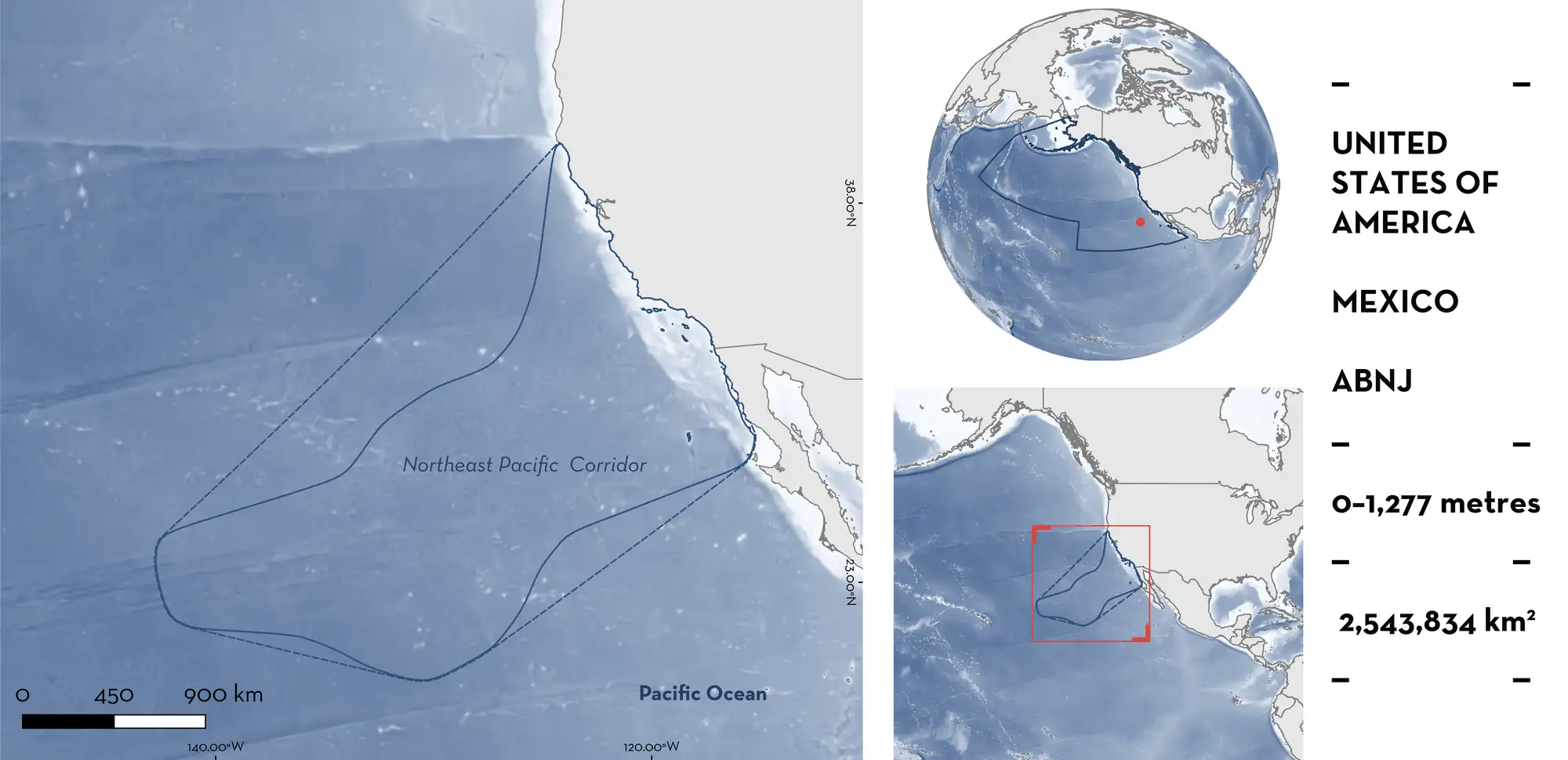
Northeast Pacific Corridor
Summary
Northeast Pacific Corridor is located in offshore waters of the United States of America, Mexico, and areas beyond national jurisdiction (ABNJ). This area stretches from coastal waters of California and Baja California into offshore waters to ~2,500 km from the coast. The habitat is characterised by both productive coastal waters with rocky and sandy substrates and kelp forests, and by pelagic, oligotrophic waters. It is influenced by the California Current System near the coast and by the North Pacific Subtropical Gyre in offshore waters. Within this area there are: threatened species and areas important for movement (White Shark Carcharodon carcharias).
Download factsheet
Northeast Pacific Corridor
DESCRIPTION OF HABITAT
Northeast Pacific Corridor is a transboundary area spanning waters of the United States of America (USA), Mexico, and areas beyond national jurisdiction (ABNJ). This movement area stretches from the coasts of California and Baja California into offshore waters in the Eastern North Pacific Ocean. The corridor extends from temperate nearshore habitats characterised by rocky reefs, kelp forests, and sandy substrate in the cool, productive waters of the California Current system, across the North Pacific Transition Zone, and into the North Pacific Subtropical Gyre, situated approximately halfway between Hawaii and the coast of Mexico. The offshore part of the area overlaps with the Molokai fracture zone. Nearshore waters are influenced by seasonal wind-driven coastal upwelling, which brings cold, nutrient-rich water to the surface, supporting high primary productivity (Jorgensen et al. 2010). By contrast, the offshore end of the corridor lies within the oligotrophic North Pacific Subtropical Gyre, where surface waters are warm, nutrient-poor, and comparatively low in primary productivity. Despite low surface productivity, this mostly offshore area supports a mesopelagic community including a deep scattering layer that may provide foraging opportunities for large pelagic predators (Nasby-Lucas et al. 2009; Jorgensen et al. 2010).
This Important Shark and Ray Area is pelagic and is delineated from inshore and surface waters (0 m) to 1,277 m based on the global depth range of the Qualifying Species.
CRITERION A
VULNERABILITY
One Qualifying Species considered threatened with extinction according to the IUCN Red List of Threatened Species regularly occurs in the area. This is the Vulnerable White Shark (Rigby et al. 2022).
CRITERION C
SUB-CRITERION C4 – MOVEMENT
Northeast Pacific Corridor is an important movement area for White Sharks.
Satellite-tagged White Sharks regularly and predictably move through this area during their annual migrations between the coast of California and northern Baja California, and an offshore focal area known as the ‘White Shark Café’ (Boustany et al. 2002; Jorgensen et al. 2010; BA Block et al. unpubl. data 2026) or the ‘Shared Offshore Foraging Area’ (Nasby-Lucas et al. 2009). A study tracked 99 sub-adult and adult White Sharks (45 females, 39 males, 15 unknown sex) with pop-up archival satellite tags between 2000–2025 (Boustany et al. 2002; Jorgensen et al. 2010; BA Block et al. unpubl. data 2026). Sharks were tagged at known aggregation sites in central California (Año Nuevo, Tomales Point, and the Farallon Islands) during seasonal surveys in the boreal autumn and winter months. Each winter, almost all sub-adult and adult White Sharks (>95% tagged individuals) depart coastal aggregation sites for a 2,000–5,000 km round-trip migration to offshore sub-tropical and tropical pelagic habitats. Animals return to the coast in late summer, with an average arrival date of August 19th ± 45 days (Jorgensen et al. 2010; S Andrzejaczek et al. unpubl. data 2026). The size-at-maturity is defined as (>450 cm total length (TL) for females and >380 cm TL for males, and subadults are >300 cm TL (Francis 1996; Pratt 1996; Tanaka et al. 2021). White Sharks spend approximately 3–4 months (mean = 105 days; Andrzejaczek et al. 2025) in coastal habitats, before travelling offshore and moving around the White Shark Café region. The location of offshore habitat use within the western part of this area is dynamic and variable between individuals and years (S Andrzejaczek et al. unpubl. data 2026). However, White Sharks generally follow a similar path from central California southwest to the White Shark Café region that extends to ~1,500 km east of Hawaii.
While coastal aggregations in California are known feeding hotspots for White Sharks hunting pinnipeds at haul out sites, the drivers of offshore movement remain unconfirmed but are hypothesised to be foraging or reproduction related (Jorgensen et al. 2012). Foraging is likely to occur throughout this corridor, given the extended duration of the migration and the fact that immature individuals, which would not be engaged in reproductive behaviours, have also been tracked on offshore migrations (BA Block et al. unpubl. data 2026). Further support comes from stable isotope evidence indicating that White Sharks consume pelagic prey, such as squid and tuna, while offshore (Carlisle et al. 2012). Satellite tag data reveal sharks diving to mesopelagic depths (Jorgensen et al. 2012), likely to access these prey resources. With respect to reproduction, mature females may use the warmer offshore waters to aid gestation. Although females are often absent from coastal aggregation sites for periods exceeding one year, return intervals are highly variable rather than fixed; a quantitative analysis of a large acoustic and photo-identification dataset from central California showed substantially higher and stochastic, non-Markovian state transitional probabilities for females than males (Chapple et al. 2016), and individual variability in return rates is also evident in long-term telemetry data (Andrzejaczek et al. 2025; S Andrzejaczek et al. unpubl. data 2026). These extended and irregular absences are consistent with an approximately 2–3-year reproductive cycle, combining an estimated 18-month gestation period with a probable resting year, and with potentially asynchronous reproductive timing among individuals (Bruce 2008). Limited longer-term SPOT-tag deployments support extended offshore residencies, with some females remaining offshore for up to 15–16 months (Domeier & Nasby-Lucas 2013). Neonates and young-of-the-year are subsequently observed at coastal sites in southern California and western Baja California (Anderson et al. 2021).
A second study tracked 52 White Sharks with pop-up archival satellite tags after tagging them at Guadalupe Island, Mexico, between 2000–2007 (Domeier & Nasby-Lucas 2008). Tagged sharks included 36 males, 11 females, and five of unknown sex, with 63.3% of animals being mature (19 of 30 with maturity status recorded). They displayed the same seasonal migration as the California-tagged White Sharks, also swimming to the offshore ‘White Shark Café’ region. Tagged sharks spent 5–8 months at Guadalupe Island and left the island between late December and early May (average 15 February). Transit time was fast (mean = 16 days), and sharks spent most of their time at the surface with occasional deep dives, indicating directional movement. They then spent an average of 140 days in the offshore habitat. Males arrived back at Guadalupe Island in July, while females remained in the offshore habitat for longer into early autumn. Diving data strongly indicated feeding in the offshore habitat, highlighting that the migration is likely to link distant feeding sites (Domeier & Nasby-Lucas 2008). Although these tracking data are historical, the boundaries of this area are slightly expanded at the southern limit based on the tracks from Guadalupe Island, also considering that they displayed the same migration as the California-tagged White Sharks.
Download factsheet
SUBMIT A REQUEST
ISRA SPATIAL LAYER REQUEST
To make a request to download the ISRA Layer in either a GIS compatible Shapefile (.shp) or Google Earth compatible Keyhole Markup Language Zipped file (.kmz) please complete the following form. We will review your request and send the download details to you. We will endeavor to send you the requested files as soon as we can. However, please note that this is not an automated process, and before requests are responded to, they undergo internal review and authorization. As such, requests normally take 5–10 working days to process.
Should you have questions about the data or process, please do not hesitate to contact us.